Wind damage to a roof in Massachusetts almost never starts in the middle of the field. It starts at the rakes, the eaves and the ridge, where wind finds a lip to pull on. You’ll see shingles lifted or creased, a row missing along one edge, granules washed into the gutter, bent drip edge, or a dark ring on a bedroom ceiling 2 days after the storm passed. In Quincy, the wind speed isn’t your problem. The Massachusetts building code sets Quincy’s design wind speed at 121 mph. A current architectural shingle is qualified to 190. If yours came off at 55, something in the install or the seal gave up long before the wind did.
Most pages on this topic answer “how much wind does it take” with “45 to 60 mph” and never say where the number came from, or what your roof is rated for. Both numbers are published. Put them side by side and the conversation changes from weather to workmanship.
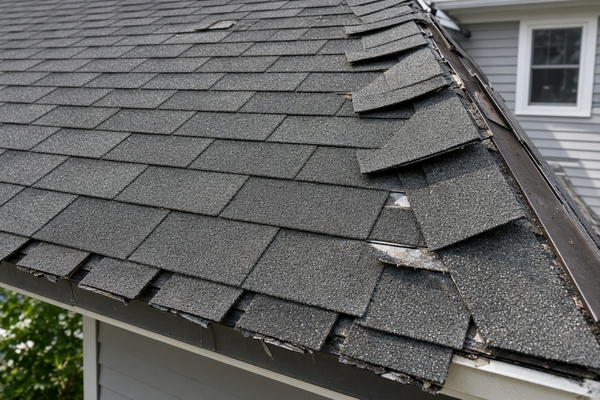
What Counts as Wind Damage to a Roof?
Wind damage is uplift damage. Wind doesn’t punch a roof in; it pulls it up and peels it back, so the damage shows at edges and seams before it shows anywhere else.
Wind damage to a roof is any loss of the roof covering or its seal caused by wind uplift: shingles lifted, creased, torn back or missing, broken seal strips, bent or detached drip edge and flashing, and the leaks that follow. It’s different from impact damage, which comes from debris, and from wear, which comes from age.
That distinction decides everything downstream. It decides whether a repair makes sense, whether a claim goes anywhere, and whether the roofer standing in your driveway is telling you the truth.
How Much Wind Does It Take to Damage a Roof?
Roof covering starts coming off between 47 and 54 mph. That figure comes from the National Weather Service, whose wind damage scale puts “chimney covers, roofing tiles blown off” at Beaufort force 9, which is 47 to 54 mph. Roofs get peeled off at 75 mph and up.
Massachusetts clears 47 mph every winter. During the blizzard on February 23, 2026, National Weather Service instruments recorded gusts of 83 mph in Wellfleet, 77 mph at Chatham Airport, 72 mph in West Falmouth and 71 mph at Hyannis Airport. Worth being straight about it: every one of the top gusts published that day was in Barnstable County. The Cape takes the worst of it. Quincy and the South Shore see smaller numbers from the same storms, which is exactly why the failures here tend to be partial and edge-first instead of catastrophic.
Then there was May 19, 2026, when straight thunderstorm wind tore a section of roof off a National Guard building on North Lake Avenue in Worcester and dropped trees onto houses in Spencer. No official gust figure was published for that one. A roof doesn’t need a named storm to lose shingles.
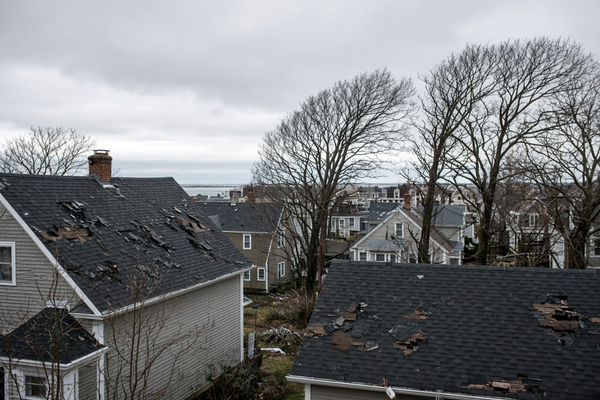
Your Shingles Are Rated for More Wind Than Massachusetts Produces
The Massachusetts building code publishes an ultimate design wind speed for every city and town, and no town on the South Shore comes close to what a modern architectural shingle is qualified to handle.
Table R301.2(2) in the 10th edition Massachusetts Residential Code lists it town by town. GAF’s UL evaluation report ER21-01 classifies Timberline HDZ as ASTM D7158 Class H. Here is what that looks like next to each other:
| Town | Code design wind speed (Vult) | Class H shingle qualified to | Headroom |
|---|---|---|---|
| Boston | 120 mph | 190 mph | 70 mph |
| Quincy | 121 mph | 190 mph | 69 mph |
| Braintree | 122 mph | 190 mph | 68 mph |
| Weymouth | 122 mph | 190 mph | 68 mph |
| Randolph | 122 mph | 190 mph | 68 mph |
| Stoughton | 122 mph | 190 mph | 68 mph |
| Brockton | 123 mph | 190 mph | 67 mph |
| Taunton | 125 mph | 190 mph | 65 mph |
| Fall River | 128 mph | 190 mph | 62 mph |
| New Bedford | 129 mph | 190 mph | 61 mph |
| Barnstable | 130 mph | 190 mph | 60 mph |
One caution, because these two numbers get mixed up constantly and the mistake runs through half the roofing content online. Shingle wind classes come in 2 flavors on 2 different scales. ASTM D3161 classes are stated on the older allowable stress scale, where Class F means 110 mph. ASTM D7158 classes are stated on the ultimate scale, where Class G means 150 mph and Class H means 190 mph. The National Roofing Contractors Association lays out both scales in its 2021 breakdown of the 2 standards. The town numbers in the code are ultimate speeds, so Class H is the one to compare them against. Timberline HDZ carries both classifications, D3161 Class F and D7158 Class H.
For the record, 780 CMR 51.00 stops applying its prescriptive wind provisions once a town’s ultimate design wind speed reaches 140 mph. Not one Massachusetts municipality in the list above gets there.
So Why Did Your Shingles Come Off?
Because a wind rating is a lab result under stated install conditions, and the roof over your head may not have met them. Three things go wrong, and I see all 3 on Massachusetts tear-offs.
The seal never bonded. Asphalt shingles have a heat-activated sealant strip. It needs sun and warmth to melt and grab. A roof installed in November on a cold, overcast week can sit all winter with the strip never fully set, and the first 50 mph gust of the season finds every unsealed tab. This is the single most common reason a young roof loses shingles in a storm that should have been survivable.
The nail count or placement was wrong. UL ER21-01 requires a minimum of 4 fasteners per shingle on slopes from 2:12 to 21:12, and 6 fasteners above 21:12. Nail high, above the nailing strip, and you’ve fastened the shingle to nothing but itself. Nail 3 per shingle to save time across 30 squares and you’ve quietly downgraded the roof below its own rating. Nobody sees it. The wind finds it.
The starter was skipped or wrong. More on this next, because it’s where most of the damage I get called out to begins.
Across the roofs we do, the problem usually isn’t the shingle. It’s flashing, ventilation, a bad previous install, reused pipe boots, valleys, rotted decking, or the edges of the roof where water has been getting in for years. The shingle is the part you can see from the street, so it takes the blame.
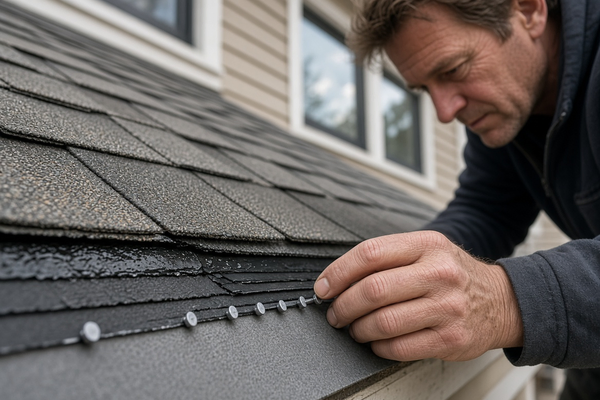
Why the Rake Is the First Thing to Go
The rake is the sloped edge of the roof running from eave to ridge, and it’s the least protected line on the whole assembly.
A starter strip is a strip of adhesive-backed material that runs along the roof edge and gives the first course something to bond to. UL ER21-01 spells out a starter course at the eave, set 3 to 4 inches from the edge with 4 fasteners per shingle. GAF’s own residential warranty comparison goes further: the 130 mph coverage under its standard architectural shingle warranty requires special installation with GAF starter strip at eaves and rakes. The 15 year WindProven coverage, which carries no maximum wind speed at all, requires a LayerLock shingle plus 4 GAF accessories including starter.
Plenty of crews run starter along the eave and stop. The rakes get field shingles turned sideways, or nothing. On a calm day you can’t tell. In a 55 mph nor’easter, the wind gets under that unbonded rake edge, lifts one course, and unzips the row behind it. That’s the classic Massachusetts wind failure: a clean vertical stripe of missing shingles marching up one side of the roof. It isn’t random. It’s the starter strip that was never there.
When we take a roof apart, what we find at the edges tells us more about the last crew than the middle of the roof ever will.
The One Massachusetts Roof Wind Does Beat
Three-tab shingles are the exception to everything above, and a lot of Massachusetts housing stock still has them.
GAF caps 3-tab shingles at 60 mph in its warranty comparison. Not 130. Not 190. Sixty. Compare that to the gusts recorded on February 23, 2026: Wellfleet at 83, Chatham at 77, West Falmouth at 72, Hyannis at 71. Every one of those exceeded the warranty ceiling on a 3-tab roof before the storm was half over.
If your roof is 3-tab and it’s over 15 years old, you’re not dealing with an install defect when shingles come off in a storm. You’re dealing with a product at the end of its range, and the honest conversation is about replacement, not repair. Architectural shingles cost more per square and they buy you a different category of wind performance. That’s one of the few places in roofing where paying more changes the physics.
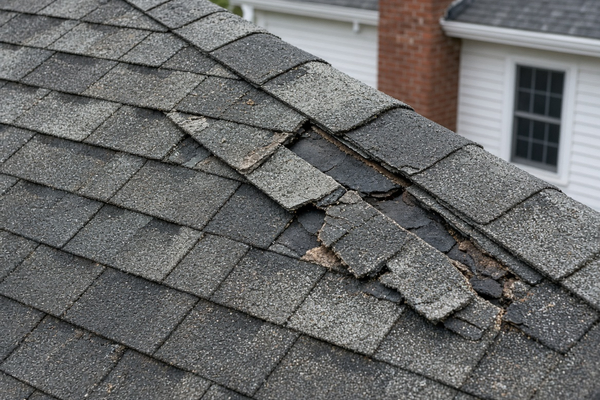
What Wind Damage Looks Like From the Driveway
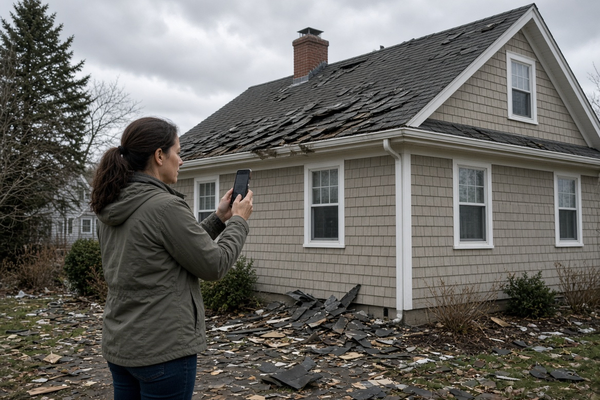
You can diagnose most of it from the ground with a phone camera and 10 minutes. Stay off the roof.
Walk all 4 sides of the house and look for a vertical stripe of missing or displaced shingles running up a rake edge, which points at starter. Look for shingles that are still attached but lifted at the bottom edge, or creased horizontally across the face, which means they got folded back and dropped again. Check the drip edge and gutter line for metal that’s bent out or pulled away from the fascia. Look at the ridge cap, since ridge and hip caps take uplift from both sides and often go first. Check the ground and the yard for shingle pieces, ridge cap fragments and granule piles at the downspout outlets.
Granules in the gutter after a storm are worth reading carefully. A light scatter on a roof under 5 years old is normal shed from manufacturing. Heavy black grit that shows bare asphalt mat on the shingles above is a different problem, and after a hail event it means something else again.
One thing that fools people: a roof can be wind damaged with nothing missing at all. If the seal strips broke but the shingles stayed nailed down, the roof looks untouched from the street and leaks the next time it rains sideways. That’s why “nothing blew off” isn’t the same as “nothing happened.”
What the Attic Tells You
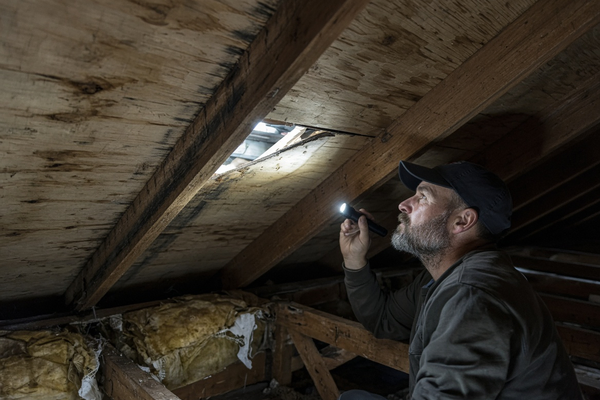
The attic is where wind damage stops being a guess. Go up with a flashlight the day after the storm, before any melt or rain confuses the timeline.
Look at the underside of the deck for daylight, which means a fastener path or a gap that shouldn’t exist. Look for dark, wet or shiny sheathing, especially near the eaves and along the rakes where the uplift concentrates. Run a hand along the rafter tails. Damp insulation directly under a rake edge, with a dry deck 6 feet inboard, is an edge failure and not a field failure, and that distinction matters when you’re deciding between a repair and a replacement.
If water is coming in now, get a bucket under it and slow the leak from inside before you think about anything else. If it’s coming in fast, that’s a call for 24/7 emergency roof repair, not a Monday morning appointment.
Wind Damage or an Old Roof?
Three questions separate the two, and any honest roofer will walk you through all 3 before mentioning insurance.
Is the damage directional? Wind comes from a direction. Real wind damage clusters on the windward face and the exposed edges. Damage scattered evenly across all 4 slopes is wear, not weather.
Are the breaks fresh? A shingle torn by wind shows a clean break with granules still bright at the edge and a matching mate somewhere on the ground. A shingle failing from age shows curled corners, a chalky surface, brittle edges that crumble when touched, and no debris anywhere.
Does the timeline hold? If the ceiling stain appeared within 2 or 3 days of a dated storm, the story holds. If the stain has a ring inside a ring, it’s been getting wet and drying out for months, and that started before this storm.
Massachusetts adds a fourth complication that other states don’t have to think about. Winter damage here often has 2 authors. A nor’easter brings wind and snow in the same 12 hours, and the ice dam that forms 3 days later does its own damage through a different mechanism. If your damage showed up after a snow event, read the signs of roof damage after snow and ice alongside this, because the fix order is different and so is the insurance treatment.
We don’t sell fear. If a roof can be repaired, we say so. If it needs replacing, we show you the photos and explain why in normal words.
What to Do in the First 24 Hours After a Wind Storm
Document first, tarp second, call third, and don’t sign anything on your doorstep.
Get these 6 shots before anyone touches the roof: all 4 elevations of the house from the ground, a close-up of each damaged area, a wide shot that places the damage on the house, any debris on the ground with something for scale, the attic underside, and every interior stain. Screenshot the storm date from a weather app while you’re at it.
If water is getting in, a tarp buys you time, but tarping a roof in a nor’easter has rules about anchoring that can wreck your ice barrier if you get them wrong. Then call for storm damage repair and get a written scope.
About the trucks that show up the day after a storm. Massachusetts registration rules exist for a reason, and hiring an unregistered crew costs you arbitration rights and a Guaranty Fund claim worth up to $25,000. The full breakdown is in our piece on storm chaser roofers in Massachusetts. Read it before you sign anything handed to you in a driveway.
Do You Need a New Roof if a Few Shingles Blew Off?
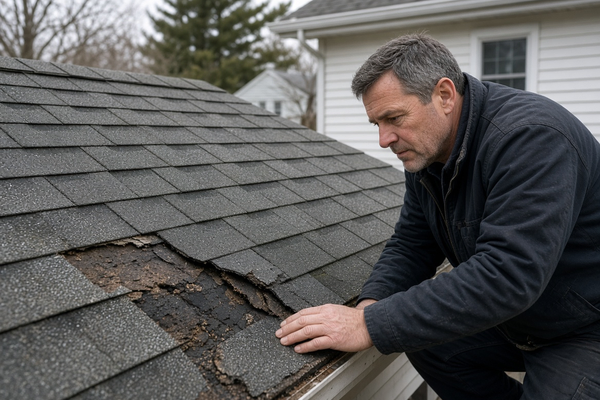
Usually not, and any roofer who says otherwise before going up there is guessing or selling. The number of missing shingles matters far less than where they are and how old the roof is.
| What you have | Age under 12 years | Age 12 to 20 years | Age over 20 years |
|---|---|---|---|
| 2 or 3 shingles off one edge | Repair, and check the starter | Repair, and price a replacement | Replacement conversation |
| A vertical stripe up a rake | Repair plus starter correction | Repair, expect more next storm | Replacement |
| Damage on 2 or more slopes | Inspect for install defects | Replacement likely | Replacement |
| Deck exposed or decking wet | Emergency repair now, then decide | Replacement | Replacement |
| 3-tab shingles, any pattern | Repair if matchable | Replacement | Replacement |
Two practical limits push a repair toward a replacement no matter what the table says. Shingle color runs change, so a discontinued color means a patch that never matches. And a roof already carrying a second layer has nothing left to give, which is a separate question about overlay versus tear off. If you’re weighing it seriously, our guide to repairing part of a roof walks through when a patch is money well spent.
What Moves the Price of Wind Damage Repair in 2026
Wind repair is priced by access and scope, not by shingle count, which is why 2 quotes on the same damage can look nothing alike.
We don’t publish numbers, because a price without a scope tells you nothing. What we can tell you is what moves it: roof size, pitch, how many layers come off, rotted decking underneath, chimney and skylight flashing, ventilation work, access around the house, and whether gutters or fascia are part of the job. A localized edge repair with a starter correction is a half-day job. A rake that has been unzipping through 3 storms is not.
Ask for a written scope instead of a number on the back of a card. One quote may include tear-off, proper flashing, ventilation, cleanup and a warranty while another leaves 3 of those out. Same address, same damage, and the 2 numbers aren’t pricing the same work.
Does Homeowners Insurance Cover Wind Damage in Massachusetts?
Wind is a covered peril on most Massachusetts homeowners policies, but coverage and payout are 2 different conversations.
Two things decide what you receive. Your policy may apply a separate wind or named storm deductible, calculated as a percentage of your dwelling limit rather than a flat dollar amount, which usually makes it larger than your standard deductible. And your roof may be settled at actual cash value rather than replacement cost, meaning depreciation comes out of the check based on the roof’s age. Damage attributed to wear rather than the storm gets excluded either way.
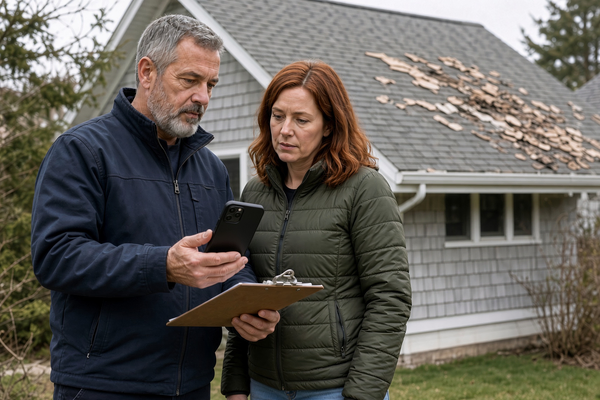
We inspect, photograph, document what we see and meet the adjuster when it helps. We don’t promise insurance will approve anything, and we won’t tell you to file a claim when the damage isn’t there. The full walkthrough, including the 30 day clock and what adjusters look at on a Massachusetts roof, is in our guide to documenting roof damage for insurance.
Get a Straight Answer About Your Roof
If wind hit your house, the question worth answering isn’t how fast it blew. It’s whether the roof was built to hold. That’s a 30 minute look at the rakes, the eaves, the starter line and the attic, and it ends with photos and a written scope rather than a scare.
Every roof Powersol Roofing installs gets the full GAF system: leak barrier, synthetic underlayment, starter at the eaves and rakes, Timberline HDZ, drip edge, new pipe boots, ridge vent and ridge cap. Most of our roof replacements go on in 1 to 2 days once material is on site and the weather cooperates, and our average install is a single day. Recent exterior projects include a roof, gutters and PVC fascia and soffit package in Taunton, a roof, gutters and siding package in Randolph, and a roof and windows project in Dorchester.
Book a free roof inspection and we’ll tell you what we find, including when the answer is that your roof is fine. Wind damage to a roof is worth catching while it’s still a repair.
Questions Massachusetts Homeowners Ask About Wind Damage
How much wind does it take to damage a roof?
Roof covering starts coming off between 47 and 54 mph, according to the National Weather Service wind damage scale, and roofs get peeled off above 75 mph. Massachusetts clears that lower threshold every winter. During the February 23, 2026 blizzard, gusts reached 83 mph in Wellfleet and 77 mph at Chatham Airport.
What wind speed are my shingles rated for?
Timberline HDZ carries ASTM D7158 Class H, which corresponds to 190 mph on the ultimate wind speed scale, and ASTM D3161 Class F. Three-tab shingles are a different story: GAF caps them at 60 mph in its warranty comparison. Check what’s on your roof before assuming either number applies to you.
Can wind damage a roof without blowing shingles off?
Yes, and it’s common. Wind can break the adhesive seal strips while the nails hold, so the shingles stay in place and look normal from the street. The roof then leaks during the next driving rain. A roof that lost nothing visible can still have taken real wind damage to the roof covering.
Why does wind damage to a roof start at the edges?
Uplift pressure concentrates at rakes, eaves, ridges and corners, and those edges depend on a starter strip to bond the first course down. GAF’s 130 mph coverage requires starter at eaves and rakes. Crews often run it at the eave only, which is why wind damage so often appears as a vertical stripe up one rake.
Do I need a full roof replacement if only a few shingles blew off?
Usually not. On a roof under 12 years old with damage confined to one edge, a repair plus a starter correction is normally the right call. Replacement moves to the front when damage appears on 2 or more slopes, when the roof is past 20 years, when the shingle color is discontinued, or when the roof is 3-tab.
Does homeowners insurance cover wind damage to a roof in Massachusetts?
Wind is a covered peril on most Massachusetts policies, but the payout depends on 2 things: whether your policy applies a separate wind or named storm deductible as a percentage of your dwelling limit, and whether the roof is settled at actual cash value with depreciation deducted, or at replacement cost. Damage attributed to wear rather than the storm is excluded.