Storm chaser roofers work Massachusetts neighborhoods after every hard nor’easter and every tropical storm remnant. Most homeowners think the risk is a bad roof. The bigger risk is paperwork. Say the person at your door is not a registered Home Improvement Contractor. Sign with them and you erase two state protections at once. One is the state arbitration program. The other is a Guaranty Fund claim worth up to $25,000. Both of them require that your contractor was registered on the day you signed. Neither one comes back afterward. No lawyer can put them back.
So before anyone talks to you about shingles, ask for one number.
What Is a Storm Chaser Roofer?
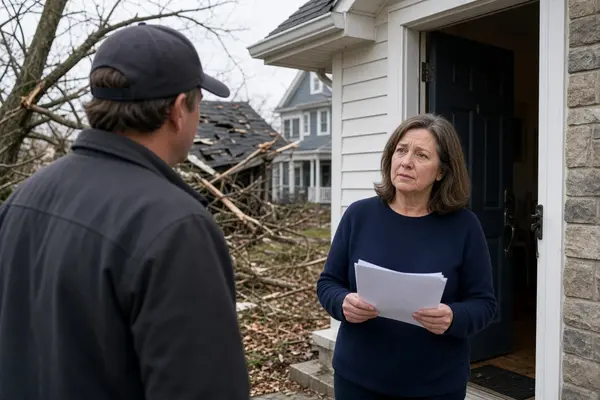
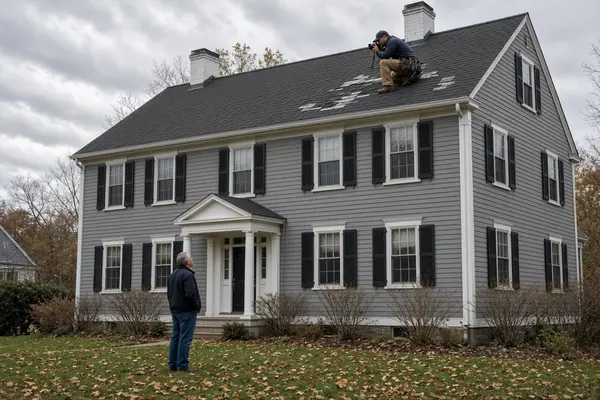
A storm chaser roofer is an out-of-town or unregistered contractor who works a neighborhood right after a storm. They offer a free inspection. Then they push for a signature the same day. In Massachusetts, what marks the difference is a Home Improvement Contractor registration number on the paperwork, not a local license plate.
I run a roofing company out of Quincy and have been on roofs in Brockton, Taunton, and Dorchester for six years. The crews that work a town for two weeks and vanish are not doing anything clever. They move fast on purpose. Speed is what keeps you from checking.

Two Protections Disappear the Moment You Sign
Signing with an unregistered contractor costs you both state remedies at once. That is the part nobody explains at the door.
The Massachusetts arbitration program exists so homeowners do not have to sue in court. To use it, the contractor had to be registered as a Home Improvement Contractor on the date you signed. Same rule for a Guaranty Fund claim. The state pays that out when you hold a judgment a contractor never honored.
| What you lose | What it is worth | What it requires |
|---|---|---|
| HIC arbitration | A state process instead of a lawsuit. Arbitrator fee runs $500 to $1,250 depending on the damages you claim. | Contractor registered on the contract date. File within 5 years of that date. |
| Guaranty Fund claim | Up to $25,000 of your actual loss, capped at $150,000 total against one contractor in any 12 months. | Contractor registered when you signed, a judgment or award first, and the contractor pulled the permit. File within 7 years. |
| Chapter 93A claim | Any Chapter 142A violation counts as an unfair or deceptive act, which opens up 93A remedies. | Nothing extra, but collecting still needs a company that exists next spring. |
Read that middle row again. Twenty-five thousand dollars of state backstop, gone, because of who held the pen. The Office of Consumer Affairs and Business Regulation published that same $25,000 figure in its contractor scam advisory dated March 20, 2026. So this is current, not a leftover from an old rule.
How Do I Check if a Roofer Is Registered in Massachusetts?
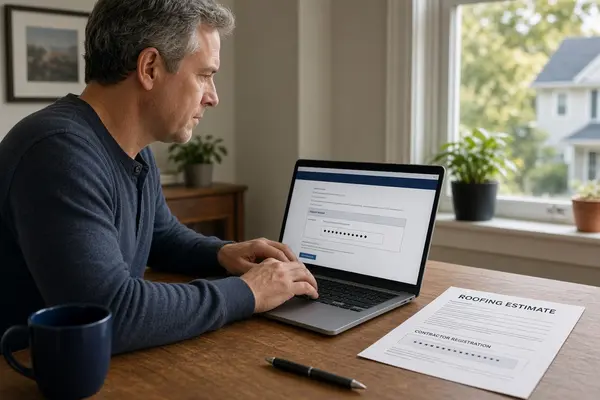
Ask to see the registration number on the document in their hand, then look it up on the state’s contractor search before you sign anything.
One line of law makes this a five-second test. Under Chapter 142A, the state’s registration law says: “Every contract, building permit and advertisement shall display the contractor’s or subcontractor’s certificate of registration number.” Every one. A door hanger with no number. A flyer with no number. An estimate with no number. Each one is already a violation before the crew touches your roof. And section 17 of the same chapter makes any violation an unfair or deceptive act under Chapter 93A.
You do not need to be a lawyer to run this. You need to read one line of a piece of paper.
Ask us for our number too. Any roofer who gets annoyed by that question has told you something useful.
Why “He’s From Out of State” Is the Wrong Red Flag
Out-of-state is not illegal here. Unregistered is. Chapter 142A section 9(a) says no contractor “shall undertake, offer to undertake, or agree to perform residential contracting services unless registered.” It says nothing about where the company keeps its office. A registered firm from Rhode Island is working legally. An unregistered outfit with a Quincy phone number is not.
Door knocking is not the red flag either. The state’s own advisory does not warn against canvassing. It warns about one specific pitch. The contractor “goes door-to-door and claims to be ‘in the area’ or that they ‘noticed damage’ to your home and offers to fix it.” That advisory also notes that FEMA does not license or certify contractors. Worth knowing, because “FEMA approved” is a line people actually use after a declared storm.
Judge the paperwork, not the plates. Plenty of working Massachusetts roofers knock after a big wind event. That is when roofs fail. And the penalty for operating unregistered runs up to $5,000 or two years, so the state is not treating registration as a formality.
The Permit Question That Decides Whether You Are Protected
If the roofer asks you to pull the building permit yourself, say no. Two separate rules bite at once here. The Guaranty Fund regulation shuts out owners who pulled their own building permit. The one exception is if the contractor never told them that pulling it forfeits the protection. So the friendly suggestion that you pull it because “it’s faster that way” can quietly void your claim, even when the contractor is fully registered.
Then the building code adds the second half. Under 780 CMR 110.R5, a homeowner who hires people for work needing a Construction Supervisor License “shall act as supervisor.” You become the supervisor of record on your own roof.
A third wrinkle is worth knowing, and I have not seen anyone else write about it. The restricted Roof Covering license, the RF card, covers roof covering work “including repair and replacement of 25% of sheathing and 25% of sistering roof rafters.” That is the ceiling. A roof needing more decking than that calls for a 1 and 2 Family or unrestricted license. Across the roofs we do, rotted decking is one of the most common things we find once the old roofing comes off. So a crew holding only an RF card can hit a legal wall in the middle of your job.
What Massachusetts Law Requires in a Roofing Contract in 2026
Above $1,000, the contract has to be in writing, and the state spells out what goes in it.
The deposit is capped. No more than one third of the total price up front. Special-order material is the one exception. The contract also has to carry a short list of items. The registration number goes on the first page. So do real start and finish dates, a detailed description of the work and materials, and the payment schedule in dollars. One line has to appear in ten-point bold at minimum: “DO NOT SIGN THIS CONTRACT IF THERE ARE ANY BLANK SPACES.” Work cannot begin until you hold a signed copy. The state publishes the full contract requirements.
You can still cancel if you signed away from the contractor’s office. Your front step counts. Chapter 93 section 48 gives you until midnight of the third business day. The seller has to say that out loud at signing. They also have to include a bold notice and a detachable cancellation form. Breaking that section carries a fine up to $500 or six months. It is a 93A violation on its own.
That three-day window is the single most useful thing to remember if you already signed something last night.
Is “We’ll Cover Your Deductible” Legal in Massachusetts?
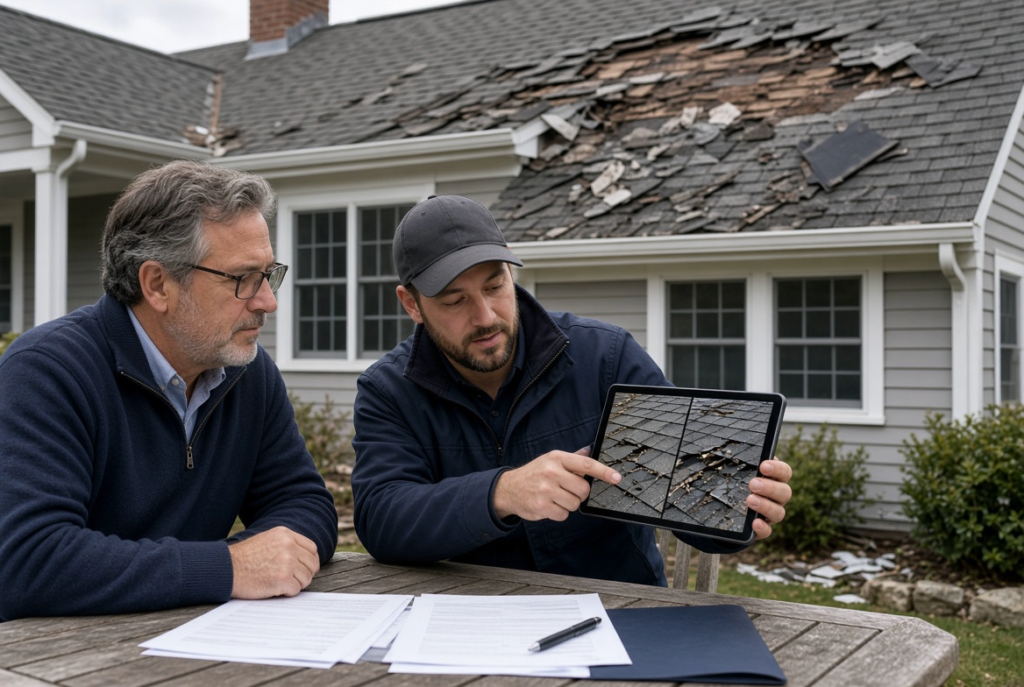
No, and it is not a gray area. Handing false or fraudulent documents to an insurer on a claim is a crime under Chapter 266 section 111A. The penalty runs up to five years in state prison. Or six months to two and a half years in jail. Or a fine of $500 to $10,000. Or both a fine and jail.
When a roofer offers to eat your deductible, that money comes from somewhere. It comes from padding the claim, or from cutting material out of your roof. Sometimes both.
We do not do it. We do not promise insurance will approve anything. And we will not tell you to file a claim when the damage is not there. If a roof can be repaired, we say so. That position costs us jobs. I am fine with that.
Can a Roofer Negotiate Your Insurance Claim for You?
Not without a public adjuster license. Massachusetts licenses public insurance adjusters under Chapter 175 section 172. The fee is capped at up to 10 percent of the final recovery. The contract has to be written, on a form the Insurance Commissioner has approved, with a three-day right to cancel printed in bold. Acting as a public adjuster without that license carries a fine up to $10,000 or up to six months.
So when someone offers to “handle the whole claim” and “deal with the adjuster for you,” ask which license they hold. A roofer can document damage, take photos, write a scope, and meet your adjuster on site. That is what we do. Negotiating your settlement for a cut is a different job with a different license.
One more thing on the insurance angle. The hail pitch gets used here, and Massachusetts is not much of a hail state. NOAA’s billion-dollar disaster record for Massachusetts, 1980 through 2024, counts 15 severe storms, 9 tropical cyclones, and 15 winter storms. Tropical systems drove about a third of the total cost. Our big losses come from wind, water, and ice. If someone leads with hail damage on a South Shore roof, ask them to show you the strike marks on the vents and the soft metal first.
What a Storm Chaser Scope Leaves Out
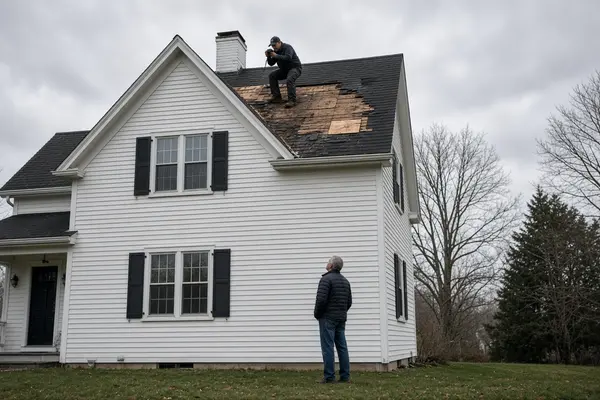
The gap between a cheap number and a real one is almost always line items, not labor rates.
Homeowners bring us scopes for a second opinion all the time. Below is our own written scope on a standard replacement. Next to it is what tends to be missing or vague on the ones we get handed. This is what we see, not a claim about any particular company.
| Line item | On our written scope | What we often see missing or vague |
|---|---|---|
| Tear-off down to the deck | Always specified | Listed as “roof over” or left unstated |
| Rotted decking replacement | Priced per sheet, with photos before it goes on | No allowance, no per-sheet price, handled as a verbal surprise |
| Drip edge | New, all eaves and rakes | Not listed |
| Ice and water leak barrier | GAF WeatherWatch at eaves and valleys | Generic “underlayment,” no product, no coverage area |
| Synthetic underlayment | GAF FeltBuster over the field | Substituted with felt, or unnamed |
| Starter course | GAF Pro-Start starter strip | Cut-up shingles used as starter |
| Step and chimney flashing | New metal, specified | “Reuse existing” |
| Pipe boots | New on every penetration | Reused, then caulked |
| Ridge ventilation | GAF Cobra ridge vent, cut and specified | Not addressed, or promised without a cut |
| Ridge cap | GAF Seal-A-Ridge | Three-tab cut down |
| Magnetic nail sweep | Included, driveway and lawn | Not mentioned |
| Final photos and walkthrough | Included | Not offered |
Across the roofs we do, the problem is usually not the shingle. It is flashing, ventilation, reused pipe boots, valleys, and decking nobody talked about. That is why we hand over a written scope instead of a single number, and why we take the photos before we cover anything up. If you want to see how we sort a fixable roof from one that is finished, our take on repair or replace walks through it.
On price, I will not post fake numbers. Plenty of Massachusetts asphalt shingle roofs land under $10,000. Plenty run $15,000 to $20,000 and up. Roof size and pitch move it most. So do the layers coming off, rotted decking, chimney and skylight flashing, ventilation, access around the house, and whether gutters or fascia are in the job. Most standard replacements go on in one to two days once material is on site and the weather holds. Our average install is usually one day. The full project timeline is a separate question, and we cover it in how long a roof install takes.
What to Do if You Already Signed or Already Let Someone on Your Roof
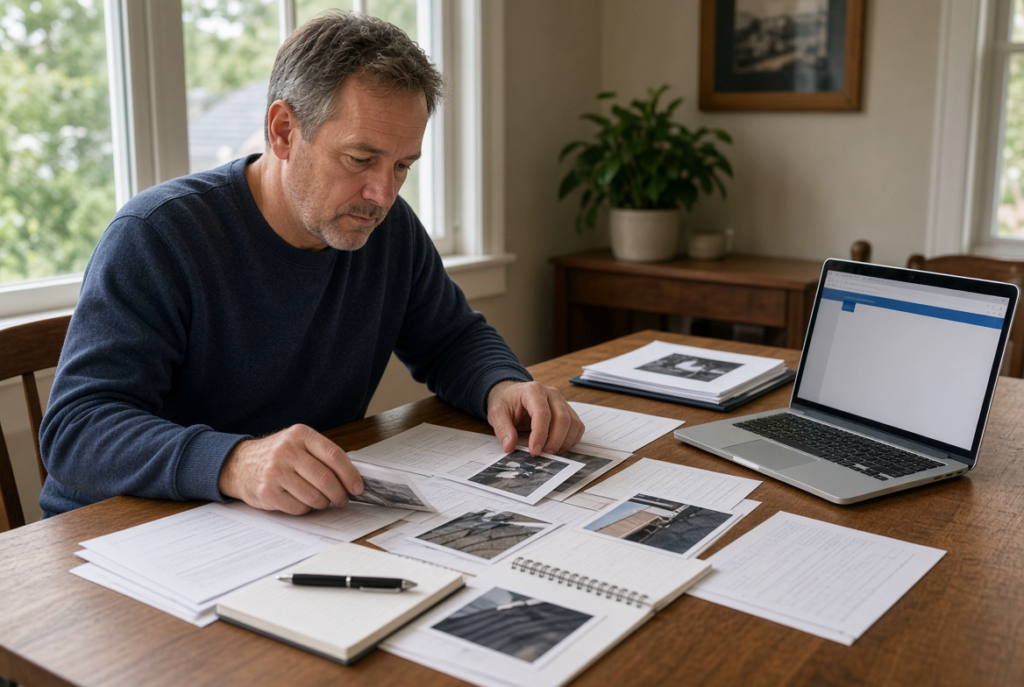
Move on the three-day window first, then document everything.
- Check the date you signed. If it was away from their office and you are inside three business days, send written cancellation. Keep proof of when you sent it.
- Look up their registration number on the state contractor search. Screenshot the result either way.
- Photograph your roof yourself, from the ground, and photograph anything they left behind.
- Do not pay another dollar until the registration checks out.
- If they are already on the roof and you want a second set of eyes, that is what a real roof inspection is for. Ours comes with photos you keep.
Get the water stopped before you argue about contracts. Our guide to temporary leak control covers what to do from the inside without hurting your claim.
How to Report a Storm Chaser in Massachusetts
File with two offices, not one. The Office of Consumer Affairs and Business Regulation handles Home Improvement Contractor complaints. It also runs the arbitration program. The Attorney General’s office takes consumer complaints under Chapter 93A. If the pitch involved an insurance claim, the Division of Insurance fraud line is the third call.
Bring the paperwork. The document with no registration number on it is the strongest thing you have. Section 13(c) makes that omission a violation on its face.
Storm chaser roofers in Massachusetts count on you deciding fast, in your driveway, with someone watching you. You do not owe anyone an answer at the door. Call us for a second opinion on storm damage from someone with a Quincy address you can drive to. Then ask us for our registration number before you let us on the roof. We will have it ready. The questions worth asking work on us too.
Storm Chaser Roofer FAQ for Massachusetts Homeowners
What is a storm chaser roofer?
A storm chaser roofer is an out-of-town or unregistered contractor who canvasses a neighborhood after a storm, offers a free inspection, and pushes for a same-day signature. In Massachusetts the practical test is whether their paperwork shows a Home Improvement Contractor registration number, which Chapter 142A section 13(c) requires on every contract, building permit, and advertisement.
What happens if I hire an unregistered roofer in Massachusetts?
You lose both state remedies. The Home Improvement Contractor arbitration program and a Guaranty Fund claim of up to $25,000 both require that your contractor was registered on the date the contract was signed. Operating unregistered also carries a fine up to $5,000 or up to two years for the contractor, though that penalty does nothing to repair your roof.
Can I cancel a roofing contract I signed at my front door?
Yes, if you act fast. Under Chapter 93 section 48, agreements over $25 signed away from the seller’s place of business can be canceled until midnight of the third business day. The seller has to tell you that at signing and include a detachable cancellation form. Send your cancellation in writing and keep proof of the date.
How much deposit can a Massachusetts roofer ask for up front?
No more than one third of the total contract price, or the actual cost of special-order or custom material. The state publishes this alongside the rest of the home improvement contract requirements. Anyone asking for half or for full payment before the first shingle comes off is outside the rule.
Should I pull my own roofing permit to save time?
No. The Guaranty Fund regulation excludes owners who secured their own building permit, unless the contractor failed to disclose that. Separately, 780 CMR 110.R5 says a homeowner who hires people for work requiring a Construction Supervisor License shall act as supervisor. You give up your claim and take on the supervisor role in one move.
Is it legal for a roofer to offer to cover my insurance deductible?
No. Presenting false or fraudulent documents to an insurer is a crime under Chapter 266 section 111A, carrying up to five years in state prison, or six months to two and a half years in jail, or a fine of $500 to $10,000. A covered deductible has to be paid for by inflating the claim or by cutting material out of your roof.
Can storm chaser roofers negotiate my insurance claim in Massachusetts?
Only with a public insurance adjuster license. Massachusetts licenses public adjusters under Chapter 175 section 172, caps the fee at up to 10 percent of the final recovery, and requires a written commissioner-approved contract with a three-day cancellation right. Acting as one without a license carries a fine up to $10,000 or up to six months.