After a Massachusetts snowstorm, the signs of roof damage after snow and ice you can actually see are a sagging or wavy roofline, a thick band of ice at the eaves, shingles torn back or missing, gutters pulling off the fascia, and a brown stain spreading across a ceiling. Two of those need a phone call the same day. The rest can wait for the melt.
Most roofing pages skip the part that matters. A lot of what homeowners in Quincy or Brockton call storm damage turns out to be a flashing or ventilation problem that the storm put on display. After enough Februaries on Massachusetts roofs, the two are not hard to tell apart. This checklist tells you which one you have, and what to do tonight versus in April.
What Roof Damage After Snow and Ice Actually Means
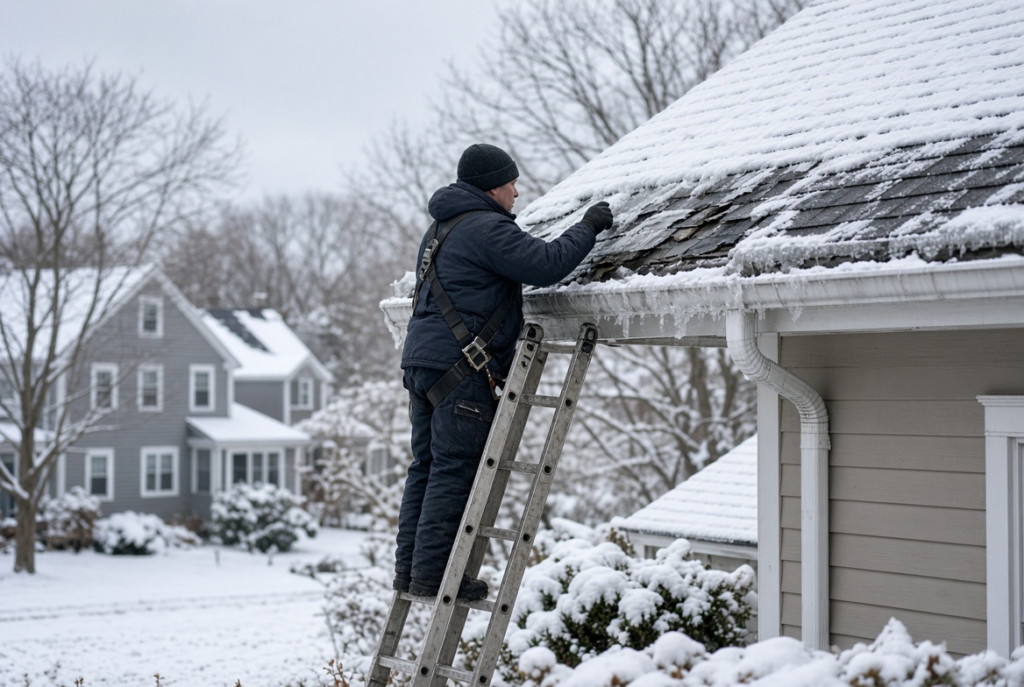
Signs of roof damage after snow and ice are the visible and interior clues that a winter storm has broken the roof’s water barrier or overloaded its structure. They include ice dams at the eaves, sagging or deformed roof planes, torn or missing shingles, detached gutters, and fresh water stains on ceilings, walls, or attic sheathing.
Two different problems look identical from the driveway. One is a storm event: wind tore shingles back, ice pried up a flashing, weight bent a rafter. The other is a building problem the storm exposed, where warm air leaks into a cold attic, melts the snow from underneath, and the meltwater refreezes at the eave. The first is usually an insurance conversation. The second is an air-sealing and ventilation job, and a brand new roof by itself will not fix it.
How Much Snow Is Too Much on Your Roof?
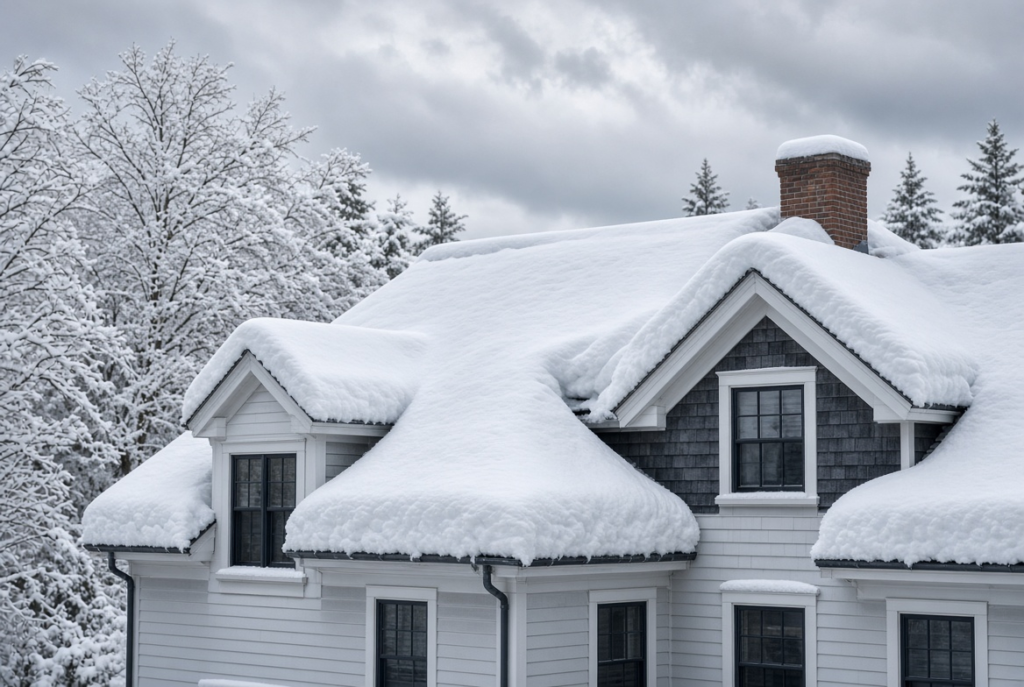
Depth is the wrong measurement. Weight is the right one. The FEMA Snow Load Safety Guide (P-957) puts one foot of light, dry snow at 3 pounds per square foot and one foot of wet, heavy snow at 21 pounds per square foot, so the same 12 inches on your roof can vary by a factor of seven depending on what fell.
| What is sitting on the roof | Weight per square foot |
|---|---|
| 1 foot of light, dry snow | 3 pounds |
| 1 foot of wet, heavy snow | 21 pounds |
| 1 inch of ice | just under 5 pounds |
| 1 foot of ice | about 57 pounds |
| 10 to 12 inches of fresh snow | about 5 pounds |
| 3 to 5 inches of old, settled snow | about 5 pounds |
| 2 feet of old snow plus 2 feet of new | up to 60 pounds |
The first four rows come from FEMA P-957. The last three come from the Insurance Institute for Business and Home Safety, published in the Department of Energy’s Building America Solution Center. That same DOE guidance puts the working number at about 20 pounds per square foot before a typical residential roof is stressed. Look at the last row again. Four feet of mixed old and new snow can run three times that.
Weight you cannot see is the reason ice matters more than snow. An inch of ice in a valley or behind a chimney weighs roughly what a foot of fresh powder does.
What an Overloaded Roof Sounds Like
FEMA lists the warning signs of overstress during a snow event, and most of them happen inside the house, not on the roof. Section 4.2 of P-957 names popping, cracking, and creaking noises, sagging roof members or plywood sheathing, doors and windows that will no longer open or close, cracked or split wood members, cracks in walls or masonry, and severe roof leaks.
The federal guidance on what to do is short. If you see those signs, FEMA says to evacuate the building and have a qualified design professional perform a structural inspection. That is not a roofing call. That is a get-out-of-the-house call.
Your Winter 2026-27 Triage: Call Tonight, Call This Week, or Wait for the Thaw
Here is how I sort the calls we get in January. The urgency column is my judgment after inspecting roofs across the South Shore, not a code table.
| What you see | What it usually means | When to call |
|---|---|---|
| Roof plane sagging or wavy, doors suddenly sticking, new cracks in a ceiling or wall, popping noises | Structural load. The frame is telling you something | Get out, then call. Same day |
| Water actively dripping or running inside during the storm | Water is already past the underlayment | Same day |
| Thick ice band at the eave, icicles hanging behind the gutter | Ice dam. Heat is escaping into the attic | This week, before the next storm |
| Gutter pulled off the fascia or bent downward | Ice weight, and the fascia board may be soft | This week |
| Brown or yellow ceiling stain that is dry to the touch | Older leak, or attic condensation | This week |
| Frost on the nail tips in the attic, damp sheathing, musty smell | Ventilation problem, not a storm event | This week if you can reach the attic |
| Shingles torn back, cracked, or missing | Wind plus freeze and thaw | After the melt, unless water is coming in |
| Granules in the gutters or at the downspout | Normal aging on most older roofs | Spring inspection |
The top two rows are the ones that get an emergency roof repair call, day or night. Notice how many of the rest say ventilation and not shingles. Across the roofs we work on, the problem usually is not the shingle. It comes from flashing, ventilation, a bad previous install, old pipe boots, valleys, rotted decking, or the edges of the roof where water has been getting in for years.
Signs of Roof Damage After Snow and Ice You Can See From the Driveway
You can read most of a roof from the ground with a phone camera and the zoom. Stand back at each corner of the house and look for these.
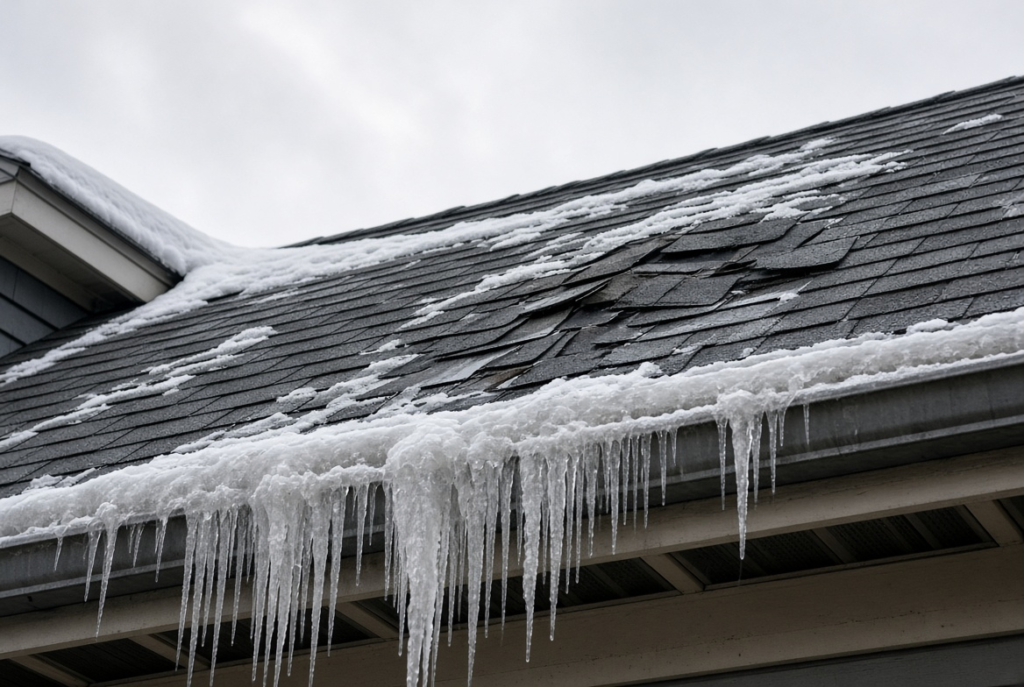
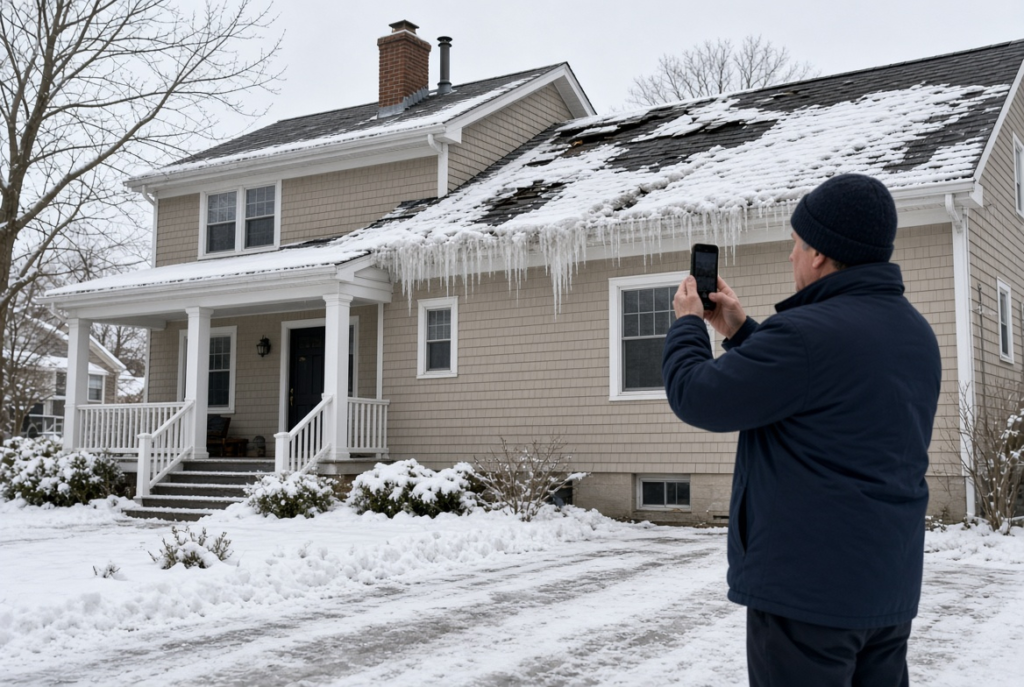
A thick, uneven band of ice along the bottom two or three feet of the roof is an ice dam, not decoration. Icicles that hang from behind the gutter rather than off the front lip mean water backed up over the edge and froze there.
Shingles that look lifted, curled, cracked, or missing are worth photographing, especially along the ridge and in the valleys where wind and ice work hardest. On the fascia, look for gutters that have pulled away, sagged, or twisted downward under ice weight. Around the chimney and any vent, look for metal flashing that has lifted or separated.
Then look at the roof planes themselves. A straight roof reads as a straight line against the sky. A dip, a wave, or a ripple in that line is the one item on this page that earns a same-day call.
What the Inside of the House Tells You
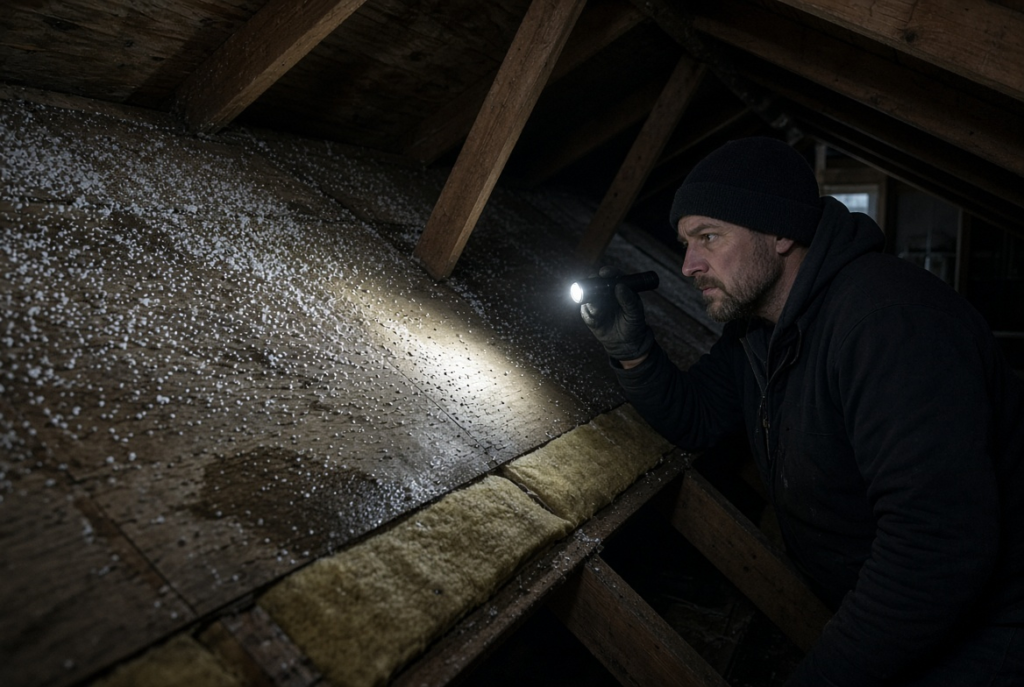
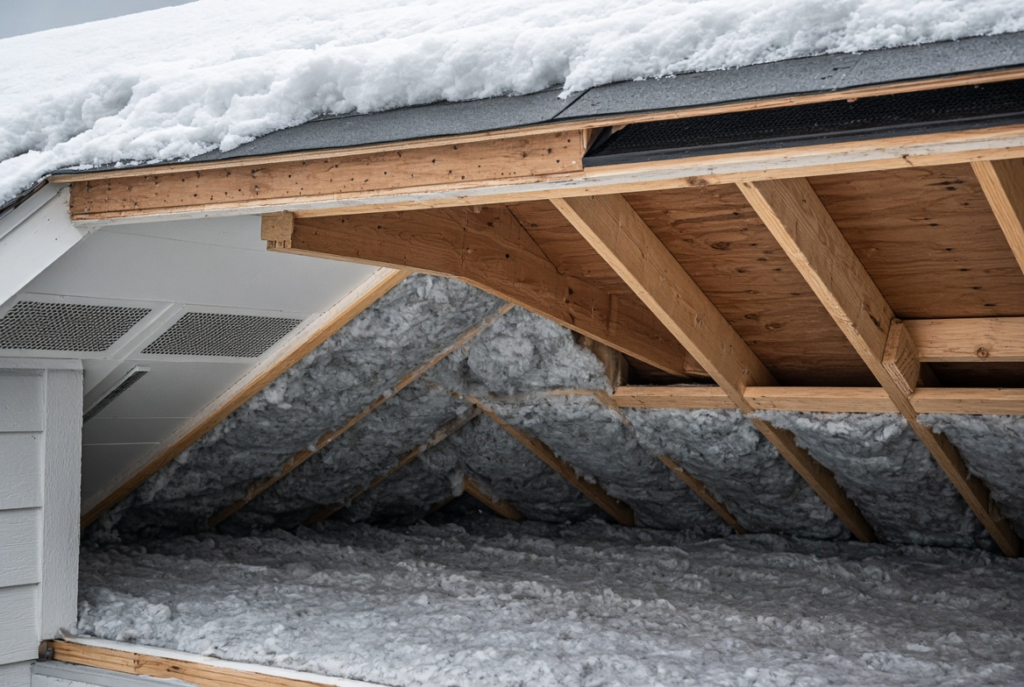
The attic is the honest room. If you can get up there safely with a flashlight, four things matter: frost or ice on the tips of the roofing nails, dark staining or damp streaks on the underside of the sheathing, insulation that is flattened or discolored in a patch, and a musty smell that was not there in October.
Frost on the nail tips is the one homeowners never expect. It means warm, moist household air is reaching the cold underside of your roof deck. That is the same mechanism that builds an ice dam, and no shingle can stop it.
Downstairs, a stain that is dry and hard-edged is usually old. A stain that is soft, spreading, or dripping is active. Peeling paint high on an exterior wall, or a door that suddenly binds in its frame, points at movement rather than water. Water travels along rafters before it drops, so finding the leak usually starts uphill from the mark on the ceiling.
Why Do You Still Get Ice Dams After a New Roof?
Because the roof was never the cause. The Department of Energy’s Building America Solution Center, citing UMass Amherst, states that ice dam formation requires three things: snow on the roof, a poorly air sealed or poorly insulated attic, and freezing temperatures. It also notes dams can form with as little as 2 inches of snow on the roof.
Read that list again. Two of the three conditions are weather you cannot control. The one you can control is inside your house, under the insulation, at every recessed light, plumbing stack, attic hatch, and top plate where heated air escapes upward.
This is the part most roofers will not put on their website, because it can talk a customer out of a roof. I would rather say it. If your attic is leaking heat and you replace the shingles without air sealing and without fixing airflow, you will get the same ice dam next February on a nicer looking roof.
Doing it right means the whole assembly, not the top layer. On our replacements we run GAF WeatherWatch ice and water leak barrier at the eaves and valleys, FeltBuster synthetic underlayment over the field, and a Cobra SnowCountry ridge vent, which is the vent GAF builds for exactly this climate. The DOE guidance is specific about the airflow side too: leave at least a 2 inch air gap between the top of the insulation and the underside of the roof deck. Bury that gap in blown-in insulation and the vent does nothing, which is why attic venting belongs on the same seasonal list as gutter cleaning and flashing checks.
Should You Rake the Snow off Your Roof?
Probably not, and the federal guidance is blunter than most roofers are. FEMA P-957 states that most buildings are not at risk of snow induced failure, and that more often than not, attempting to remove snow from a roof is more hazardous than beneficial. When removal is warranted, the same guide says at least 2 inches of snow should be left on the roof.
That last detail is the one homeowners get wrong. Scraping a roof down to the shingle with a metal-edged rake in freezing weather knocks granules off asphalt and can tear a shingle that is stiff and brittle at 20 degrees. You trade a snow problem for a roof problem.
If you do rake, work from the ground, pull downhill in short strokes, stop at 2 inches, and stay away from anything electrical. Never climb onto an icy roof, and never send someone up on a ladder to chip an ice dam with a hammer. I have replaced shingles and fascia that were destroyed by the ice removal, not the ice.
What Massachusetts Code Requires at Your Roof Edge
Massachusetts is one of the states where an ice barrier is not optional. Under 780 CMR, Section R905.1.2 requires the barrier to run from the lowest edges of all roof surfaces to a point not less than 24 inches inside the exterior wall line. On a steeper roof, 8:12 or greater, it goes not less than 36 inches measured from the eave edge. The material has to be either two layers of underlayment cemented together or a self-adhering polymer-modified bitumen sheet.
Measure that from inside your house sometime. Twenty-four inches past the wall line is well up the roof, past the top of the wall plate, because that is roughly where meltwater backs up to before it finds a seam.
Ask any roofer bidding your job to say, out loud, how far up the ice barrier goes and what product it is. If the answer is one course of ice and water at the drip edge, that is a number you can compare against the code language above.
Does Homeowners Insurance Cover Ice Dam Damage in Massachusetts?
Usually yes for the damage itself, and no for the underlying condition. The Massachusetts Division of Insurance says damage to the exterior and interior of a home from the weight of ice and snow, or from ice dams, is generally covered under a homeowners policy. The same page sets the limit: only the area damaged in the loss will be covered, and further damage sustained due to wear and tear or neglect will not be covered.
That sentence decides most claims. A ceiling that got wet in the February storm is a loss. A twenty year old roof that has been leaking at the chimney since 2019 is wear and tear.
We inspect for storm, wind, and hail damage, we photograph everything, and we tell you plainly whether what we see looks like real storm damage or normal wear. If you open a claim, we can provide the documentation and meet the adjuster. If it is real, storm damage repair is a different conversation than a planned replacement. We do not promise that insurance will approve anything, and we will not tell you to file if the damage is not there. Your deductible, and anything the carrier declines, stays yours.
What to Photograph, and When
Do it before the melt. Evidence disappears in this category faster than any other kind of storm damage, because the ice dam that caused the leak is gone by the time an adjuster is scheduled.
Take a wide shot of each side of the house from the ground, with the snow and ice still on the roof. Get a close zoom on the ice band at the eave with something in frame for scale, a gutter bracket or a window trim line works. Photograph every interior stain the day you notice it, and again three days later, so the spread is documented. If the attic is safe to enter, shoot the sheathing and the nail frost. Keep the timestamps and do not crop them out. The same clock applies to the repair. A small winter leak that waits until spring is rarely still small in April.
Repair or Replace After a Hard Winter?
Repair, if the roof is otherwise sound and the damage is local: a lifted flashing, a torn shingle field, a bad pipe boot, a section of rotted decking at one eave. Replace when the shingle field is at the end of its life and the damage is showing up in more than one place. Age is usually what decides it, and the repair or replace math shifts once a roof is near the end of its rated life.
I will not put a fake price on a page. Prices in Massachusetts move with roof size, pitch, how many layers come off, rotted decking, chimney and skylight flashing work, ventilation, and access around the house. A lot of Massachusetts asphalt shingle roofs land under $10,000, and many run $15,000 to $20,000 and up. The cheapest number is not always the best deal. If one bid is far lower than the others, ask what is missing: tear-off, decking, ventilation, flashing, cleanup, warranty, insurance, and who stands behind the work.
Once material is on site and the weather cooperates, most standard replacements are a 1 to 2 day install, and our average is usually one day. We have done full exterior work in Taunton, Randolph, and Dorchester where the roof was only part of the job, and the edges of the roof mattered as much as the shingles did.
Get a Straight Answer About Your Roof
If you are looking at any of the signs of roof damage after snow and ice on this page and you are not sure how bad it is, that is the whole reason to have someone look. Powersol Roofing works across Quincy, the South Shore, and Greater Boston. We inspect, we photograph what we find, and we tell you in plain words whether it needs a repair now, a replacement, or nothing yet. If the roof can be repaired, we will say so. Book a roof inspection and we will show you the pictures.
Questions Massachusetts Homeowners Ask After a Storm
How much snow is too much on a roof?
Weight matters, not depth. FEMA P-957 puts one foot of light dry snow at 3 pounds per square foot and one foot of wet heavy snow at 21 pounds per square foot. Department of Energy guidance citing IBHS puts about 20 pounds per square foot as the point where a typical residential roof becomes stressed. Two feet of old snow plus two feet of new can reach 60 pounds per square foot.
Can a roof be inspected with snow on it?
Partly. We can read the eaves, the ice pattern, the gutter line, and the interior and attic evidence with snow on the roof, and that is often enough to tell you whether something is urgent. A full surface inspection of the shingles, valleys, and flashings needs a clear, dry roof, so we usually split it into a triage visit now and a detailed inspection after the melt.
What are the signs of roof damage after snow and ice that need a same-day call?
Two things. A roof plane that sags, dips, or waves out of line, and water actively running or dripping inside during the storm. Add the FEMA overstress signs: popping or cracking noises, doors and windows that stop working, and new cracks in walls or ceilings. FEMA’s guidance for those is to evacuate the building and get a structural inspection.
Do gutters cause ice dams?
No. Clogged gutters make a dam worse by holding water and ice at the eave, but the dam forms because heat escaping the attic melts snow on the roof above and the meltwater refreezes at the cold edge. Cleaning gutters helps. Air sealing the attic is what actually addresses the cause.
Is granule loss after winter normal?
On an older roof, some granules in the gutter are normal aging. What is not normal is a heavy pile at one downspout, bare black patches visible on the shingle field, or granules showing up after a specific storm on a roof under 10 years old. That combination is worth a photo and an inspection.
Does homeowners insurance cover ice dam damage in Massachusetts?
The Massachusetts Division of Insurance states that damage from the weight of ice and snow or from ice dams is generally covered under a homeowners policy, exterior and interior. The limit is that only the area damaged in that loss is covered, and damage from wear and tear or neglect is not. Your deductible still applies.