Photograph your roof before you call your insurance company. Start with all four sides of the house from the ground. Then close-ups, with a coin or a ruler in the frame for scale. Then the attic, and every ceiling stain inside. Screenshot the storm date, save your receipts, and write down when you first saw the damage. Leave the originals uncropped so the time and location data stays attached.
That’s how to document roof damage for insurance almost anywhere. Massachusetts adds three wrinkles the Texas and Florida guides skip. Your carrier may already own a photo of your roof. Ice dam coverage is limited to the area that actually got damaged. And a named storm can multiply what you pay out of pocket.
Powersol Roofing is a roofing company. We’re not a public adjuster and we’re not a law firm. Nothing below is legal or insurance advice, and no roofer can promise you a carrier will approve anything.
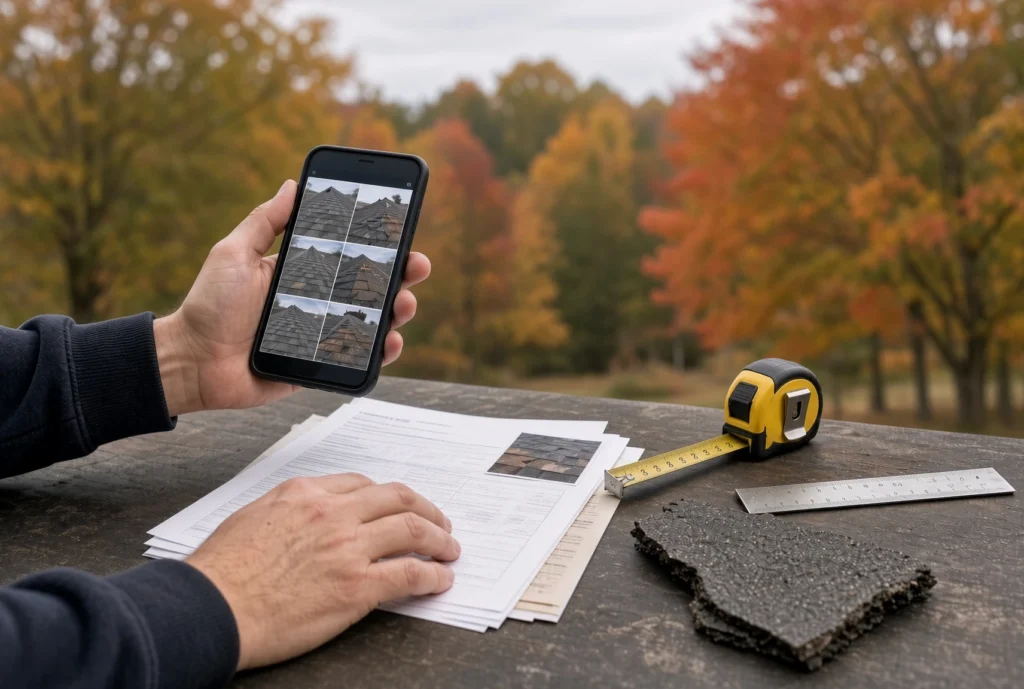
What Counts as Roof Damage Documentation in Massachusetts?
Roof damage documentation is the file you build to prove what your roof looked like, when it changed, and how far the damage runs. It holds dated ground-level photos, close-ups with something for scale, attic and interior shots, the storm date, repair receipts, and a written note of what you saw and when.
Most homeowners build half of that file. They build it after the storm.
I want you to build two files instead. A condition file you keep year-round, and a loss file you build in the 48 hours after something happens. The second one is what every other article talks about. The first one is what actually saves Massachusetts homeowners, and the reason comes down to how carriers here look at roofs now.
Why Does Your Insurer Already Have a Photo of Your Roof?
Because a lot of Massachusetts carriers stopped waiting for a claim. They’re pulling drone and satellite images of roofs and making underwriting decisions off them, and the state had to step in twice.
On April 30, 2025 the Massachusetts Division of Insurance issued Bulletin 2025-02, an aerial imaging bulletin that put limits on the practice. Three lines in it matter to you:
- An insurer has to “timely review any relevant material provided by an applicant or insured that contests the insurer’s findings” and adjust the decision accordingly.
- “Cosmetic damage that does not fundamentally reflect the structural quality” can’t be the only reason for a denial.
- If the imagery doesn’t “unequivocally provide clear evidence,” the carrier is expected to do more work, which may include an actual physical inspection.
Now the bad news. In March 2024 the Division of Insurance published a plain-language explainer called “The truth about your roof.” It says there’s no formal appeal process for a roof-condition decision, not under state law and not under your policy. You can ask for an explanation and you can hand over documentation. That’s the whole toolkit. The example the state gives of persuasive evidence is a receipt from a roofing company showing recent work.
One more number worth knowing. Under Massachusetts General Laws chapter 175, section 193P, a carrier that won’t renew your fire or homeowners policy owes you written notice at least 45 days before it expires. That notice has to state the specific reasons. Forty-five days is not much time to find a roofer, get on a schedule, and get work done in New England weather. A condition file you already have beats a scramble you start in November.
The Condition File: What to Photograph Before Anything Happens
Shoot your roof once a year and once after any storm that knocks branches down, then put the photos somewhere you’ll find them. Ten minutes, no ladder.
The Shots to Take
- All four elevations from the ground, from far enough back that the whole roof plane is in frame.
- The eaves and gutter line on each side, straight on.
- Any valley you can see from the ground.
- Chimney flashing and any skylight, zoomed in as far as your phone goes.
- The ridge line against the sky.
- A close-up of one shingle surface so the granule texture is visible.
Then photograph the paperwork. Your last inspection report. Any repair invoice. The date on your policy declarations page. If you’ve replaced the roof, that receipt is the single most useful document you own, because it’s the exact evidence the state names.
Keep it in one dated folder in your phone’s cloud storage. Not in your camera roll with 4,000 other pictures. When a non-renewal notice shows up with a satellite image attached, you want to answer it that week, not go hunting. Our roof inspection checklist walks the same ground if you’d rather work off a list.
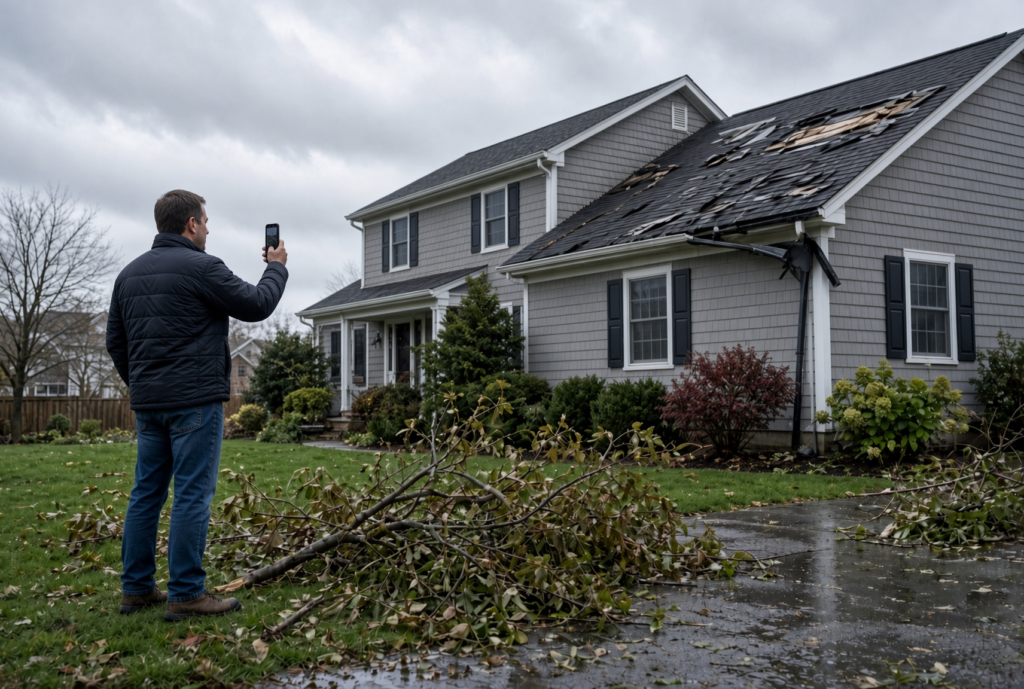
The Loss File: How to Document Roof Damage for Insurance in the First 48 Hours
Start on the ground, work in three distances, and get inside before you call anyone. Storm damage claims in Massachusetts turn on two questions: what got damaged, and when. Your file has to answer both without anybody taking your word for it.
Stay Off the Roof
Don’t climb up. Wet shingles are slick, hail-struck shingles are brittle, and stepping on a damaged roof can create damage that gets read as yours. Nearly everything an adjuster needs is visible from the ground with a phone that has decent zoom.
Walk the full perimeter and photograph:
- Granules piled in gutters or washed out below the downspouts.
- Dents or creases in gutters, downspouts, drip edge, and fascia.
- Shingles that are cracked, missing, or lifted along the rake and eave edges.
- Damaged vents, pipe boots, skylights, and anything mechanical on the roof.
- Fences, siding, window screens, deck boards, and your car. If wind or hail marked those, it reached the roof too, and that supports your timeline.
Some of what you’re shooting overlaps with ordinary wear and tear anyway. Worth knowing the difference before you assume every bad shingle is storm-related, because your carrier will draw that line whether you do or not.
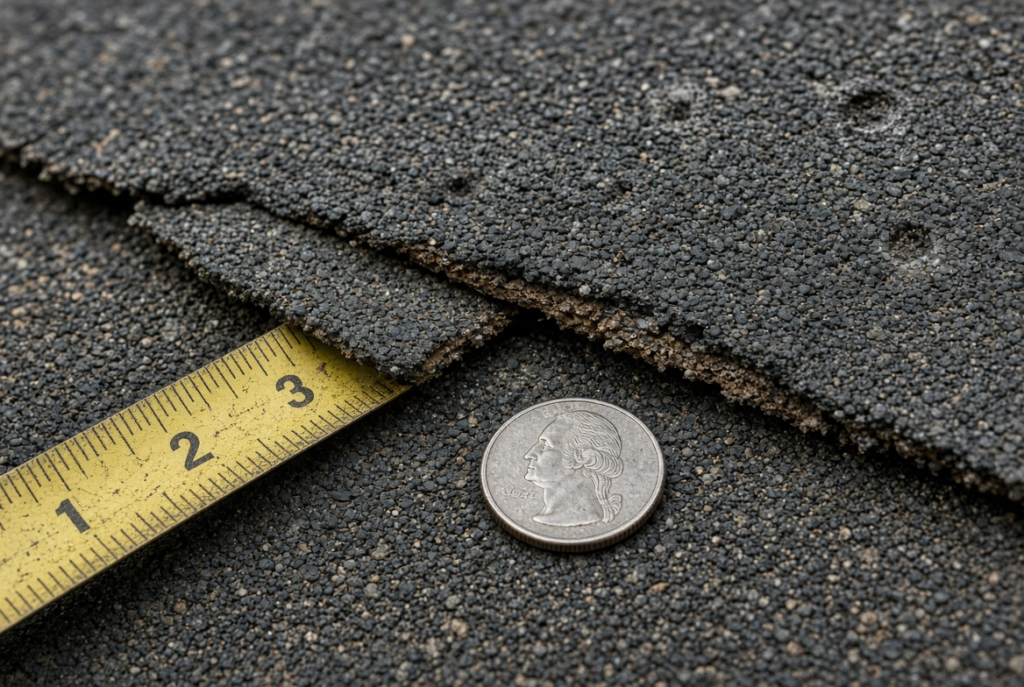
Wide, Mid, Close, and Something for Scale
Three distances on every damaged area. A wide shot that shows where on the house you are, a mid shot that shows the section, and a close-up. Put a quarter, a tape measure, or a piece of chalk in the close-up frame so size is provable. That last step is the one most homeowners skip and every adjuster notices.
Check that location and timestamp are switched on in your camera settings before you start. Don’t crop, filter, or screenshot the photos, because that strips the metadata that proves when you took them. Overcast light right after a storm is better for this than bright sun.
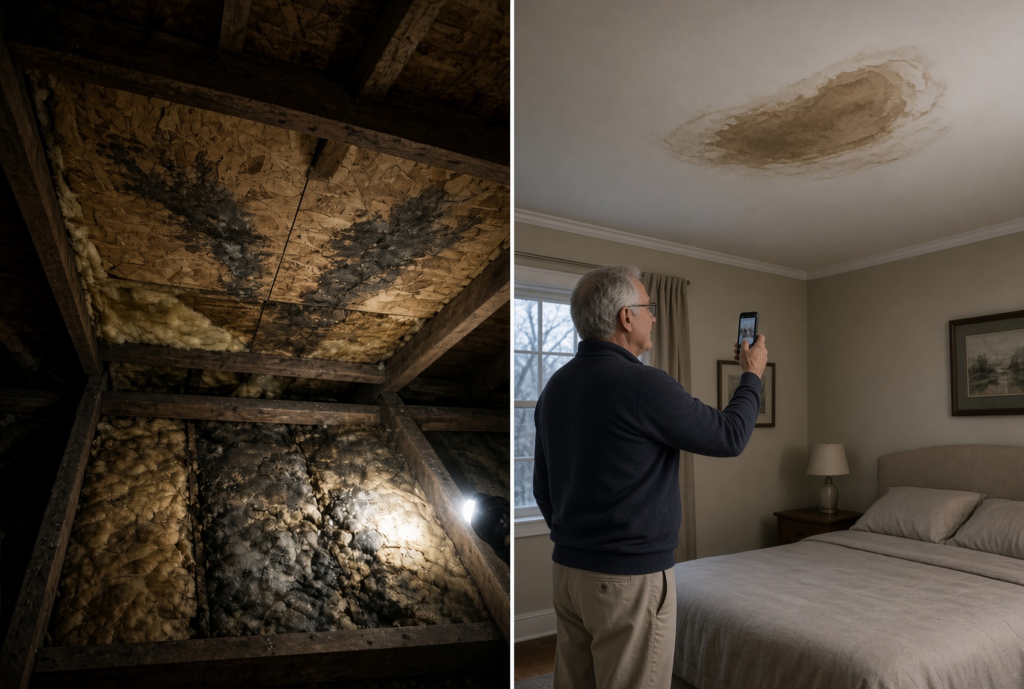
Inside and Up in the Attic
Bring a flashlight to the attic and look for wet insulation, daylight through the sheathing, dark staining on the underside of the decking, and boards that flex when you press them. Then walk every room and look at ceilings and walls along the outside edges of the house. Water stains, bubbling paint, nail heads showing through, a musty smell. Photograph all of it, even the things you’re not sure are related.
If water is actively coming in, deal with that first and document second. Our guide to emergency roof repair covers what to do in the hour before anybody can get there. Keep the receipt for the tarp and the boards.
What Does an Adjuster Actually Look At on a Massachusetts Roof?
Less of the shingle field than you’d expect, and more of the edges and the details.
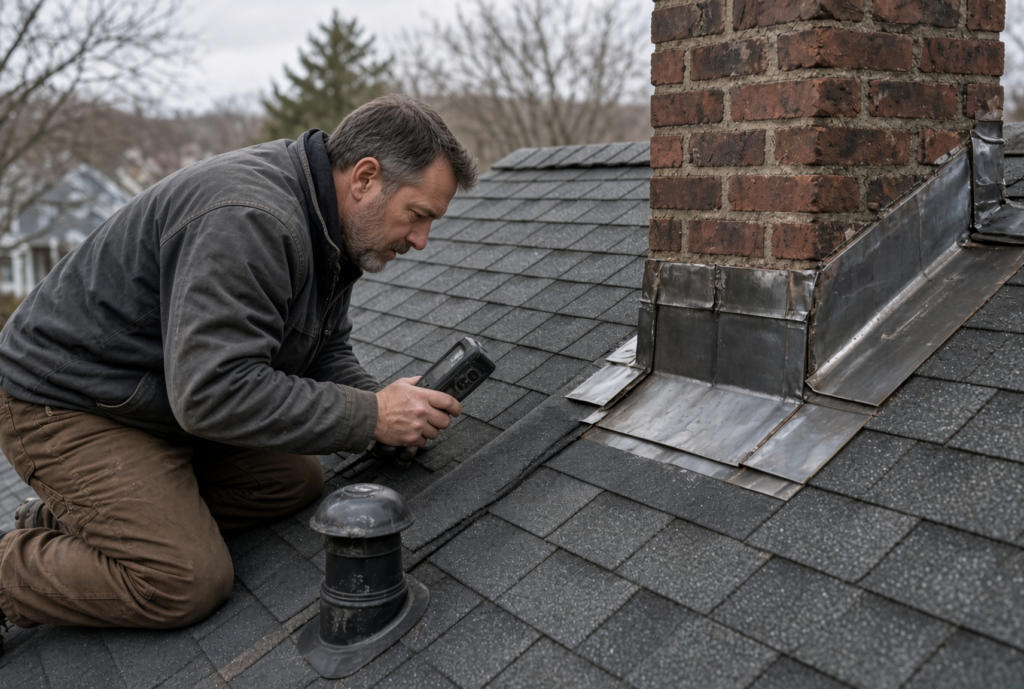
Across the roofs we work on, the problem usually isn’t the shingle. It’s flashing, ventilation, a bad previous install, reused pipe boots, valleys, nail placement, rotted decking, and the edges of the roof where water has been getting in. That’s what we find when the old roof comes off, and it’s what decides whether a claim reads as sudden storm damage or as wear that built up over years.
So photograph these six things nobody tells you to photograph:
- Chimney and wall flashing. Where the metal meets the shingle. Lifted, rusted, or caulked-over flashing is the most common leak path we see.
- Pipe boots. The rubber collars around plumbing vents. Cracked boots leak, and a reused boot on a newer roof is a red flag.
- Valleys. Water volume concentrates there, so damage shows up there first.
- The eave and the first three feet up from it. In New England this is ice dam territory.
- Ridge and soffit vents. Blocked or missing ventilation shortens shingle life, and carriers use shingle condition against you.
- Any spot where a previous repair was done. Mismatched shingles, smeared sealant, exposed nail heads.
None of that is exotic. It’s just what somebody who tears roofs off for a living looks at first. If your photos cover those six areas plus the four elevations, your file is more complete than most contractor reports. It’s also close to what a roofer looks for on a real inspection.
How Do You Document Ice Dam Damage in Massachusetts?
Document the extent, not just the fact. The state’s homeowners insurance FAQ says damage from the weight of ice and snow, or from ice dams, is generally covered inside the house and out. Then it adds the line that changes your whole approach: “only the area damaged in the loss will be covered.”
That one line is why the hail-belt method fails here. In Texas you document a uniform impact pattern across every slope to argue for a full replacement. In Massachusetts the loss is usually concentrated at the eaves, in the valleys, and around the chimney, so a settlement gets scoped to the area you can prove. Under-document the extent and you get a patch.
What that means in practice:
- Photograph every roof plane, including the ones that look fine. A plane you can’t prove is a plane that isn’t in the scope.
- Go room by room on the top floor and photograph every ceiling and wall stain, with a note of which room it’s in.
- Photograph the insulation in the attic directly above each interior stain.
- Measure. A stain is easier to scope when there’s a tape measure in the picture.
Ice dams also mean the timeline question is different. A hail claim has one date. An ice dam builds over a cold stretch, so write down the first day you saw water inside and keep the weather screenshots for the whole period. If you’re not sure where water is entering, our post on how to find a roof leak explains why the stain is almost never directly under the hole.
How Does Your Date of Loss Change Your Deductible?
It can change what comes out of your pocket, and that’s the part nobody warns coastal homeowners about.
Massachusetts policies frequently carry a separate named storm or wind deductible on top of the regular one. In its August 2024 hurricane guidance the Division of Insurance explains that named storm deductibles are usually a percentage of the home’s value, generally 1 percent to 5 percent. Read that again. It’s a percentage of what your house is worth, not a percentage of the repair. The state’s Understanding Home Insurance page describes wind deductibles the same way, as a percentage of your dwelling limit.
That’s a different animal from the flat deductible most people remember from their auto policy. Pull your declarations page and find both numbers before you need them.
So the date and time you write down isn’t housekeeping. If the damage happened during a named storm, a different and much larger deductible may apply than if it happened during an ordinary nor’easter or a summer thunderstorm three days earlier. The state also tells homeowners to find out whether that deductible applies per event, per season, or per calendar year. Ask your agent that question before you file, not after.
Quincy, Braintree, Weymouth, Hull, Marshfield, New Bedford, Fall River. If you’re near the water, go pull your declarations page tonight and find out whether you have one of these.
What Each Piece of Your File Proves
Every item in your file answers a specific objection. Here’s which piece answers what, so you can see the holes before your adjuster does.
| What you document | What it proves | What it protects you from |
|---|---|---|
| Four ground-level elevations, dated | The condition of every roof plane on a specific day | A scope limited to one slope |
| Close-ups with a coin or tape for scale | Size and depth of individual damage | Damage dismissed as cosmetic |
| Untouched photo metadata | When and where the photo was taken | A dispute over the date of loss |
| Attic and interior stains, by room | The damage reached the inside | An exterior-only settlement |
| Weather screenshots for the event window | A storm happened, and when | “This looks like wear and tear” |
| Pre-storm condition photos and receipts | The roof was sound before | A condition-based denial or non-renewal |
| Receipts for tarping and board-up | You mitigated the loss | An argument that you let it get worse |
| A written note of what you saw and when | Your own timeline, in your words | Memory gaps months later |
| Photos of flashing, boots, valleys, vents | The failure point, specifically | A vague scope that misses the actual repair |
What Massachusetts Law Gives You After You File in 2026
Three clocks and one process most homeowners never hear about. They all live in the state’s standard policy language at Massachusetts General Laws chapter 175, section 99.
The Thirty Day Clock
Once you’ve been asked for it, you’re expected to “forthwith render” a signed, sworn statement of proof of loss. After you submit that statement, the statute gives the company thirty days to either pay what it owes or take the next step. That’s why the file matters before you file. A complete proof of loss starts a clock. An incomplete one starts a conversation.
Massachusetts has a second law worth knowing, chapter 176D, section 3. It lists unfair claim settlement practices. Three of them matter here:
- Failing to acknowledge and act reasonably promptly on communications about a claim.
- Refusing to pay without conducting a reasonable investigation based on all available information.
- Failing to affirm or deny coverage within a reasonable time after proof of loss statements have been completed.
If you’re getting silence, those are the words to use in your email.
The Reference Panel Almost Nobody Mentions
If you and the carrier agree there’s a covered loss but can’t agree on the amount, section 99 provides for the disputed amount to go to three disinterested people, with each side choosing one. It’s a valuation process, not a coverage fight. Your documentation is what your appointee argues from.
The outer limit is two years. The statute says no suit against the company can be sustained “unless commenced within two years from the time the loss occurred.” That’s short. Florida homeowners get talked about a lot for their two-year window, and Massachusetts has had the same one sitting in its standard policy form the whole time.
Can a Roofing Contractor Handle Your Insurance Claim in Massachusetts?
No, and you should be suspicious of any roofer who says otherwise. Adjusting or negotiating a claim on your behalf is public adjuster work. In Massachusetts, licensed public adjusters answer to the Division of Insurance. The state notes they may charge up to 10 percent of the final recovery. It also notes that a public adjuster’s contract has to state in bold that you can cancel within three days. And it tells homeowners to verify a contractor’s registration with the Office of Consumer Affairs and Business Regulation before signing anything.
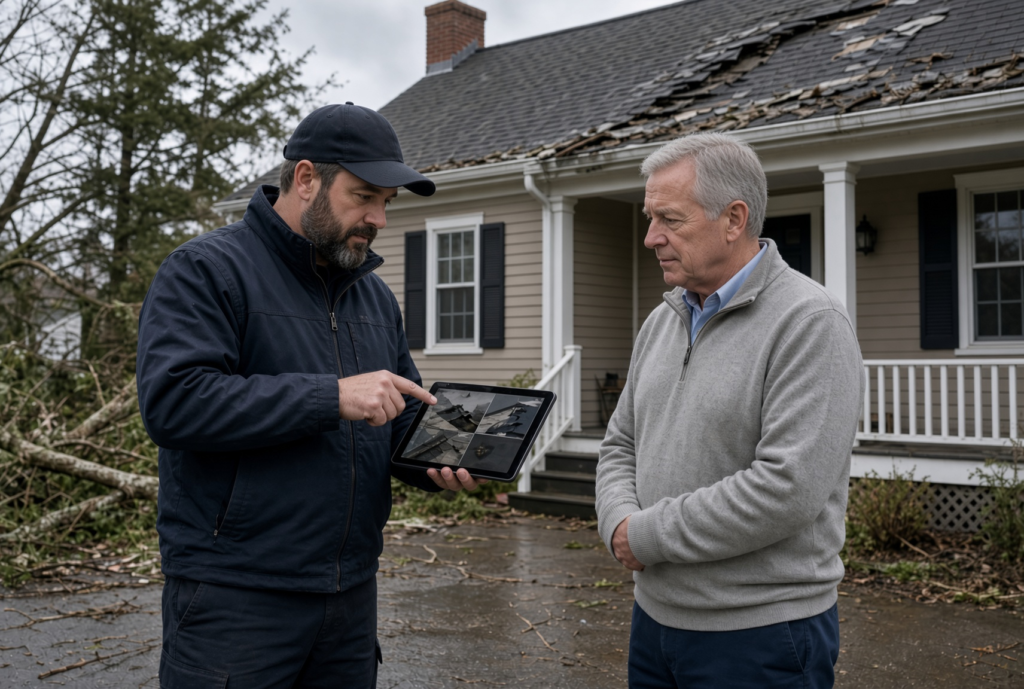
What a roofer can do is inspect, document, write a scope, and be standing there when the adjuster shows up. That’s the useful part anyway. Somebody who does tear-offs for a living can point at the flashing detail and say what the repair actually requires.
What we won’t do: tell you to file when the damage isn’t there, promise you a free roof, promise approval, or touch your deductible. You’re responsible for your deductible and for anything the carrier won’t cover. Anyone telling you different is telling you something that isn’t true.
What Happens When a Massachusetts Homeowner Calls Us After a Storm
We come out, get on the roof, photograph what’s there, and tell you what we see. If it’s normal wear, we say that. If it’s real damage, we show you the photos and explain what the repair involves in plain words, and we’ll meet your adjuster if you open a claim.
If it turns into a replacement, we tear off to the deck and replace bad sheathing. Then the full system goes on. Drip edge, GAF WeatherWatch ice and water leak barrier, GAF FeltBuster synthetic underlayment, GAF Pro-Start starter strip, flashing, new pipe boots, GAF Timberline HDZ shingles, a Cobra ridge vent, and Seal-A-Ridge ridge cap. After that, a magnetic nail sweep, final photos, and a walkthrough.
Most standard replacements go on in one to two days once the material is on site and the weather cooperates. Our average is usually a single day. We work across Quincy, Boston, Dorchester, Randolph, Stoughton, Brockton, Bridgewater, Taunton, New Bedford, and Fall River. One Taunton project needed the roof, the gutters, and the fascia and soffit handled together. The edges of that roof were the actual problem.
If a storm just went through, or a non-renewal letter with a satellite photo of your roof just landed in your mailbox, start the file today. Take the four ground-level photos before you call anybody. Then call us at (617) 631-5435 or set up an inspection and we’ll tell you what’s really up there. If you want to know what we’re looking for before we get there, read up on storm damage repair first. Knowing how to document roof damage for insurance in Massachusetts is most of the work, and it’s work you can do this afternoon with a phone.
Frequently Asked Questions
How Soon After a Storm Should I Document Roof Damage for Insurance in Massachusetts?
Within 24 to 48 hours, as soon as it’s safe to walk outside. Same-day photos tie the damage to the storm before anybody can argue it built up slowly. The outer deadline is longer but harsher. The standard Massachusetts policy form in chapter 175, section 99 says a suit against the insurer has to be commenced within two years from the time the loss occurred.
Do I Need to Get on the Roof to Document Roof Damage for Insurance?
No, and you shouldn’t. Wet or storm-damaged shingles are dangerous, and stepping on them can create damage that gets attributed to you. Shoot all four elevations from the ground, use your phone’s optical zoom for the flashing and vents, and let a roofer or the adjuster handle anything that needs a ladder.
Is Ice Dam Damage Covered by Homeowners Insurance in Massachusetts?
Generally yes, with a limit that catches people out. The Division of Insurance says damage from the weight of ice and snow, or from ice dams, is generally covered inside the house and out. Then it adds that only the area damaged in the loss will be covered. So your settlement tracks the extent you can prove. Photograph every roof plane and every interior stain, not just the worst one.
What Is a Named Storm Deductible, and Do I Have One?
It’s a separate, usually larger deductible that applies only when the damage comes from a named storm. Division of Insurance guidance describes it as generally 1 percent to 5 percent of the home’s value, which is a different calculation from the flat deductible most homeowners expect. Check your declarations page for it, and ask your agent whether it applies per event, per season, or per calendar year.
What Do I Do if My Insurer Says My Roof Is in Bad Shape Based on a Drone or Satellite Photo?
Send them documentation, promptly. Division of Insurance Bulletin 2025-02, issued April 30, 2025, requires insurers to timely review relevant material an insured provides that contests their findings, and to adjust the decision accordingly. It also says cosmetic damage that doesn’t reflect structural quality can’t be the sole basis for a denial. Under chapter 175, section 193P, you get at least 45 days written notice with specific reasons before a non-renewal.
How Long Does My Insurance Company Have to Respond to a Roof Claim in Massachusetts?
The standard policy form gives the company thirty days after you submit your sworn statement of proof of loss to pay what it owes or take the next step. Chapter 176D, section 3, also lists unfair claim settlement practices. Two of them are failing to acknowledge and act reasonably promptly on claim communications, and failing to affirm or deny coverage within a reasonable time after proof of loss statements are completed.
Can Powersol Negotiate My Insurance Claim for Me?
No. Negotiating or adjusting a claim on your behalf is public adjuster work. Public adjusters in Massachusetts are licensed by the Division of Insurance, and may charge up to 10 percent of the final recovery. What we do is inspect, document, write a real scope, and meet your adjuster on site. We don’t promise approval and we don’t touch deductibles.