Water stains on the ceiling mean water reached the drywall or plaster from above, soaked in and dried. In a Massachusetts house, the usual sources are roof flashing or a pipe boot, an ice dam, attic condensation and plumbing on the floor above. In summer, a stain near an AC vent points to a clogged condensate line.
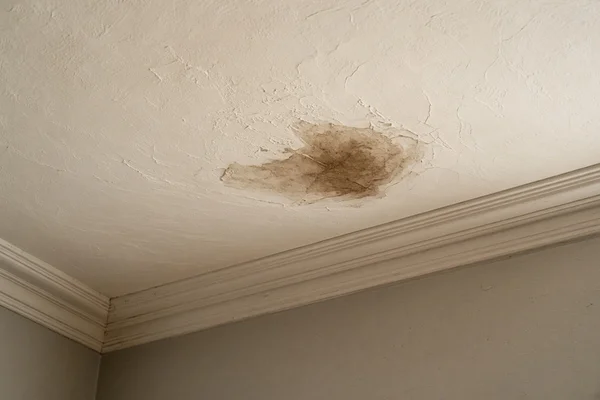
A water stain on the ceiling is the brown or yellow mark left after water soaks into drywall or plaster and dries. The edge is darker because evaporation pulls water, and the dirt and minerals it carries, out to the rim of the wet patch. A ring proves water got there. It doesn’t prove the leak is still active.
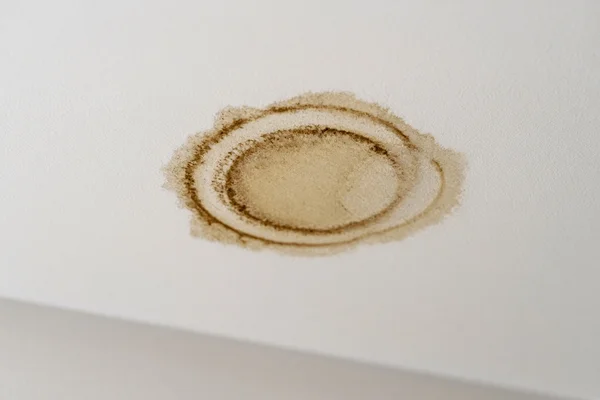
What Do Water Stains on the Ceiling Tell You?
They tell you water got through, about where it ended up, and whether it’s still coming. They can’t pin down where it got in, because water follows a rafter and can show up as a faint ring rooms away from the entry point.
In 1997, University of Chicago scientists explained in the journal Nature why a dried coffee drop leaves a ring: the edge of the drop stays pinned in place, and evaporation there pulls liquid, and the solids in it, out from the center. A wet ceiling dries the same way. When we trace a leak, the stain’s shape, color and ring count tell us how many times it got wet, how recently, and roughly how much water came in per storm.
To tell an old stain from an active one, touch the edge with a dry hand, unless it’s bulging or near a light. Soft, cool or damp drywall means water reached it recently and may still be coming. Trace the edge in pencil and check it after the next rain or thaw. Growth past the line means an active leak. Black, gray or green spots can mean mold.
A dried stain still counts. It’s a past leak that will reopen, because the entry point is still there and the weather hasn’t found it again yet.
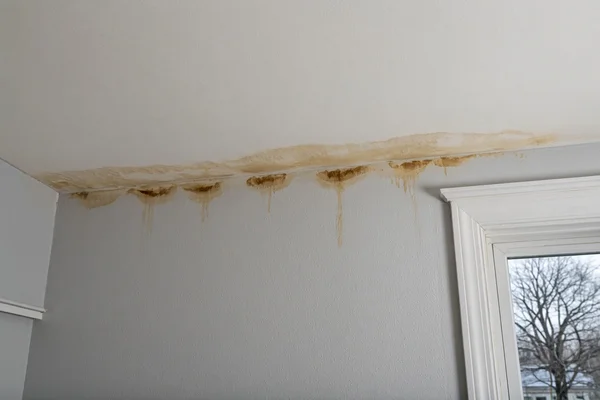
The 2026 Ceiling Stain Decoder for Massachusetts Homes
Where the stain sits and when it shows up narrow the source faster than anything else. Find your match, then call the trade it points to.
- Along an outside wall of a top-floor room, after snow or during a thaw: an ice dam. A roofer handles the leak, and attic air sealing handles the cause.
- Beside the chimney or where a roof meets a wall, in rain and worse with wind: step or counter flashing, which is roofing work.
- In the middle of a top-floor ceiling, often near a bathroom, in steady rain: a cracked or worn pipe boot. Call a roofer.
- Below a skylight when it rains: skylight flashing or a failed seal. A roofer checks both.
- Small spots near a bath fan, a light or the attic hatch on cold, dry mornings: attic condensation from warm, moist house air. That’s attic air sealing and venting work.
- Under a bathroom, kitchen or laundry when water runs upstairs, rain or not: a supply line, drain, toilet seal or shower pan. Call a plumber.
- Near an AC vent or air handler in summer, with the AC running: a clogged condensate line or drain pan, a job for an HVAC tech.
Treat the location as a starting point. Tracks along the rafters and sheathing point uphill toward the entry, often feet from the ceiling mark. Chimneys, walls, skylights and vent boots uphill of that path get checked first, because they cause most leaks. Our breakdown of roof leak causes covers each one.
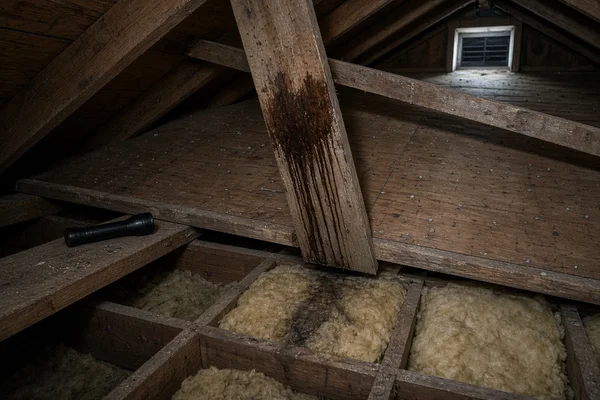
How to Tell a Roof Leak From Plumbing, AC or Condensation
A stain that shows up after rain or snowmelt on a top-floor ceiling is probably the roof. One that shows up in dry weather points to plumbing, the AC or the attic.
Under a bathroom, run the upstairs shower and watch the stain. If it darkens, check the drain, the toilet seal and the shower pan. For supply lines, the EPA’s WaterSense program gives a 2-hour test: check your water meter before and after 2 hours with no water running. If it changes at all, you probably have a leak.
When it isn’t raining, the 2 usual suspects in Massachusetts are ice dams and condensation. Poor attic ventilation lets warm indoor air condense on cold sheathing and drip like a leak, and a bath fan that ends under the roof instead of outside puts warm, wet air right against that sheathing. From the living room, condensation and a roof leak look identical. New shingles won’t fix condensation. Our post on attic ventilation covers what does.
If you can get into the attic safely during a rain, follow the wet wood uphill with a flashlight, as our guide to finding a roof leak shows.
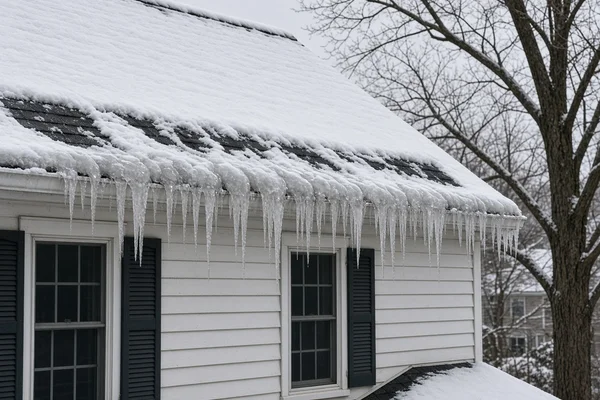
Why Do Ceiling Stains Show Up Along Outside Walls in Winter?
Ice dams are the usual cause. Heat from the house melts snow on the upper roof, the water refreezes at the cold eave, and the meltwater behind that ice backs up under the shingles.
University of Minnesota Extension explains where that meltwater goes. It finds openings in the roof covering and flows into the attic. From there, it can “flow into exterior walls or through the ceiling insulation and stain the ceiling finish.” That’s why these stains line up along the outside walls of top-floor rooms. In the attic, damaged drip edge and stained sheathing at the eaves give away winter meltwater paths that only leak in February.
Once the snow melts, the stain stops growing, but the cause is still there. Extension advises against repairing interior damage until ceilings and walls are dry, and says to fix the heat loss behind the dam at the same time, or the damage will happen again.
Every shingle roof we install gets GAF WeatherWatch ice and water leak barrier at the eaves, which Massachusetts code requires. Stopping the dam itself is attic work, covered in our ice dam guide.
Does a Water Stain on the Ceiling Mean You Need a New Roof?
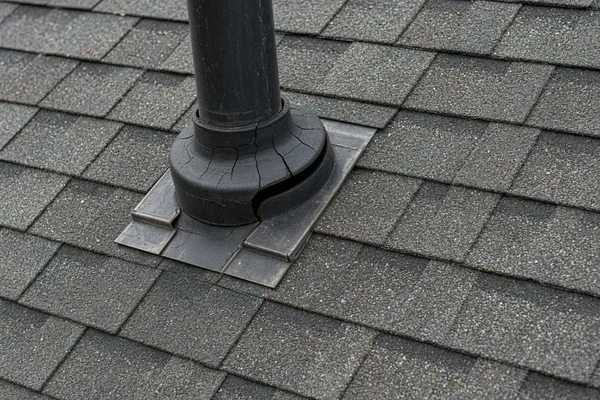
Usually not. Leaks tend to come from small failures, like flashing at chimneys and walls, cracked vent boots, lifted or missing shingles and ice dam paths at the eaves, not from the roof wearing out as a whole.
The Department of Energy’s Building America Solution Center calls each roof penetration “a weak spot in the roof’s armor where water could leak into the building.” Vents, chimneys and skylights each get their own boot or flashing, so each can be fixed on its own. A worn pipe boot is one of the most common and least expensive repairs we do, and most single-source repairs are finished in 1 visit once the materials are matched.
We don’t sell fear. If a repair solves it, we tell you that, even when a full replacement would pay us more. A new roof makes sense when the damage is widespread, the roof is near the end of its life, or it’s been patched more than once. If the trace shows the roof is at the end of its life, we show you the photos and quote both paths. Our repair or replace guide covers the signs.
What to Do in the First 48 Hours
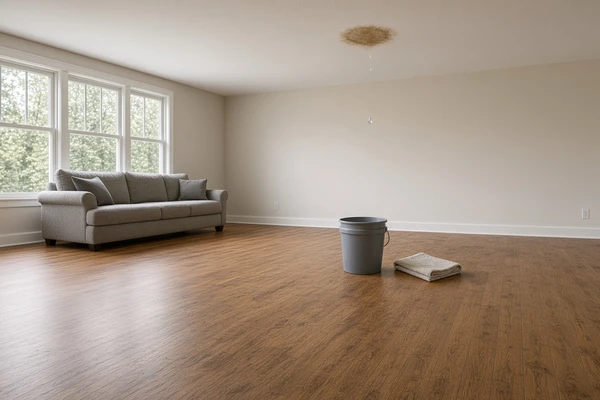
Make it safe, catch the water, take photos and start drying. The EPA says that in most cases mold won’t grow if you dry wet materials within 24 to 48 hours of a leak.
- Keep away from water near a light, an outlet or the panel. If anything electrical is wet or near water, the CDC says to turn off power at the main breaker, but not to step into standing water to reach it. Call an electrician instead.
- Put a bucket under the drip and move furniture and electronics.
- If water pools in a paint or drywall bubble on a smooth ceiling, pierce the lowest point with a screwdriver over a bucket. Skip this near a light fixture, on sagging plaster, or on a textured ceiling in a pre-1978 home.
- Photograph everything before you clean up.
- Stay off the roof, especially in wind, rain or ice. There’s no safe way to work on a wet roof without fall protection.
Our emergency roof repair guide covers the rest.
Older Ceilings Need More Care: Plaster, Lead and Asbestos
If your house was built before 1978, test before you scrape, sand or cut out a stained ceiling. Wet plaster, lead paint and asbestos texture turn a paint job into a safety job.
Massachusetts housing is old. The typical owner-occupied home here is 59 years old, against 42 nationally, according to NAHB’s analysis of 2024 Census Bureau data. Only New York’s homes are older.
Plaster and lath
Older ceilings are often plaster over thin wood strips called lath, held on by plaster “keys” pushed through the gaps. The National Park Service’s guide to historic plaster lists leaking roofs as a cause of ceiling damage. When the keys break and the plaster isn’t repaired, it warns, “gravity will simply cause chunks of plaster to fall to the floor.”
If a plaster ceiling sags, bows or cracks around the stain, keep people out from under it and call a pro. Fix the leak first, too: the same guide says repairs made to a wet base fail again.
Lead paint
Homes built before 1978 are more likely to have lead-based paint, the EPA says, and painted surfaces that peel, chip or crack become a hazard. Repair work that disturbs them may create large amounts of lead dust. In Massachusetts, hired work that disturbs more than 6 square feet of painted surface per room in pre-1978 housing needs a licensed lead-safe renovation contractor.
Asbestos in textured ceilings
The Consumer Product Safety Commission says asbestos may be present in textured paint and in patching compounds used on wall and ceiling joints, and that their use was banned in 1977. Sanding, scraping or drilling them may release fibers, and so can sprayed-on ceiling material that’s water-damaged.
If a textured ceiling in a pre-1978 home is holding water, don’t poke it. Keep people out of the room, catch what drips and call. Scraping, sanding and cutting out the stain can wait for a test.
Can You Paint Over a Water Stain on the Ceiling?
Yes, once 3 things are true: the leak is fixed, the ceiling is dry and firm, and there’s no mold. Then put a stain-blocking primer under the ceiling paint.
Give the repair 1 hard rain, or 1 thaw if it was an ice dam, before you paint. If the stain stays inside your pencil line, you’re clear.
Mold changes the job. Don’t paint or caulk moldy surfaces, the EPA says, because paint over mold is likely to peel, and porous materials like ceiling tiles may have to be thrown away. In most cases, the agency says, a homeowner can clean up a patch under about 10 square feet.
Skip the bleach scrub some DIY guides recommend. EPA remediation guidance says chlorine bleach isn’t recommended as a routine practice, though a professional may call for it, and it should never be mixed with ammonia cleaners. A dry ring with no mold can go straight to primer.
Plain ceiling paint tends to let the ring bleed through. KILZ, for one, lists water damage among the stains its Restoration primer blocks, on surfaces that are clean and free of mold and mildew.
What We Check When You Call About a Ceiling Stain
We follow the trail from inside the house, through the attic and up onto the roof, and we photograph the source before and after the repair.
Every finding is photographed and explained in plain English, and the inspection ends in a written verdict: what needs attention now, what can wait and what is fine. Repairs are priced line by line, and every estimate is free and itemized. If water is coming in, call (617) 631-5435 any hour. Active leaks get same-day tarping whenever conditions allow, and emergency visits are quoted before anyone climbs a ladder.
If you’ve got water stains on the ceiling, note when they showed up, trace the edges in pencil and take photos. Then book a leak inspection this week rather than next month. We work across Quincy and the South Shore from 100 Hancock St, and you’ll see what we see.
FAQs
Is a water stain on the ceiling an emergency?
It is if water is dripping, spreading or near a light or outlet, because each hour adds damage. If wiring is wet or near water, the CDC says to turn off power at the main breaker, but not to step into standing water to reach it. A dried stain from a past storm is urgent but not an emergency. Dry anything still wet within 24 to 48 hours; the EPA says that in most cases, mold won’t grow if you do.
Why is there a water stain on my ceiling when it hasn’t rained?
Look at plumbing, the AC and the attic. A stain under a bathroom points to a drain, a toilet seal or a supply line. For supply lines, the EPA’s WaterSense program suggests checking your water meter before and after 2 hours with no water running; if it moves at all, you probably have a leak. In winter, an ice dam or attic condensation can drip on a sunny day after a snowfall.
Will a water stain on the ceiling come back after I paint it?
It will if the leak isn’t fixed, the ceiling wasn’t dry, or plain paint went on without a stain-blocking primer. Mold makes it worse, since the EPA says paint applied over moldy surfaces is likely to peel. Wait through 1 hard rain after the repair, then prime and paint.
Does homeowners insurance cover a water-stained ceiling?
It depends on the cause. The Massachusetts Division of Insurance says damage inside and outside a home from ice dams or the weight of ice and snow is generally covered, but only the area damaged in the loss, and further damage from wear and tear or neglect is not. We document the cause with photos when we trace the leak, which gives you what you need if a claim applies.
Is it safe to scrape a water-stained ceiling in an old house?
Not until it’s tested, if the house was built before 1978. The EPA says pre-1978 homes are more likely to have lead paint, and the CPSC says asbestos may be in textured paint and patching compounds, whose use was banned in 1977. In Massachusetts, hired work that disturbs more than 6 square feet of painted surface per room in pre-1978 housing requires a licensed lead-safe renovation contractor.