A pipe boot is the seal where a plumbing vent pipe passes through your roof, and on most Massachusetts homes it’s the first part of the roof to fail. Not the shingles. The boot.
Here’s what nobody tells you at the estimate. The biggest pipe boot problem we find isn’t cheap rubber. It’s that the boot never got replaced at all. A crew tears the shingles off, works around the vent pipe, slides new shingles up to the old boot, and leaves a fifteen year old part sitting in the middle of a brand new roof.
Reused pipe boots are one of the most common things Powersol Roofing finds when an old roof comes off a Massachusetts home.
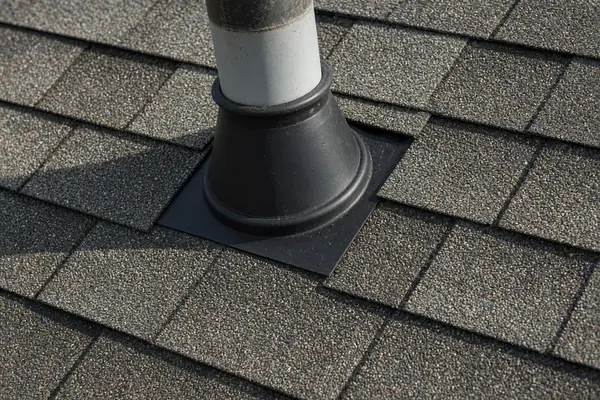
What Is A Pipe Boot On A Roof?
A pipe boot seals the hole your plumbing vent makes when it passes through the roof deck and the shingles.
A pipe boot is a flashing assembly that seals the gap where a plumbing vent pipe passes through a roof. It has a metal base flashing that lies under and over the surrounding shingles, plus a collar that wraps the pipe. Most use a rubber or silicone collar, which is the part that fails first.
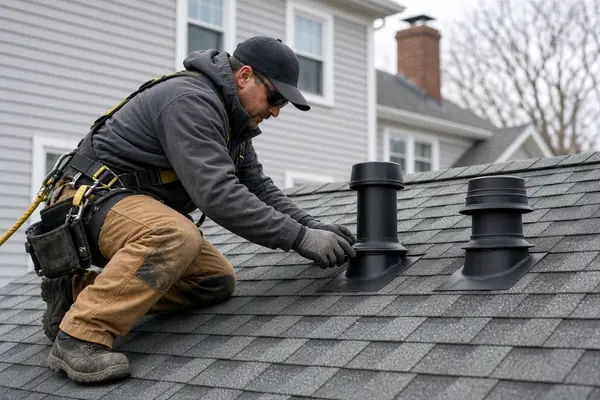
Your house has two to four of them, usually. One over the main soil stack, one over a bathroom group, sometimes one for a kitchen vent. You can spot them from the driveway. They’re the short pipes sticking up out of the shingles with a black collar around the base.
Most homeowners have never heard the term. People call and say “there’s a stain on my bathroom ceiling” or “water’s coming in near the vent.” They don’t say pipe boot. That’s fine. Knowing the difference is our job, not theirs.
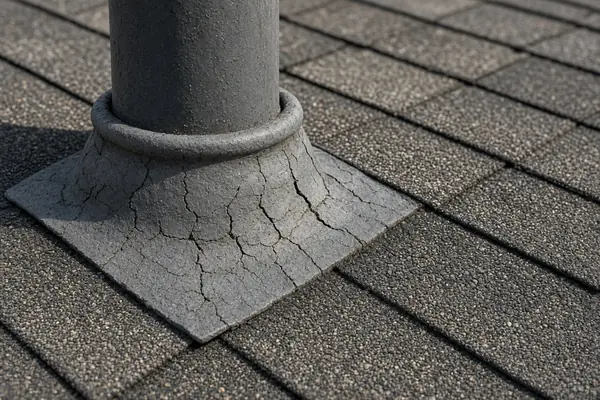
Why The Rubber Fails Before The Shingles Do
The collar sits in direct sun with nothing over it, so it ages faster than every other part of the roof.
Think about what that piece of rubber does. It sits on top of the shingles, exposed on all sides, and it has to stay flexible while the pipe underneath it moves with the temperature. Shingles get shade from each other and they’re built to take UV. The collar gets nothing.
So you end up with a part rated for a decade sitting on a roof rated for three to five. That mismatch is the whole problem, and it’s why a roof can be leaking at fourteen years old with shingles that still look almost new.
If you’ve got a ceiling stain and no idea where it’s coming from, the vent stack is where we look first. Our walkthrough on how to find a roof leak covers the rest of the suspects.
How Many Times Does A Pipe Boot Freeze And Thaw In Massachusetts?
About 68 times a year in Boston, based on NOAA’s own numbers.
Most roofing articles wave at freeze-thaw without a source. Here’s the actual math. NOAA’s 1991 to 2020 climate normals for Boston show a minimum temperature at or below 32 degrees on 91.6 days a year, and a maximum at or below 32 degrees on 23.2 days a year. Subtract the days that never get above freezing and you’re left with about 68 days a year where that collar freezes and then thaws.
Run that out:
- A boot that lasts 15 years goes through roughly 1,000 freeze-thaw cycles
- A 50 year roof sees about 3,400
Every one of those cycles works the rubber a little. Water that got into a hairline crack expands when it freezes and opens the crack a little wider. That’s the mechanism. It’s not dramatic, it just never stops.
This is also why waiting on a small leak costs more here than it does in Georgia. A leak can’t wait for spring in Massachusetts.
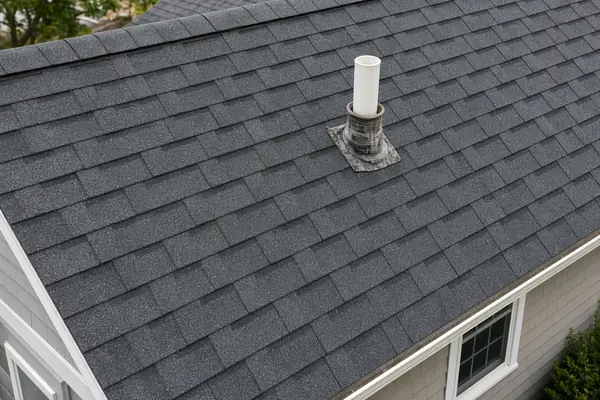
Do Pipe Boots Have To Be Replaced When The Roof Is Replaced?
Yes, and this is where a lot of Massachusetts roofs go wrong.
There’s no line in the code that says “replace the pipe boot.” What the code says is that the flashing has to go on the way the shingle manufacturer printed it. Section R905.2.8.4 of the 2021 International Residential Code reads:
“Flashing against a vertical front wall, as well as soil stack, vent pipe and chimney flashing, shall be applied in accordance with the asphalt shingle manufacturer’s printed instructions.”
Massachusetts runs on those 2021 codes. The tenth edition of the state building code took effect October 11, 2024, and since the concurrency period ended on June 30, 2025 it’s been the only building code in effect here.
So what do the printed instructions say? For a GAF roof, the install sheet for the Master Flow Pivot pipe boot calls for a minimum 24 inch by 24 inch square of leak barrier, centered over the pipe with an X-cut through it, laid down before the boot goes on. Two feet by two feet of peel-and-stick membrane, on the deck, under the flashing. The same sheet limits that boot to roof slopes between 3:12 and 12:12, and to pipes standing 6 to 15 inches above the deck.
Now picture a crew reusing the old boot. They can’t get that square in. The boot never came off the pipe. So a reused boot can’t meet the printed instruction that the code points at, no matter how good the rubber looks.
That’s the part a homeowner should walk away with. Before you argue about which boot is better, ask whether the boot is new and what went under it.
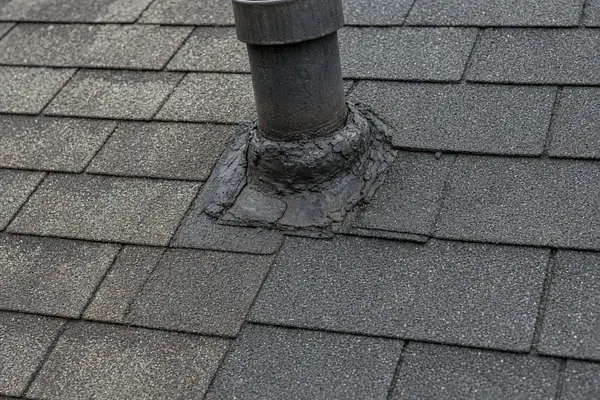
What A Reused Boot Looks Like After The Fact
From the ground it looks like a finished roof. That’s the problem.
On a roof inspection of a home that had work done a few years back, the tell is usually the shingle line. New shingles butted up against an old boot leave a seam that doesn’t sit flat, and the base flashing is a different color and weathering than everything around it. Sometimes there’s caulk smeared around the pipe to buy time.
The way we put it on almost every consult: a roof is not just shingles, it’s a system. The shingle is what you see, but the deck, underlayment, flashing, ventilation, drip edge, pipe boots, nails, and cleanup are what make the job last.
The homeowner paid for a new roof. What’s over the bathroom is a fifteen year old part with a new shingle butted up against it. And a boot leak that runs a season doesn’t stop at the boot. It’s insulation, then drywall, sometimes framing, sometimes mold work.
How To Spot A Failing Pipe Boot From The Ground
You don’t need to get on the roof. Binoculars or the zoom on your phone will tell you most of it.
Look for:
- Cracks or splits in the collar, or chunks missing from it
- Rubber gone gray, dry, or chalky instead of black
- Rust streaks running down the shingles from the metal base
- A gap or daylight between the collar and the pipe
- Shingles lifted or unsealed on the downhill side of the boot
- Caulk, tar, or a slip-on collar over the original, which means somebody already patched it
From inside, check the attic on a bright day and look for daylight around the pipe, or feel the sheathing near it after a rain. A ceiling stain in a bathroom or kitchen that lines up with a vent stack is worth a call, and it sits near the top of the causes of roof leaks we see across Massachusetts.
Not every one of these means a full replacement. Sometimes it’s one boot. Our post on a partial roof repair covers when a patch actually makes sense and when it wastes money. If you’re weighing repair against replacement, we walk through that call without the fear pitch.
Pipe Boot Types And What Each One Actually Comes With
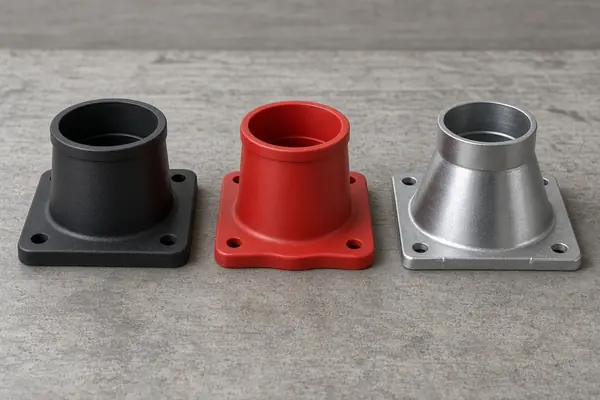
There are three real choices, and the spec sheets tell you more than the sales pitch does.
| Standard Stepped Boot | Silicone “Lifetime” Boot | All-Metal Boot | |
|---|---|---|---|
| Example | Gibraltar 56001 | Lifetime Tool Ultimate Pipe Flashing | GAF Master Flow Pivot |
| Collar | Elastomer collar, heat tested to 180 degrees | 100 percent pure silicone, 3/16 inch nominal wall | None. “No exposed seals, gaskets, collars or caulking” |
| Base | Galvanized steel | 24 gauge galvanized steel per ASTM A653-09, Kynar PVDF finish | All-metal exterior |
| Pipe sizes | Adjustable, 1-1/4 inch to 4 inch | 1-1/4, 1-1/2, 2, 3 and 4 inch | 1.5, 2, 3 and 4 inch |
| Manufacturer warranty | None listed on the retail spec | “For the life of the roof,” labor excluded | Up to 50 years, or as long as the warranty on the adjacent roof cladding |
Three things in that table are worth saying out loud.
First, the stepped boot is not as limited as it gets made out to be. Some contractor pages claim the Gibraltar 56001 only fits up to 2 inch pipe. The manufacturer’s own retail listing says the adjustable collar fits penetrations from 1-1/4 inch to 4 inch. Argue against the part on its lifespan, not on made up specs.
Second, “lifetime warranty” isn’t what most people hear. Lifetime Tool’s published warranty runs for the life of the roof, not your life, and it states that removing the defective part and the associated labor and materials are the purchaser’s responsibility. The part gets replaced. The labor to open the roof back up doesn’t.
Third, the all-metal option removes the argument instead of upgrading it. If there’s no gasket, there’s nothing sitting in the sun to crack. Older Massachusetts homes often have lead flashing at the stack for the same reason, formed over the pipe with no rubber involved at all.
Four Questions To Ask Before You Sign A Roofing Contract In 2026
Ask these four and you’ll learn more about a bid than any brochure will tell you.
1. Are The Pipe Boots New, And Is That Written Into The Scope?
Not “we’ll take care of the boots.” Written. A good answer names the count. A bad answer moves on quickly.
2. What Goes Under The Boot?
You’re listening for leak barrier or ice-and-water membrane on the deck at the penetration. For a GAF system that’s a 24 inch by 24 inch square minimum. If the answer is “we seal around it,” that’s caulk, and caulk is a repair, not an install.
3. What Boot Are You Installing, And Can I See The Manufacturer’s Warranty Document?
The document, not the word. Ten minutes of reading tells you whether it’s five years or fifty.
4. Does That Warranty Cover The Labor To Fix It?
Usually not. Worth knowing before the second trip is on you.
Those four fit into the bigger list of questions to ask a roofing contractor, and they’re the same things we walk through on our Massachusetts roof inspections before writing a scope.
New pipe boots go on every roof we replace. They sit in the sequence with the drip edge, the leak barrier, the underlayment, the starter, the flashing and the ridge vent, and they’re on the written scope you get before anything comes off the house. If you want somebody to actually look at your penetrations and tell you the truth about them, that’s a free inspection with no pressure attached to it.
Pipe Boot Questions We Get On Massachusetts Roofs
How Long Do Pipe Boots Last In Massachusetts?
Most rubber collars give out somewhere in the 10 to 15 year range, which is a third to half of what the shingles above them are rated for. Boston sees about 68 freeze-thaw days a year based on NOAA’s 1991 to 2020 normals, so a 15 year boot here has been worked about 1,000 times before it fails.
Do Pipe Boots Have To Be Replaced When The Roof Is Replaced?
They should be. Section R905.2.8.4 of the 2021 IRC, which Massachusetts adopted in the tenth edition of the state building code, requires vent pipe flashing to be applied per the shingle manufacturer’s printed instructions. GAF’s instructions call for a 24 inch by 24 inch leak barrier square under the boot, and you cannot install that under a boot you never removed.
Can You Replace A Pipe Boot Without Replacing The Whole Roof?
Yes. A single boot is a standard repair. The boot comes off, the shingles around it get lifted, new leak barrier and a new boot go in, and the shingles get reset. It’s the caulk-and-hope version you want to avoid.
What Does A Failing Pipe Boot Look Like?
Cracked or split rubber, a collar gone gray and chalky instead of black, rust streaks below the metal base, or a visible gap between the collar and the pipe. A ceiling stain under a vent stack is the indoor version of the same thing.
Is A Lifetime Pipe Boot Worth The Upgrade?
It’s the second question, not the first. A silicone boot outlasts a standard one, but the warranty usually covers the part and not the labor to install the replacement. Confirm the boot is new and that leak barrier went under it before you spend anything on the upgrade.
Does The Building Code Require A Specific Pipe Boot?
No. The 2021 IRC points to the shingle manufacturer’s printed instructions rather than naming a product, which is exactly why the cheapest pipe boot in the truck passes inspection. The real standard lives in the manufacturer’s install sheet.