The fastest way to spot the wrong roofer isn’t the question you ask. It’s the answer you get. Ask any Massachusetts contractor whether they’re insured and they’ll say yes. The ones worth hiring hand you the certificate before you finish the sentence.
The right questions to ask a roofing contractor cover five things: license and insurance, the full scope of work, the exact materials and warranty, the payment terms, and who actually shows up to do the job. Good answers come with proof. Photos, certificates, and a written scope, not just a number at the bottom of a page.
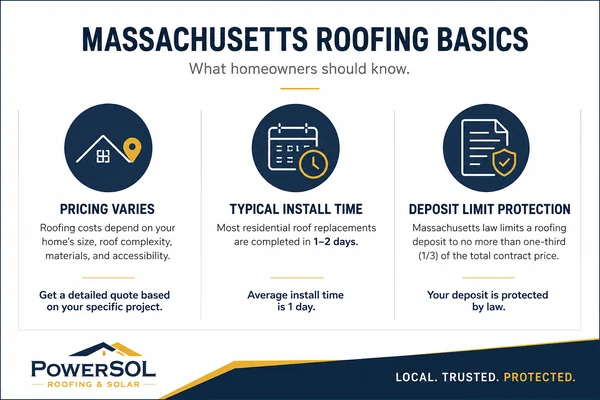
One thing most homeowners don’t know before they sign: Massachusetts caps your roofing deposit at one-third of the contract price. So a contractor who wants half up front is already stepping around a rule you’re both supposed to follow. What follows is the list I’d hand my own family before signing off on a new roof installation that has to last thirty years. Fifteen questions, and for each one, what a straight answer sounds like and what should make you slow down.
Why the Cheapest Roofing Quote Usually Costs the Most
The lowest number on the page is rarely the cheapest roof. It’s the quote with the most left out. A roof replacement in Massachusetts often runs under $10,000 on a smaller, simple home, and $15,000 to $20,000 or more on a bigger or steeper one. What moves the price is real work: roof size, pitch, how many old layers come off, rotted decking, chimney and skylight flashing, ventilation, and how hard the house is to get around. Most standard replacements install in one to two days once materials land and the weather holds. Our average is about a day. At Powersol Roofing, we put the full scope in writing so you’re comparing the same work across every bid.
So when one bid comes in thousands under the rest, it isn’t magic. Someone skipped the tear-off, reused old flashing, or left the decking line blank. If you’re already seeing water stains or curling shingles, you’re likely past the point of a small roof repair, and the gap between two quotes is usually the gap in what they plan to actually do. The fifteen questions below exist to find out which quote is which.
The 15 Questions To Ask A Roofing Contractor In Massachusetts
1. Are you registered to do this roof in Massachusetts, and licensed if it turns structural?
Every contractor doing residential roofing on a Massachusetts home has to hold a Home Improvement Contractor (HIC) registration. The moment the work turns structural, like replacing rotted sheathing or a rafter, the state also calls for a Construction Supervisor License (CSL). A good roofer knows the difference and shows you both without flinching. Walk away from anyone who tells you licensing ‘doesn’t really matter for roofs.’
2. Are you insured, and will you show me the certificates first?
You want two kinds. General liability covers damage to your home. Workers comp covers the crew while they’re on your roof. A real contractor emails both certificates the same day you ask. If a worker gets hurt on a ladder and there’s no workers comp behind them, that bill can land on your homeowners policy.
3. Will you get on the roof and in the attic, then show me photos?
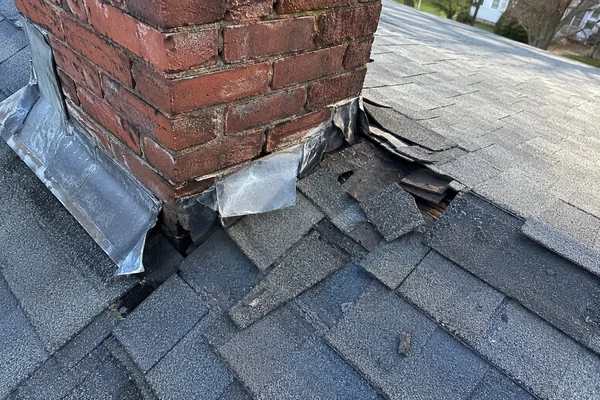
A quote written from the driveway isn’t an inspection. A real roof inspection checks the deck, attic, flashing, chimney, valleys, and every pipe penetration, plus any storm damage from the last few seasons. From the ground, a roof can look perfect while the flashing quietly leaks. Photos are how you tell a real inspection from a guess.
4. Are you tearing off to the deck, or going over the old shingles?
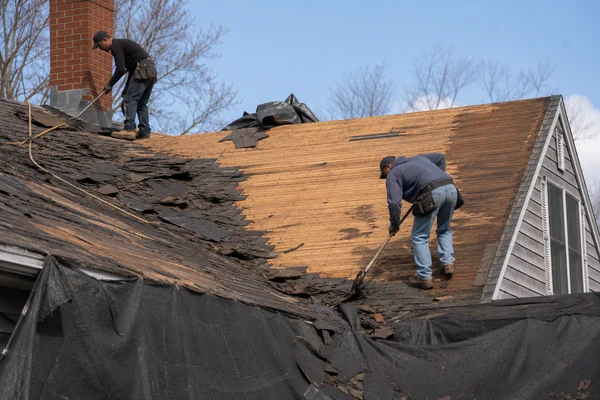
Most homeowners never think to ask this, and it changes the whole job. Laying new shingles over an old layer is cheaper and faster. It also hides rotten wood, traps heat, and voids some manufacturer warranties. We tear off to the deck so we can see what we’re building on. A full tear-off costs more today, and it’s most of what a replacement actually gets you over the next few decades. If a quote looks low, ask how many layers they plan to leave up there.
5. What happens if you find rotted decking after the tear-off?
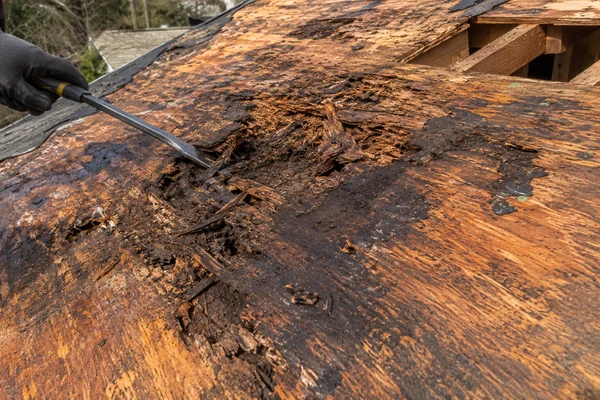
On a lot of older Massachusetts homes, there’s soft, water-damaged wood under the shingles that nobody sees until the old roof is off. The honest way to handle it is a set per-sheet price, written into the estimate and agreed before the job starts. That way a surprise isn’t a surprise. A shrug and a ‘we’ll figure it out later’ is how a fair-looking quote turns into an ugly final bill.
6. Did you actually check the attic ventilation?
Poor ventilation cooks shingles from underneath and can grow mold in the attic. Your contractor should look from inside the attic, not guess from the street, and tell you whether the intake and exhaust are balanced. When ventilation never comes up at all, you’re talking to a crew that installs shingles, not one that builds roofs.
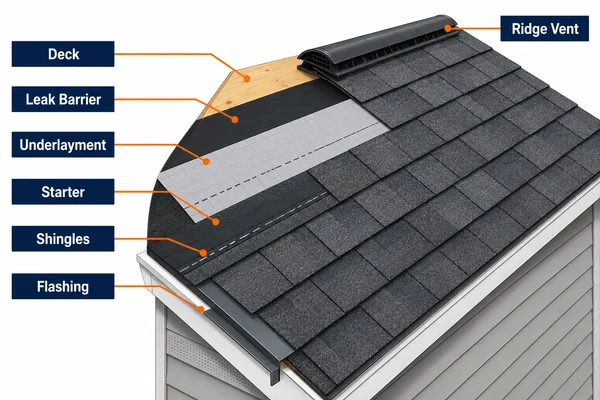
7. What’s the full system you’re installing, part by part?
A roof is a system. The shingle is only the part you can see from the street. Ask them to name every layer, from starter strip and leak barrier to underlayment, flashing, drip edge, pipe boots, ridge vent, and ridge cap. We install a full GAF roofing system, and every one of those pieces has a job. A roofer who can’t name the parts is guessing with your house.
8. Do I need an ice and water barrier, and where does it go?
In New England, almost always. Ice dams push melt-water back up under the shingles at the eaves, and wind-driven rain hunts for valleys and penetrations. Our climate calls for leak barrier in the spots most likely to fail first. A contractor who can explain where it belongs and why understands your roof deck. One who puts the same thing everywhere, or nowhere, does not.
9. What shingle options do I actually get to choose from?
You should always get choices, not one line on a page. Some Massachusetts roofs do better with impact-resistant or reflective shingles, and color changes both the look and how hot the roof runs. We install GAF Timberline HDZ architectural shingles as our standard and walk you through colors and upgrades. If you’re handed a single option with no explanation, ask what else is on the table.
10. Will you put the full scope in writing, and tell me what is not included?
A written estimate should list the work and the exact products, plus anything getting subcontracted out. The line that saves people the most money is the exclusions line. Ask straight out what’s not in the price: tear-off, decking, flashing, cleanup, permits, dump fees. The cheap quote and the fair quote often cover the same work. One just wrote down less so the total looked smaller.
11. What’s the difference between your workmanship warranty and the manufacturer’s, and what certification do you hold?
These are two separate promises. The manufacturer, like GAF, warranties the materials. The contractor warranties the labor, which is the part that fails first when a roof goes on wrong. GAF also certifies contractors in tiers, and only the higher tiers can register the longest material and labor coverage. Ask which tier the contractor holds, then get the warranty length and terms in writing, because the answer depends on it.
12. What deposit do you want, and when is the balance due?
Massachusetts draws a hard line here. Under state law, a home improvement deposit can’t top one-third of the total contract price, unless special-order material costs more than that. Most standard roof jobs need no large deposit, with the balance due once the work is done and you’ve walked it with the crew. A roofer asking for half up front is either ignoring the rule or short on cash. Neither is your problem to fund.
13. Do you offer financing?
Even if you’re paying cash, the answer tells you something. Lenders vet a contractor’s finances before they’ll let them offer financing, so having it is a small sign of a business stable enough to still be around for a warranty call in year six. We offer financing through approved partners. Just don’t let a low monthly payment pull your eyes off what’s actually in the scope.
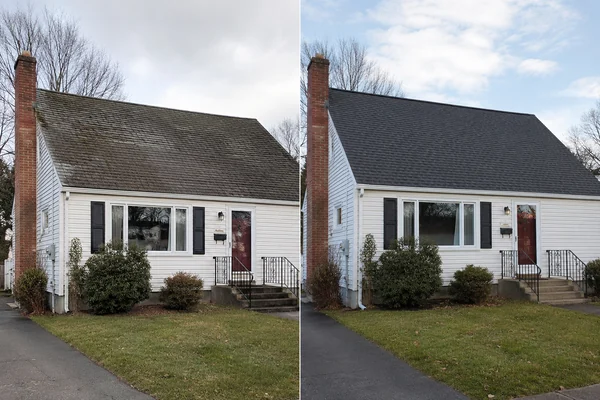
14. Who is on my roof, and who’s my point of contact if something goes wrong?
Some companies sell the job and then hand it to a crew you’ve never met. Ask who’s swinging the hammer, whether they’re in-house or a sub, and who owns the project from first inspection to final walk-through. At Powersol, who’s actually behind the work doesn’t change after you sign. You’re hiring a company that stays responsible, not a salesperson who vanishes.
15. Can you give me local references and recent addresses?
Any established roofer has them and shares them happily. Ask for jobs in your area from the last year, then call one or drive by and look. We’ve completed roof and exterior projects in towns like Taunton, Randolph, and Dorchester, and we keep our photos organized by job so you can see real work, not stock images. Vague references, or none at all, usually mean there’s nothing to show.
Two Things the Questions Won’t Tell You
Fifteen questions will filter out most of the bad options. The conversation handles the rest. First, does the contractor listen? If it’s hard to get a straight answer before you’ve paid a dime, it does not get easier after the contract is signed. Second, are they honest about the schedule? Weather moves roofs around all year in Massachusetts, so you want a real window and steady updates, not a promise no one can keep.
You’re not really buying shingles. You’re buying whoever picks up the phone in year eight when there’s a stain spreading across the ceiling. The roofing contractor who answers all fifteen of these without dodging is usually the same one who answers that call. When you’re ready, get a written estimate from Powersol and set it next to the number you already have. The difference will tell you everything.
What a Complete Roof Scope Includes, and What a Lowball Leaves Out
| Line item | In a complete scope | Often missing from a cheap quote |
|---|---|---|
| Tear-off to the deck | Yes, all old layers removed | ‘Go-over’ on top of old shingles |
| Rotted decking | Set per-sheet price, agreed up front | Blank, then billed as a surprise |
| Ice and water leak barrier | Eaves, valleys, penetrations | Skipped or minimal |
| Synthetic underlayment | Full coverage | Thin felt or partial |
| Flashing | New chimney, wall, and step flashing | Old flashing reused |
| Pipe boots | New | Reused until they crack |
| Ventilation | Checked and balanced | Ignored |
| Cleanup | Magnetic nail sweep, haul-away | Left for you |
| Workmanship warranty | In writing, with the certification tier | Verbal or none |
| License and insurance | HIC, CSL if structural, GL, workers comp | ‘Trust me’ |
Frequently asked questions
What questions should I ask a roofing contractor before hiring?
Ask about license and insurance, whether they tear off to the deck, what happens if they find rotted decking, the full material and warranty scope, and who is actually on your roof. In Massachusetts, also ask about the deposit, since state law caps it at one-third of the contract price. Good answers come with photos, certificates, and a written scope.
How do I know if a roofer is licensed in Massachusetts?
Ask for their Home Improvement Contractor (HIC) registration, which every residential roofer here must carry. If the job involves structural work like replacing sheathing or rafters, the contractor also needs a Construction Supervisor License (CSL). A legitimate roofer will show you both, and you can verify a registration through the state’s Office of Consumer Affairs.
How much does a new roof cost in Massachusetts?
Many Massachusetts asphalt shingle roofs run under $10,000 on smaller, simple homes and $15,000 to $20,000 or more on larger or steeper ones. The biggest factors are roof size, pitch, how many old layers are removed, rotted decking, flashing work, ventilation, and access around the house. Get a written scope so you can compare quotes on the same work.
How long does a roof replacement take?
Most standard roof replacements install in one to two days once materials arrive and the weather holds. The average job runs about a day. Larger, steeper, or more complex roofs take longer, and weather can move the schedule, so ask your contractor for a realistic window rather than a fixed promise.
What is the difference between a workmanship warranty and a manufacturer warranty?
The manufacturer warranty covers the roofing materials if they’re defective. The workmanship warranty covers the contractor’s labor, which is what fails first when a roof is installed wrong. They come from two different parties, and you should know who to call for each. Ask for both in writing, including the contractor’s certification tier, since that affects the coverage length.
How much deposit can a roofing contractor ask for in Massachusetts?
By state law, a home improvement deposit cannot exceed one-third of the total contract price, unless special-order materials cost more than that amount. Most standard roof jobs need no large deposit at all, with the balance due when the work is finished. A contractor demanding half or more up front is a warning sign.
Should I get a repair or a full roof replacement?
It depends on the roof’s age, the extent of the damage, and whether the problem is isolated or widespread. A localized leak on a newer roof is often a repair. Widespread granule loss, multiple leaks, or an aging roof usually points to replacement. Ask for inspection photos so you can see the reason behind the recommendation.