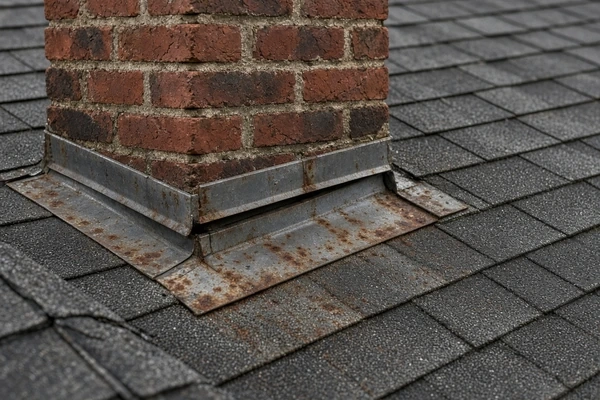
Roof flashing repair replaces or reseals the metal that seals your roof where it meets a chimney, a wall, a valley or a vent. At Powersol Roofing, “water coming in by the chimney” is one of the most common calls we get, and chimney flashing tops our list of where Massachusetts roofs leak most. When someone calls about a leak around the chimney, the flashing is the first thing we pull back, not the shingles. Cement over old flashing is a patch.
What Is Roof Flashing Repair?
Roof flashing repair is the work of fixing the metal that seals the joints where a roof meets a wall, a chimney, a valley or a vent. A small repair can mean resealing flashing at a chimney or vent. A lasting fix puts in new step and counter flashing, integrated into the shingle courses and the masonry.
The code spells out where flashing goes. Section R903.2.1 of the International Residential Code requires flashing “at wall and roof intersections, wherever there is a change in roof slope or direction and around roof openings.” Massachusetts builds its residential code on the 2021 edition, and its amendments leave that section as written. Metal flashing has to be corrosion resistant and at least 0.019 inch thick, the thickness of No. 26 galvanized sheet.
Massachusetts has some of the oldest houses in the country. The median owner-occupied home here is 59 years old, against 42 nationally, tied with Rhode Island for second-oldest, according to the National Association of Home Builders’ analysis of 2024 American Community Survey data. On a lot of the Massachusetts roofs we open up, the old flashing was reused or face-nailed on the last job instead of being woven into the shingles the way it should be.
How Do You Know Your Flashing Is Failing?
Around a chimney, the signs are a chalky white residue on the brick, rust on the flashing or stains on the wall near the fireplace. Flashing pulled away from the chimney and water showing up near it after a storm point the same way.
After chimneys, our list of where Massachusetts roofs leak most runs to skylights, valleys where 2 roof planes meet, and the step flashing along a wall or dormer. Metal flashing separates from masonry as mortar ages and freeze-thaw cycles work the joint open.
Along a wall, the kick-out at the bottom of the run sends roof water away from the wall and usually into the gutter. The Department of Energy’s guidance on kick-out flashing warns that fiber cement, vinyl siding and brick veneer “can mask the evidence for years.”
Inside, the stain may not sit under the bad flashing. Water finds a gap at a lifted piece of flashing, runs down the underside of the deck and drips through the ceiling 3 or 4 feet away. That’s why chimneys, walls, skylights and vent boots uphill of the water path get checked first: they cause most leaks. Our breakdown of what causes roof leaks covers the other suspects.
Reseal or Re-Flash: Picking the Right Fix
A partial repair can be as small as resealing flashing at a chimney or vent. Flashing that was reused, bent flat or replaced with a bead of tar will leak, and it needs new metal.
Cement isn’t the fix for failed metal. Our temporary-fix guide calls asphalt roofing cement the right tool for a gap around flashing, then adds that it “will hold for weeks, sometimes a couple of months, but it’s a patch, not a permanent roof repair.” On a real repair, our rule is metal, not caulk, because caulk is a countdown timer.
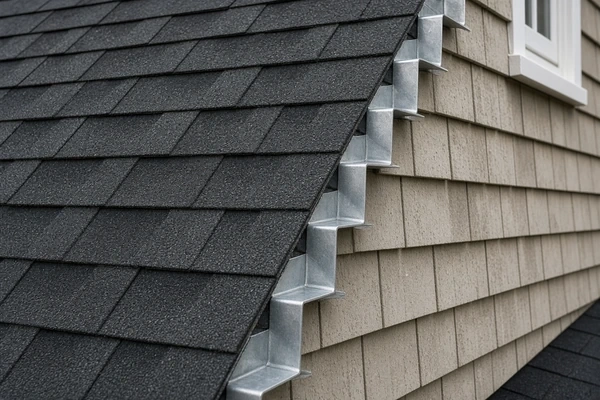
Step flashing is a stack of overlapping metal pieces woven into the shingle courses, so a shingle-only repair misses it. In our words: “Replace the visible shingle, leave the bad flashing, and you’ve spent money to move the leak six inches.”
When shingles do get replaced, matching is the catch. Shingles fade in the sun and shed granules as they age, so a bundle of the “same” color off the shelf comes out lighter and cleaner than the 10-year-old shingles around it. Our guide to partial roof repairs covers the options.
Chimney Flashing Repair: Step, Counter and Cricket
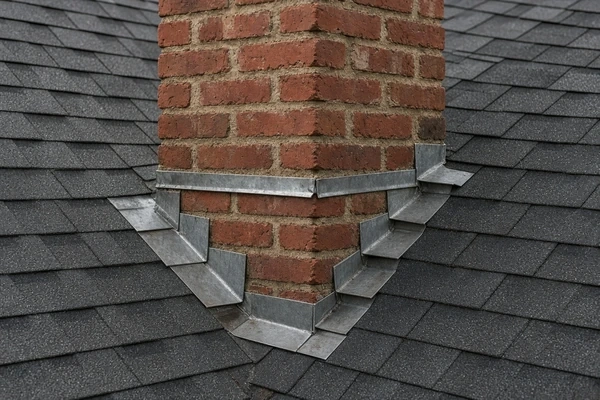
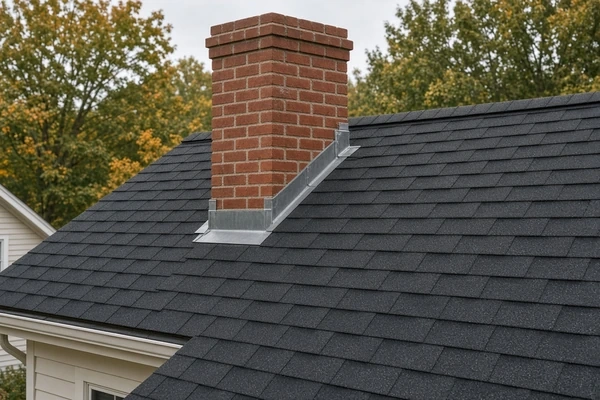
On a chimney, the fix is new step and counter flashing integrated into the courses and the masonry. The counterflashing has to be cut into the mortar and layered over the base flashing.
The Brick Industry Association’s chimney flashing brief sets the overlaps: base flashing at least 4 inches along the roof and 4 inches up the chimney face, with counterflashing lapped over it at least 3 inches. GAF’s instructions add a layer under the metal. The leak barrier goes over the underlayment and at least 5 inches up the sides of the chimney.
A wide chimney needs a small peak called a cricket behind it to split the water. Section R903.2.2 requires one on the ridge side of any chimney more than 30 inches wide, measured across the slope.
Water by the chimney is almost always flashing, and no amount of shingle work touches it. A chimney flashing leak needs new flashing, not a sales pitch.
Walls and Dormers: Why the Siding Comes Off
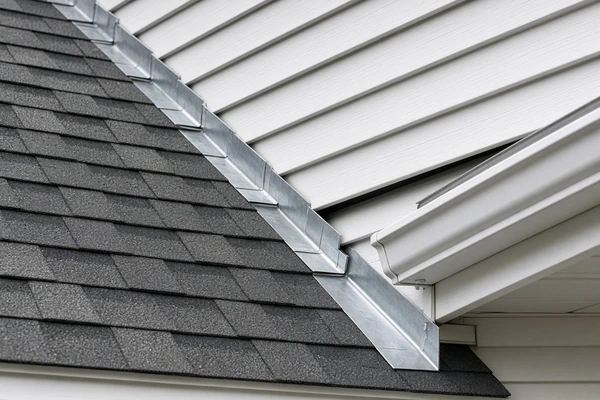
Along a wall, the siding covers the top of the step flashing, so the repair starts at the siding. The Department of Energy’s guidance for existing homes says to remove the siding and any existing flashing to expose at least 8 inches of wall when the flashing is missing, damaged or installed wrong.
For that flashing, the code minimum is 4 inches up the wall and 4 inches across the roof (R905.2.8.3). GAF’s Timberline installation instructions ask for more: 1 piece of step flashing per shingle course, 5 inches up the wall and 5 inches over the shingle, each piece overlapping the one below by 2 inches. GAF’s wall details nail the metal to the deck, not to the wall. The leak barrier runs at least 5 inches up the wall, and the siding sits at least 2 inches above the roof while covering the flashing by at least 2 inches.
At the bottom of the run, section R903.2.1 adds the kick-out: “A flashing shall be installed to divert the water away from where the eave of a sloped roof intersects a vertical sidewall.”
First on our list of what the driveway hides: bad flashing at chimneys and walls, where a past crew caulked over the problem instead of replacing the metal. Our leaky roof repair page lists aging flashing on Wollaston three-deckers as a neighborhood pattern, next to coastal wind-driven rain in Squantum and ice dams in Milton.
Valleys, Vents, Skylights and Roof Edges
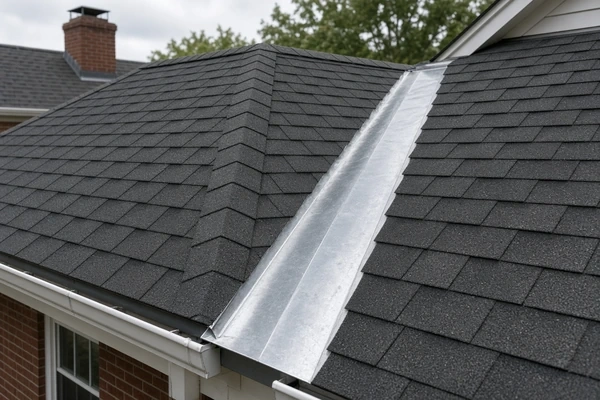
The code’s list covers more than walls and chimneys. Valleys change the roof’s direction, vents and skylights are roof openings, and the edges get drip edge, so all 4 get flashing.
GAF calls for open valley metal at least 20 inches wide and warns not to nail through it: “Nailing through the metal may cause leaking and buckling due to movement.” In a closed-cut valley, GAF keeps nails at least 6 inches from the center line.
Pipe boots seal the plumbing vents, and we cover them in a separate post on reused pipe boots. A leaking skylight often needs the flashing kit redone, not a bead of sealant, and our skylight leak guide walks through it.
At the edges, drip edge is the flashing. It’s required at the eaves and rakes of shingle roofs, with joints lapped at least 2 inches. Each piece reaches at least 1/4 inch below the sheathing and 2 inches back onto the deck, fastened at least every 12 inches.
“Up to Code” Is the Floor in Massachusetts
A flashing job can meet the code and still miss what the shingle maker requires. In Massachusetts, the maker’s printed instructions win when the 2 disagree.
Take the wall flashing above. The code’s minimum is 4 inches by 4 inches, and GAF’s Timberline sheet calls for 5 by 5. The national code already says roof coverings go on according to the manufacturer’s installation instructions. Massachusetts’ amendment to section R905.1 adds a tiebreaker the national text doesn’t have. It reads: “Where there is a discrepancy between the requirements of this section and the manufacturer’s printed instructions or code evaluation report, the manufacturer’s printed instructions or code evaluation report shall govern.”
Re-roofs follow the same idea. Section R908.6 says flashings “shall be reconstructed in accordance with approved manufacturer’s installation instructions.”
So when a roofer says a repair is up to code, ask whose instructions it followed. On a GAF roof, the answer should be GAF’s sheet, and GAF posts it for anyone to read.
The 2026 Flashing Photo Checklist: 7 Things to Look For
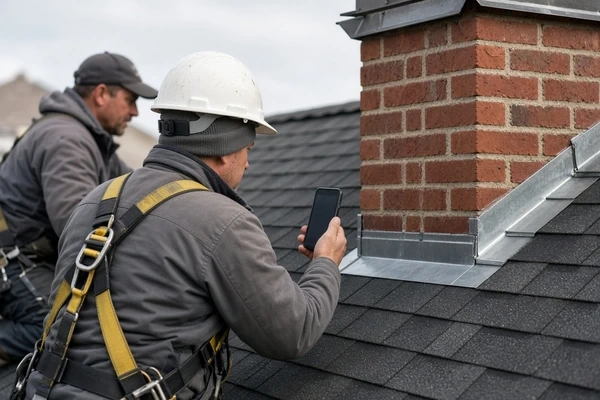
Ask for before and after photos of any flashing repair, then check them for these 7 things. Every repair we do is documented with photos, so you know what you paid for.
- New metal. Flashing that was reused, bent flat or replaced with a bead of tar will leak.
- Step flashing in single pieces, 1 per shingle course, each lapping the piece below by 2 inches.
- Nail heads in the roof deck and none in the wall.
- A kick-out at the bottom of every roof-to-wall run, aimed at the gutter.
- At brick, counterflashing cut into the mortar and lapped over the step flashing by at least 3 inches.
- A cricket behind any chimney wider than 30 inches.
- No exposed bead of cement doing the sealing. GAF limits asphalt plastic cement to a thin layer under 1/8 inch and warns that excess amounts can cause blistering of the shingles.
If a photo shows a smear of cement where metal should be, ask what’s under it.
What Does Flashing Repair Cost in Massachusetts?
The cost depends on what is damaged, where the problem is located and how difficult the area is to access, so I’m not going to post repair prices. A number over the phone is a guess dressed up as a quote.
Flashing repairs vary, and anything involving a chimney climbs from there. What a repair costs is decided by what sits under the shingles, and nobody knows that from the driveway.
What you get from us is the specific repair, priced line by line, with the source photographed before and after. Most single-source repairs, flashing included, take 1 visit once the materials are matched.
Should Flashing Be Replaced With a New Roof?
Yes. Our quote checklist calls for new flashing at chimneys, walls and valleys, not reused old flashing.
The code sets a lower bar. Section R908.5 requires replacing existing flashings “where rusted, damaged or deteriorated.” Reused flashing can also cost you skylight warranty coverage. If a quote calls for new shingles over the old ones, our post on overlay vs. tear-off covers what the Massachusetts code says.
Repairing Flashing Yourself: Where to Stop
A homeowner can seal an exposed nail head with a dab of roof sealant or patch a gap around flashing until a roofer gets there. Chimney and wall flashing is roofer work.
Our DIY roof repair guide lists the stop points: soft decking, ceiling stains, chimney or wall flashing, valleys, and more than 3 or 4 shingles. For a stopgap, the steps to temporarily stop a leak cover the cement patch and the tarp.
If you’re seeing water by the chimney or a stain near a roof-to-wall joint, get the flashing looked at. Our roof repair visits trace the leak back to where water gets in. You see photos of what’s broken before we start and photos of the fix after. A roof flashing repair should leave you with new metal in the right places and the pictures to prove it. If water is coming in right now, we answer 24/7 at (617) 631-5435.
FAQs
Can roof flashing be repaired without replacing the roof?
Yes. Flashing is one of the single-source repairs we complete in 1 visit once materials are matched. A partial repair usually means swapping damaged shingles, resealing flashing at a chimney or vent, or stopping a small leak on 1 slope. We look at replacement when the photos show a system failing, not a spot.
Will roofing cement fix leaking flashing?
Only for a while. Our temporary-fix guide says asphalt roofing cement “will hold for weeks, sometimes a couple of months, but it’s a patch, not a permanent roof repair.” GAF limits asphalt plastic cement to a thin layer under 1/8 inch and warns that excess amounts can blister shingles. A lasting repair replaces the metal.
What is kick-out flashing, and is it required?
Kick-out flashing is the piece at the bottom of a roof section that meets a wall. It directs runoff away from the wall, usually into a gutter. Section R903.2.1 of the residential code requires flashing that diverts water where a roof eave meets a sidewall. The Department of Energy warns that fiber cement, vinyl siding and brick veneer can hide the damage from a missing kick-out for years.
Does every chimney need a cricket?
No. Section R903.2.2 requires a cricket on the ridge side of any chimney more than 30 inches wide, measured across the slope. The cricket is the small peak behind the chimney that splits the water.
Should flashing be replaced during a roof replacement?
Yes. Our quote checklist calls for new flashing at chimneys, walls and valleys, not reused old flashing. Section R908.5 of the code requires replacing existing flashings where they’re rusted, damaged or deteriorated.
How much does roof flashing repair cost in Massachusetts?
We don’t post prices, because what a repair costs is decided by what sits under the shingles. The cost depends on what is damaged, where the problem is located and how difficult the area is to access, and anything involving a chimney climbs from there. You get the specific repair priced line by line, with the source photographed before and after.
Who sets the standard for a roof flashing repair in Massachusetts?
The code sets the minimum, and the shingle maker’s instructions set the rest. The code asks for sidewall flashing at least 4 inches by 4 inches, and GAF’s Timberline instructions call for 5 by 5. Massachusetts’ version of section R905.1 says the manufacturer’s printed instructions govern where they and the code’s roof covering rules disagree.