Massachusetts doesn’t ban roof overlays. The building code names three situations where the old roof has to come off first, and then it points at one more rule that quietly catches most of what’s left.
Powersol Roofing replaces roofs across Massachusetts, from Quincy down through Taunton, Randolph and Brockton, and homeowners ask about roof overlay vs tear off almost every week. It’s usually the same story. Two quotes on the kitchen table, one of them lower because it leaves the old shingles on, and nobody sure whether that’s a smart save or a corner being cut.
So here’s what the code says, what GAF says, and why we still don’t quote overlays in this state.
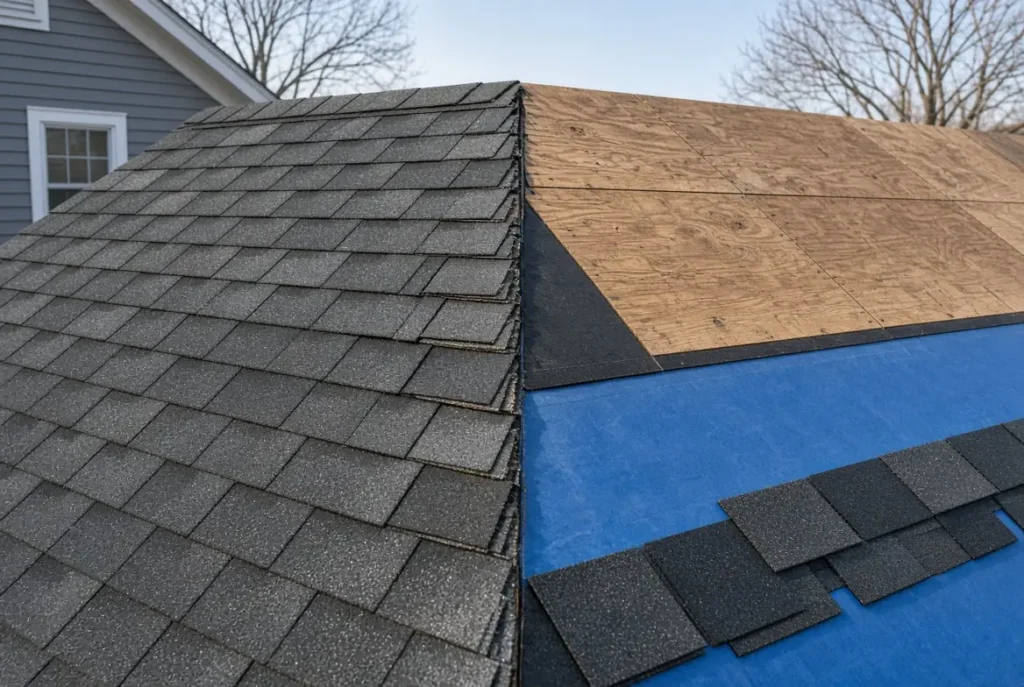
Roof Overlay vs Tear Off: The Plain-English Difference
An overlay leaves your old shingles on the roof. A tear off takes them off.
What Is a Roof Overlay? A roof overlay, called a roof recover in the building code, means installing new shingles directly over the existing shingles without removing them. A tear off, called a roof replacement, means stripping every layer down to the wood deck, repairing what’s underneath, then building the new roof from the deck up.
That’s the whole difference, and it sounds small. It isn’t. Everything below the shingle, the part you’re actually paying for, only gets touched on one of those two jobs.
Roofers use “reroofing” as the umbrella word for both. If somebody uses reroofing to mean one specific thing, ask them which one they mean, because half the industry uses it to mean an overlay and the other half uses it to mean any new roof.
Is a Roof Overlay Legal in Massachusetts in 2026?
Yes, sometimes. The code allows a recover, then fences it with conditions, and the fence is tighter than most homeowners expect.
One detail almost nobody writes about. Massachusetts is on the 10th edition of the state building code. It took effect on 11 October 2024. The older 9th edition stopped being accepted for permits after 30 June 2025. So any roofing advice written before the middle of last year describes a code that no longer applies here.
Massachusetts publishes its own changes to the roofing chapter, and you can read the state’s roof assembly amendments yourself. Six items get changed. The reroofing section, R908, isn’t one of them. Neither is the ice barrier section, R905.1.2.
Translation: on this question, the model code text applies in Massachusetts word for word. No local softening, no state carve-out.
You also need a permit. Section R105.1 of 780 CMR requires a written permit application before any construction, alteration, repair or removal on a one or two family home, and that includes putting a new roof on. The building official checks how many layers you already have as part of reviewing that permit. This is not a rule you get around by not mentioning it.
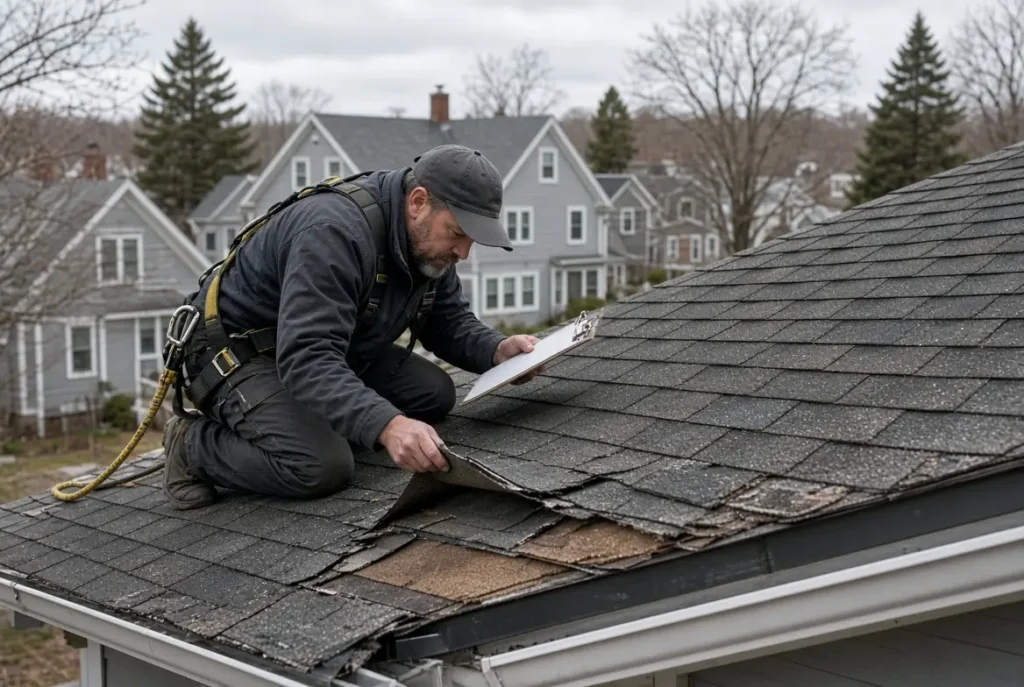
The Three Situations Where the Code Makes You Strip the Roof
Section R908.3.1.1 lists exactly three. If any one of them describes your roof, an overlay is off the table, full stop.
One. The existing roof is water soaked or too far gone to build on. The code’s words: where the roof or covering “is water soaked or has deteriorated to the point that the existing roof or roof covering is not adequate as a base for additional roofing.” If you’ve got active leaks, this is usually you.
Two. The existing covering is slate, clay, cement or asbestos-cement tile. Asphalt shingles don’t go over any of those.
Three. The roof already has two or more layers of any type of roof covering. Not two layers of asphalt. Two layers of anything. This is the one that ends the conversation on a lot of older Massachusetts houses, because somebody already did the overlay in 1998 and nobody told the current owner.
Three situations, one list, and it’s short. Which is why a lot of contractors stop reading there and tell you an overlay is fine.
The Fourth Rule, and It’s the One Nobody Points At
There’s a fourth condition, and it isn’t on that list. It’s sitting in the sentence right before it.
Section R908.3.1 says a recover is allowed “where the new roof covering is installed in accordance with the roof covering manufacturer’s approved instructions.”
Read that again. The code doesn’t describe a compliant overlay itself. It hands the job to whoever made your shingles and makes their instructions enforceable. In Massachusetts, on a GAF roof, GAF’s rules are the code’s rules.
So what does GAF say? GAF’s own answer is that yes, it’s possible to install new shingles on top of existing ones, “but specific conditions must be met.” GAF confirms the two-layer ceiling. GAF says that where shingles are “weathered, warped, or curling, they aren’t suitable to be shingled over.” GAF warns against an overlay when you’re replacing the roof because of extensive leaking.
And GAF recommends tearing off so the leak barrier can be installed properly at the rakes, eaves, valleys, hips and penetrations.
That last one is the whole ballgame in this state. Here’s why.
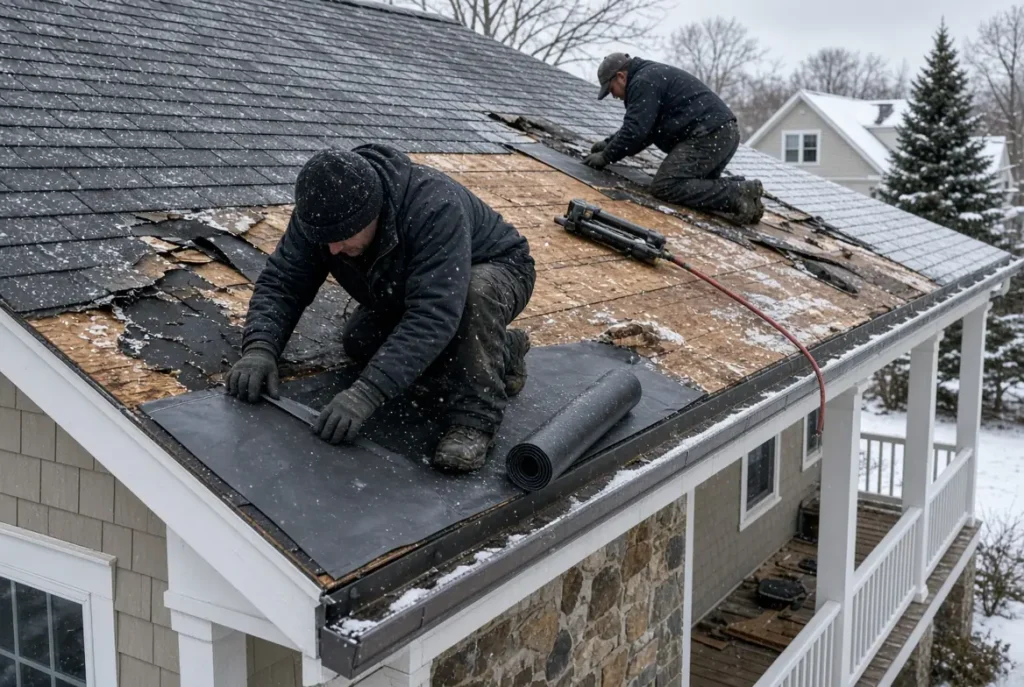
Why an Overlay and a Massachusetts Winter Fight Each Other
An ice barrier bonds to the wood deck. An overlay never exposes the wood deck. Those two facts don’t reconcile.
Massachusetts requires an ice barrier on asphalt shingle roofs in areas with a history of ice forming at the eaves and backing water up under the shingles. Section R905.1.2 says what it has to be: not fewer than two layers of underlayment cemented together, or a self-adhering polymer-modified bitumen sheet. It also says how far it has to reach. That’s the number worth remembering.
It runs from the lowest edge of the roof to a point not less than 24 inches inside the exterior wall line. On a steeper roof, 8:12 or better, it’s not less than 36 inches measured from the eave edge.
Twenty-four inches past the wall. That membrane’s whole job is to sit under the shingles, stuck to the wood, in the exact strip where ice dams push water backward. It’s a peel-and-stick sheet. It goes on the deck or it doesn’t go anywhere.
There’s a tell in the code itself. The roof replacement section, R908.3, includes a specific provision for ice barriers: if the existing roof already has an ice barrier adhered to the deck, that one can stay and get covered with another layer. The code thought carefully about ice barriers during a tear off. It says nothing equivalent for an overlay. That silence isn’t an oversight, it’s the answer.
Meanwhile the state’s own homeowner guidance on ice dams tells people to air seal the attic, insulate the attic floor, and install a waterproof membrane above the areas where water collects. All three of those are tear off work or attic work. None of them happen on an overlay.
So on a Massachusetts house, an overlay hands you a brand new shingle and the same eave detail you already had. If that detail was the problem, and on the roofs we open up it usually is, you just covered it up.
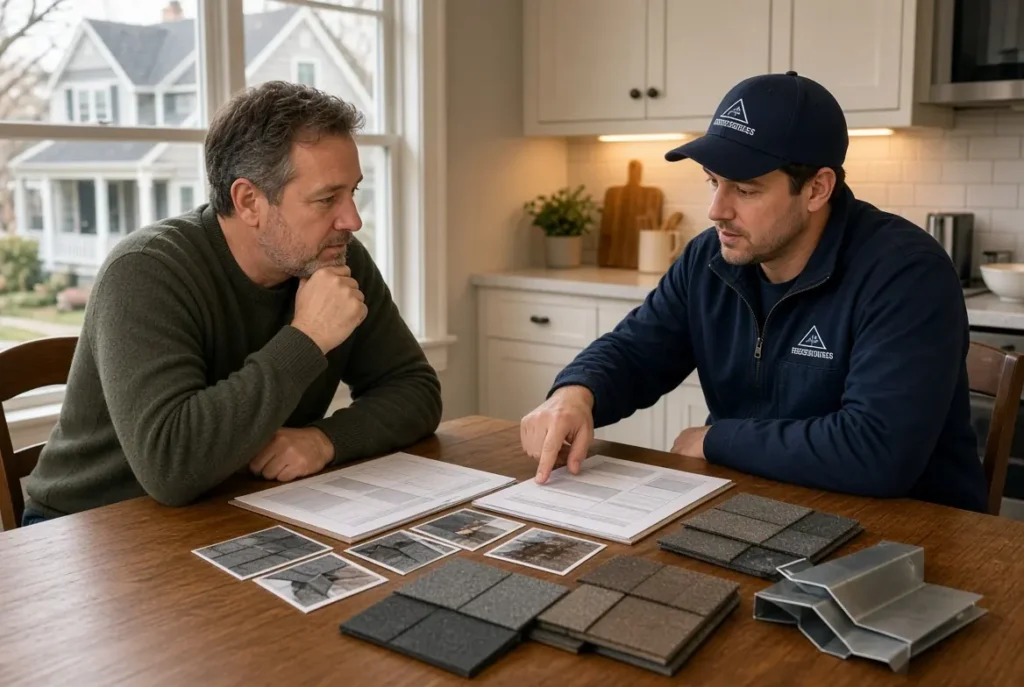
What Are Two Very Different Quotes Actually Telling You?
Usually that they’re two different jobs, not two versions of the same job.
The gap between an overlay quote and a tear off quote isn’t a discount. It’s a scope difference, and the whole difference sits under the shingle where you can’t see it. One quote includes stripping the roof, looking at every square foot of decking, replacing rotted wood, laying a new ice barrier at the eaves, new underlayment, new flashing and new pipe boots. The other includes new shingles.
Here’s what to compare, line by line, before you compare anything else. Are you tearing off to the deck, or leaving the existing layer on? What happens if you find rotted wood after the old roof comes off? What exact shingle and system are you installing, by product name? Where does the ice barrier go, and how far past the wall line? Is the flashing new, or are you reusing what’s there? Are the pipe boots new? What’s the ventilation plan? Who is managing the job, and what is not included?
Homeowners tell us the same thing after the fact: they wish they’d known what was included before they started comparing. A scope on paper answers that. A number on a business card doesn’t.
| Roof Overlay (Recover) | Tear Off (Replacement) | |
|---|---|---|
| Does the old roof come off? | No | Yes, down to the wood deck |
| Can anyone see the deck? | No | Yes, every square foot |
| New ice barrier at the eaves? | No, it bonds to the deck | Yes |
| Underlayment replaced? | No | Yes |
| Allowed if the roof already has two layers? | No | Yes |
| Rotted decking found and fixed? | Only what’s already visible | Yes, before the new roof goes on |
| What GAF’s warranty covers underneath | Not the base you laid over | The new system |
| Time on site | Not something we quote | 1 to 2 days, usually 1 |
What You Give Up When You Skip the Tear Off
You give up six of the parts, and you keep a warranty gap you probably don’t know about.
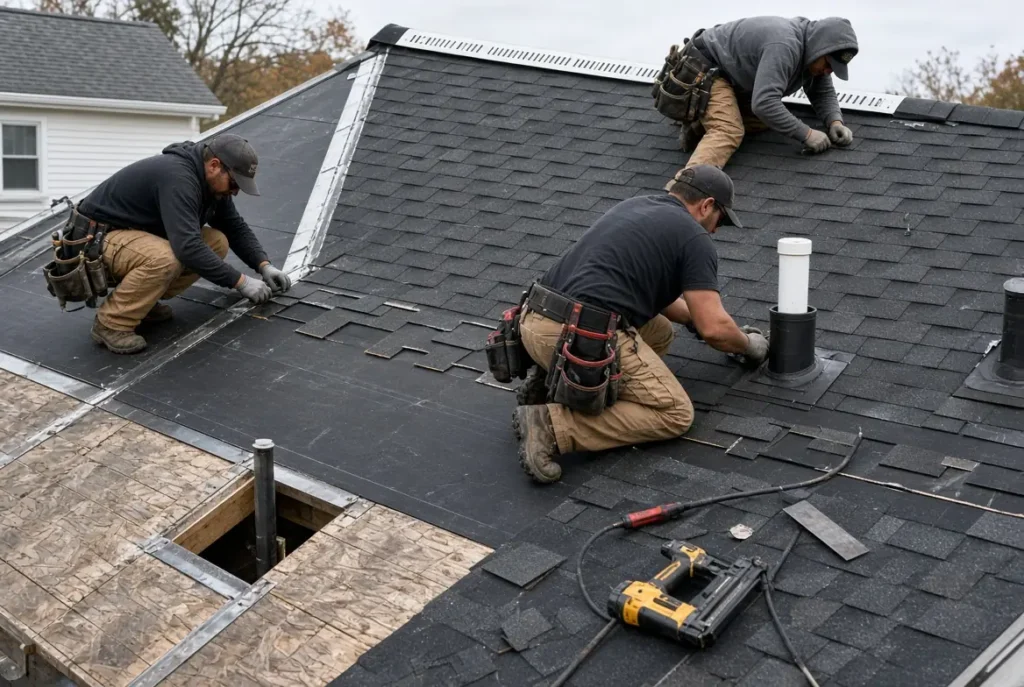
When we do a roof, this is what goes on, in order. GAF WeatherWatch leak barrier at the eaves and valleys. FeltBuster synthetic roof deck protection over the field. Pro-Start starter strip at the edges. Timberline HDZ architectural shingles, a Cobra ridge vent, and Seal-A-Ridge ridge cap. Drip edge, flashing and new pipe boots go in along the way.
On an overlay, the leak barrier and the deck protection can’t go where they belong, and nobody’s looking at the wood or the flashing underneath. You get new shingles. You keep everything that was already failing.
Now the warranty part. GAF’s System Plus limited warranty is good coverage on materials: lifetime for the original owner on a single family home, with a 50 year Smart Choice Protection Period that isn’t prorated, plus 15 years of wind coverage. Read the exclusions, though. It doesn’t cover “settlement, movement, structural damage, or defects in the building, walls, foundation, or the roof base over which the shingles or accessories were applied.”
The roof base over which the shingles were applied. On a tear off, that’s your wood deck, and we’ve inspected it. On an overlay, that’s your old shingle layer, and nobody has. That isn’t the same as an overlay voiding your warranty, because the document doesn’t say that. What it says is this: whatever’s under the new shingles is your problem, not GAF’s.
One more thing, since people assume an overlay saves weeks of noise. It doesn’t. Most of our standard roof replacements go on in one to two days once material is on site and the weather holds. One day is our usual. You’re not trading a month of disruption for a shortcut. You’re trading the underside of your roof for one less day of trucks in the driveway.
Would We Ever Recommend an Overlay?
Honestly, not in Massachusetts, and it isn’t about selling a bigger job.
An overlay makes sense somewhere with no ice dams, on a roof with one clean flat layer, on a house somebody is selling next spring. Take away the ice dams and the objection gets a lot weaker. We don’t get to take away the ice dams here.
There’s also the arithmetic nobody runs. Overlay now and the next roofer has to remove two layers instead of one. You didn’t skip the tear off. You moved it, and you made it bigger. If you’re still in the house when that bill lands, it’s your bill.
What we’d rather do is look at it first. Sometimes a roof that got quoted for full replacement can be repaired, and we’ll say so. If you’re weighing a repair against a replacement, that’s a real fork in the road and it deserves an actual inspection, not a guess from the driveway. We’ll take photos, show you what we see, and explain it in normal words.
Before you sign anything with anybody, there’s a short list of questions worth asking a roofer that will tell you more than the bottom line does.
How to Tell How Many Layers Are Already on Your Roof
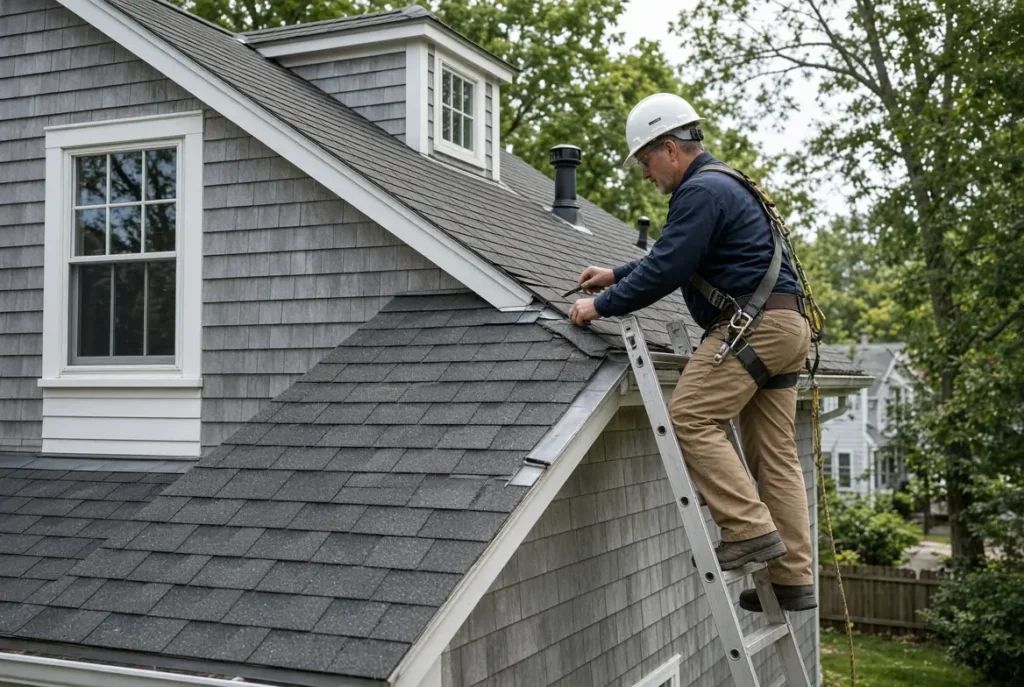
You can usually get a good idea from the ground, and you should, because the layer count decides whether you even have a choice.
Stand back and look at the edges of the roof, especially at the rake and along the eave. One layer has a thin, even edge. Two layers look thick and slightly stepped. Then look at the field around the vents, the pipes and any skylight. Two layers tend to show up as raised, lumpy areas where the shingles are stacking around an obstruction.
If the roof looks uneven or wavy in places where it should be flat, that’s worth a closer look. So is a soft or spongy feel underfoot, though that one’s for us to check, not you. Please don’t get on the roof.
The reliable version is somebody lifting a shingle at the edge and counting. That’s part of what we do on an inspection, along with the flashing, the pipe boots, the valleys, the ventilation and the attic. Here’s a rundown of what a Massachusetts roof inspection covers if you want to know what you’re paying for.
Across the roofs we do, the problem usually isn’t the shingle at all. It’s flashing, ventilation, reused pipe boots, valleys, rotted decking, or the edges of the roof where water’s been getting in for years. An overlay replaces the one part that was probably still fine.
If you’re not sure you’re at that point yet, the signs a roof is done are usually visible before a leak shows up inside.
Roof Overlay vs Tear Off in Massachusetts: The Short Version
The code allows an overlay in narrow cases. GAF allows it in narrow cases. Our winters close most of what’s left.
Three situations rule it out on paper. The ice barrier at your eaves rules out most of the rest in practice.
If somebody quoted you an overlay, ask them one question: how are you getting a leak barrier 24 inches inside my wall line without taking the old roof off? Then listen to the answer.
When you want a straight read on your own roof, we do roof installation in Quincy and across Massachusetts, and the inspection comes with photos.
Frequently Asked Questions
Can You Put New Shingles Over Old Shingles in Massachusetts?
Yes, in limited cases. Massachusetts follows the model code section R908.3.1.1, which forbids a recover where the existing roof is water soaked or deteriorated, where the covering is slate, clay, cement or asbestos-cement tile, or where the roof already has two or more layers of any roof covering. Everything else has to follow the shingle manufacturer’s approved instructions, and you need a permit either way.
How Many Layers of Shingles Are Allowed on a Roof in Massachusetts?
Two. The code prohibits installing a new covering where the roof already has two or more applications of any type of roof covering, so the second layer is the last one. GAF states the same ceiling on its own site. Your building official checks the layer count during permit review, so a third layer is not something a contractor can quietly add.
Does a Roof Overlay Affect My GAF Warranty?
It doesn’t void it, but it leaves a gap. GAF’s System Plus limited warranty covers materials, with a 50 year Smart Choice Protection Period that isn’t prorated, and it excludes defects in the building, walls, foundation, or the roof base over which the shingles or accessories were applied. On an overlay, that roof base is your old shingle layer, and nobody inspected it.
Can You Install Ice and Water Shield on a Roof Overlay?
No. An ice barrier is either two layers of underlayment cemented together or a self-adhering membrane, and it has to bond to the roof deck and run at least 24 inches inside the exterior wall line under section R905.1.2. An overlay never exposes the deck, so the membrane can’t go where the code puts it. You keep whatever the last roofer installed.
Do I Need a Permit to Reroof a House in Massachusetts?
Yes. Section R105.1 of 780 CMR requires a written permit application before construction, alteration, repair or removal work on a one or two family home, and that covers reroofing. The permit review is also where the building official confirms how many layers are already on the roof.
How Long Does a Roof Replacement Take in Massachusetts?
Most standard replacements we do go on in one to two days once the material is on site and the weather cooperates, and one day is our usual. Tearing off the old roof is part of that same window, so skipping the tear off doesn’t buy you much time. Bad weather and rotted decking are what actually stretch a schedule.