Curling shingles mean the shingle has lost its bond and the mat underneath is moving. On Massachusetts roofs that traces back to 1 of 3 things almost every time: the roof is near the end of its life, the attic below it is not venting, or somebody laid it over an old roof. Missing shingles are a separate problem with a separate cause. On a newer roof, a shingle that blew off is usually a shingle that never sealed.
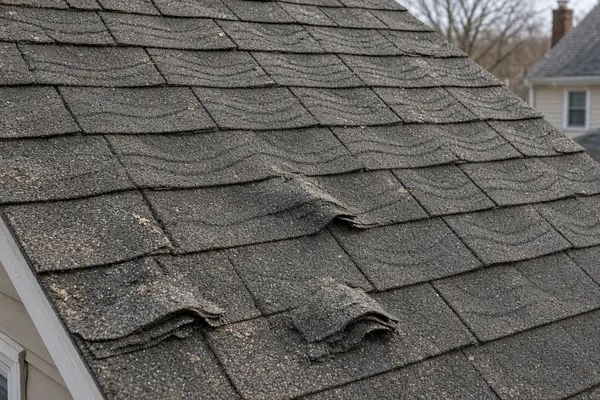
What Are Curling Shingles?
Curling shingles are asphalt shingles whose edges or centers have lifted away from the roof deck. Cupping means the edges turn up. Clawing means the center lifts while the edges stay down. Both mean the shingle mat has dried out, the seal below has failed, or the deck under it is moving.
That last one matters more than most homeowners are told. The Asphalt Roofing Manufacturers Association names deck movement as a direct result of poor attic ventilation, listing “buckling of the roofing shingles” and “premature failure of the roofing system” among the consequences. A shingle can look wavy because the wood under it is wet and swelling, not because the shingle is old.
Here’s what you’re actually looking at from the ground:
| What you see | Name | Usual cause | How urgent |
|---|---|---|---|
| Edges turned up, center flat | Cupping | Age, heat from below, failed seal | Watch it, plan ahead |
| Center raised, edges down | Clawing | Moisture in the mat, deck movement | Get it looked at |
| Long waves across several courses | Buckling | Wet or moving deck, bad underlayment | Get it looked at soon |
| Bubbles or pits in the surface | Blistering | Trapped moisture in the shingle | Usually cosmetic |
| Bare spots, tab gone | Missing | Wind, unsealed shingle, nail placement | Fix within days |
Curling And Missing Are Two Different Problems
Curling is slow. Missing is sudden. Treating them as one problem is how homeowners end up replacing a roof that needed 2 hours of work, or patching a roof that was done 5 years ago.
Curling is a wear pattern. It shows up across a slope, it gets worse over seasons, and it gives you time to plan. A missing shingle is a bond failure at 1 spot on 1 day. The rest of the roof might be fine. The question with a missing shingle is never “is my roof old,” it’s “why did that one let go.”
Why Are My Shingles Curling After Only 5 Years?
A 5-year-old roof that’s curling almost always has a heat or moisture problem underneath it, not a shingle problem. Shingles don’t age on a calendar. They age on temperature.
The 3 things I find when I go in the attic on a young curling roof:
The attic isn’t venting. The International Residential Code sets the baseline at 1 square foot of net free ventilating area for every 150 square feet of vented space, and allows 1 to 300 only when 40 to 50 percent of that area sits in upper vents no more than 3 feet below the ridge, with the rest at the eaves. Plenty of Massachusetts houses have ridge vent and no soffit intake. Air can’t leave if it can’t get in.
There’s a second layer under there. The old roof holds heat against the new one and telegraphs every lump. If you’re weighing an overlay against a tear off, this is the part nobody mentions at the kitchen table.
Bath fans dump into the attic. A bathroom fan venting into insulation instead of outside puts warm wet air right under the deck all winter.
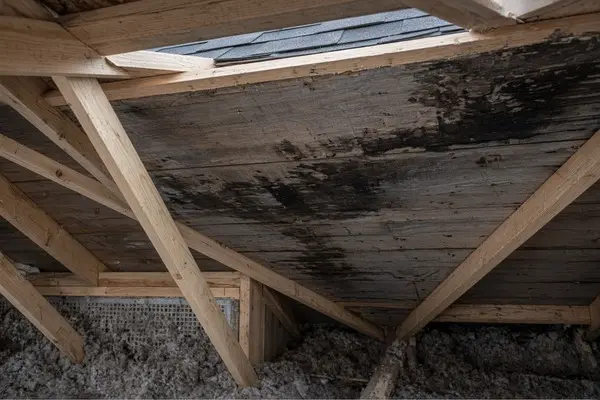
Attic Ventilation Is The Cause Homeowners Never Check
Bad attic ventilation is the single most common cause of early curling I find on Massachusetts roofs, and you can check it yourself in about 10 minutes.
Go in the attic on a hot afternoon. If it feels like a sauna and you can’t feel air moving at the eaves, you have an intake problem. Look at the underside of the deck. Dark staining, rusty nail tips, or frost in February all say the same thing: moist air is sitting up there.
ARMA is direct about the fix. Whichever ratio you use, the free-flow ventilation has to be “equally balanced between intake and exhaust vents.” Most of the failures I see aren’t missing vents. They’re all exhaust and no intake, usually because someone blew insulation over the soffit baffles.
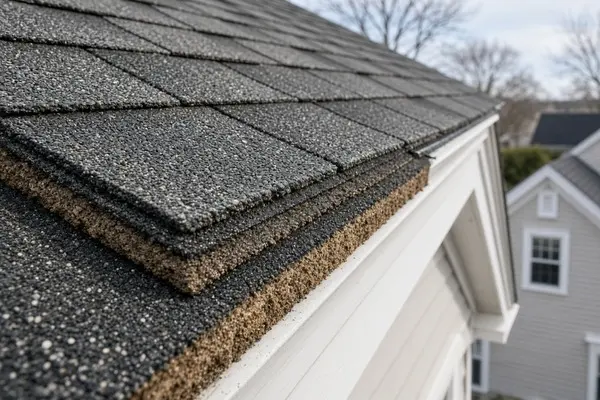
A Second Layer Of Shingles Cooks The One On Top
Shingles installed over an existing roof run hotter and curl sooner than shingles installed on a clean deck. The old layer acts like a blanket, and it also hides whatever’s wrong with the wood.
This is the cause I’d bet on when a homeowner tells me the roof is 8 years old and already clawing. You can usually confirm it from the ground. Look at the rake edge where the roof meets the gable trim. If you can count 2 distinct shingle thicknesses, you’ve got an overlay. Massachusetts also requires an ice barrier on asphalt shingle roofs, extending 24 inches inside the exterior wall line, so a layover that skipped that step left a gap at the eave where ice dams do their work.
Across the roofs we do, the problem is rarely just the shingle. It’s flashing, ventilation, a bad previous install, reused pipe boots, valleys, or rotted decking nobody talks about until the old roof comes off.
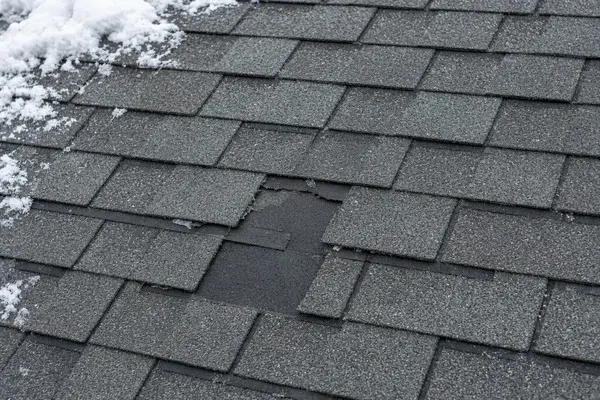
Why Do Shingles Blow Off A Newer Roof?
Because the shingle never sealed. This is the part of the field nobody writes about, and it’s the most useful thing I can tell a Massachusetts homeowner.
Asphalt shingles don’t hold down with nails alone. They hold down with a heat-activated adhesive strip that bonds each course to the one below it. The Insurance Institute for Business and Home Safety tested this in 2017 and found that “the most important factor affecting high-wind performance for self-sealing asphalt shingles is the strength of the seal between shingles.”
The timing is the part that matters here. In that study, summer-installed shingles became tacky within 1 day once shingle temperature passed 140F. Winter-installed panels took roughly 12 weeks to fully seal, and the researchers found that “shingles on winter-installed panels consistently exhibited lower wind uplift resistance than shingles on summer-installed panels.” North-facing slopes were worst. South-facing summer panels logged an average of 228 hours above 140F. North-facing winter panels logged 37.
Now put that on a Massachusetts calendar. A roof installed in December on a north-facing slope may not be fully sealed until March. That’s a whole nor’easter season on an unbonded roof. So when a 3-year-old roof loses a tab and everyone reaches for “defective shingles” or “storm damage,” there’s a third answer that fits better and nobody checks.
One more finding from that study worth knowing, because it kills a myth: roof pitch barely matters for wind uplift. Average passing wind speed only moved from 127 mph at a 2:12 slope to 117 mph at 12:12. A 10 mph spread across the entire range of residential pitches.
That doesn’t mean every winter roof is a bad roof. We install in cold weather and so does everybody else in New England. It means a winter install needs hand-sealing at the rakes and eaves, and it means the first spring after a cold-weather install is when you should be looking up. If yours wasn’t hand-sealed and you’re checking for storm damage after a wind event, the wind may have found an unsealed edge rather than a weak shingle.
Shingle wind ratings are worth understanding here too. Under ASTM D7158, the standard the building code points to for self-sealing shingles, Class D covers 115 mph, Class G covers 150 mph, and Class H covers 190 mph. The older ASTM D3161 fan test tops out at Class F, 110 mph. Every one of those numbers assumes the seal did its job. An unsealed Class H shingle is a Class nothing shingle.
How Many Curling Shingles Before You Need A New Roof?
There’s no code number for this, and anybody who gives you a clean percentage is guessing. What I use is simpler: count the slopes, not the shingles.
If curling shows up on 1 slope and the others are flat, you’ve got a localized cause. Usually a venting dead spot, a valley, or a section that got redone. That’s repairable.
If curling shows up on every slope at the same rate, the roof is telling you its age and you’re on the clock. Repairs on that roof buy you seasons, not years.
If shingles crack when you lift them, the mat is done regardless of what the calendar says. A curled shingle that flexes is still working. A curled shingle that snaps is not.
What A Curling Shingle Inspection Should Cover
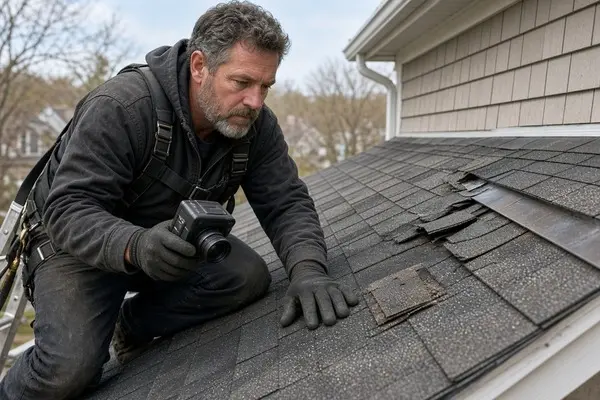
A real inspection puts somebody in your attic, not just in your driveway. From the ground a roof can look fine. Once you get on it and under it, you start seeing lifted tabs, granule loss, bad flashing, soft wood, nail pops, old pipe boots, poor ventilation, and water damage a homeowner would never notice until it became a bigger problem.
Here’s what we actually check, and what gets skipped when somebody sizes up your roof from the street:
| Where we look | What we’re checking | What a drive-by misses |
|---|---|---|
| Roof surface | Lifted tabs, granule loss, nail pops, cracked mat | Looks fine from the street |
| Rake and eave edges | Second layer, drip edge, ice barrier coverage | Hidden behind the gutter line |
| Attic deck | Staining, frost, soft wood, rusted nail tips | Never opened |
| Soffit and ridge | Whether intake and exhaust are balanced | Counted from outside, if at all |
| Penetrations | Pipe boots, flashing, valleys, chimney | Assumed fine |
Every Powersol Roofing inspection ends the same way. We photograph what we find, walk you through it in plain English, then put the work in writing. We don’t sell fear. If a roof can be repaired, we say that.
When a replacement is the right call, most standard roofs go on in 1 to 2 days once material is delivered and the weather holds. Our average is usually a single day.
Insurance Covers Storm-Torn Shingles, Not Curled Ones
Usually no for curling, sometimes yes for missing. Carriers separate wear from damage, and curling reads as wear.
Curling from age, heat, or bad ventilation is maintenance. No carrier pays for that. Shingles torn off by a named wind event are property damage and often are covered, minus your deductible. That’s why documenting the date matters more than documenting the damage.
We inspect for storm, wind, and hail, photograph what we find, and tell you honestly whether it looks like real damage or normal wear. We don’t promise an approval and we don’t tell anybody to file a claim when the damage isn’t there.
What To Do Right Now If A Shingle Blew Off
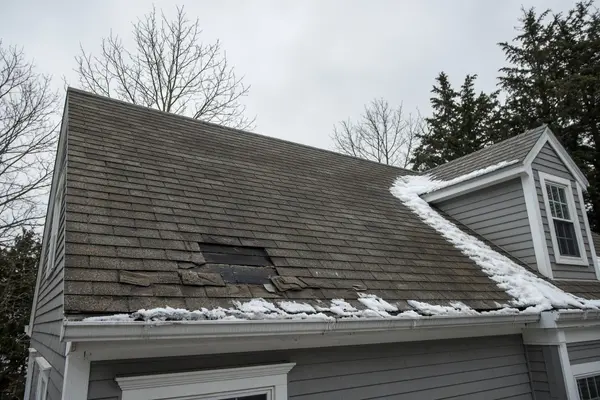
Photograph it from the ground today, before anything else. Date-stamped photos from the day after a storm are worth more to a claim than anything a roofer writes later.
Then check inside. Go to the attic and look at the deck directly under the bare spot for water stains. A single missing shingle doesn’t mean you’re leaking yet, because the underlayment below it is doing its job. It does mean you’re 1 layer from leaking.
Don’t go up there yourself. A curled shingle in cold weather snaps when you step on it, and you’ll turn 1 repair into 5. We covered what’s worth doing yourself in a separate post.
One thing worth checking while you’re looking: the rubber boots around your plumbing vents. Those fail before the shingles do, and a cracked pipe boot causes more ceiling stains in Massachusetts homes than missing tabs do. If you’re already seeing water inside, start with the common causes of roof leaks in Massachusetts rather than assuming the shingles did it.
Get A Straight Answer On Your Roof
If your shingles are curling or a tab blew off, the useful next step is somebody in your attic and on your roof with a camera. We inspect roofs across Quincy and the South Shore, photograph what we find, and put the scope in writing. Sometimes that scope says repair. Sometimes it says you have 3 more seasons. If it can be repaired, we’ll tell you so.
We’re licensed and insured in Massachusetts, and new roofs carry a 25-year workmanship guarantee plus manufacturer coverage. Call (617) 631-5435 or book a free inspection. Curling shingles rarely need an answer today, but they always need an honest one. We’ve done roof and exterior work in Taunton, Randolph, and Dorchester, and we’ll show you photos of your own roof, not stock images of somebody else’s.
Curling Shingle Questions We Get On Massachusetts Roofs
What causes curling shingles on a Massachusetts roof?
Curling shingles come from heat and moisture under the roof more often than from the shingle itself. The 3 causes I find most are poor attic ventilation, a second layer of shingles trapping heat, and a roof that has reached the end of its service life. The Asphalt Roofing Manufacturers Association ties poor ventilation directly to premature roofing failure and shingle buckling from deck movement.
Can you repair curling shingles without replacing the whole roof?
Yes, when the curling is on 1 slope and the shingles still flex instead of snapping. A localized cause like a venting dead spot or a valley is repairable. When curling shows up at the same rate on every slope, repairs buy seasons rather than years.
Why are my shingles curling after only 5 years?
A young roof that curls has a heat or moisture problem under it. Check whether your attic has soffit intake, not just a ridge vent. Code sets the baseline at 1 square foot of net free ventilating area per 150 square feet of vented space, and the 1 to 300 alternative requires 40 to 50 percent of that area in upper vents within 3 feet of the ridge.
Why did a shingle blow off my 3-year-old roof?
It probably never sealed. Shingles bond with a heat-activated adhesive, and IBHS found in 2017 that summer-installed shingles sealed within 1 day above 140F while winter-installed panels took about 12 weeks. A roof installed in a Massachusetts December on a north-facing slope can sit unbonded through most of nor’easter season.
Does homeowners insurance cover curling shingles?
Almost never. Carriers treat curling from age, heat, or ventilation as wear and tear, which policies exclude. Shingles torn off by a specific wind event are a different category and often are covered, less your deductible, which is why the date of the storm matters more than the look of the damage.
How many missing shingles is a problem?
Even 1 is worth handling within a few days. The underlayment under a missing shingle is a temporary layer, not a roof. Photograph it from the ground the same day for insurance purposes, then check the attic deck underneath for staining before you decide how fast to move.
How long do asphalt shingles last in Massachusetts?
Service life depends more on ventilation and install quality than on the shingle’s rated lifespan. Two identical roofs on the same street can differ by a decade based on attic airflow and whether the old roof was torn off. Wind ratings tell a similar story: ASTM D7158 Class H covers 190 mph, but only if the sealant strip bonded.