The short answer on how to prepare for a roof replacement: about two hours of physical work, and one careful read of your contract.
Move the cars. Clear a 15-foot ring around the house. Take the pictures off the walls. Get the kids and the dog somewhere quiet. That is the easy half, and every roofing blog on the internet will tell you the same thing.
The half nobody warns you about happens on paper. Massachusetts caps your deposit at one third of the contract price on a standard job. Pull the building permit yourself instead of letting your contractor do it, and the state says you have waived all rights to the Guaranty Fund. And the rotted-decking price should be settled in writing before anyone sets a ladder against your house.

What Does It Take to Prepare for a Roof Replacement?
Preparing for a roof replacement means three separate jobs. Clear the work area so the crew can move and nothing of yours gets broken. Protect the inside of your home from vibration and attic dust. And lock down the contract, the permit and the rotted-wood price before day one. The paperwork is the part that costs money when it’s skipped.
Most homeowners get the first two right on instinct. It’s the third one that shows up later as a surprise invoice.
Your 48-Hour Countdown Before the Crew Arrives
Start two days out, not the night before. Two days gives you room to move a car, reach your solar company, and read the contract without rushing.
Here’s the split I give our customers. The right column is the part you should not be doing yourself.
| When | Your job | Your roofer’s job |
|---|---|---|
| 48 hours out | Read the contract again. Confirm the permit is in your contractor’s name. Call your solar company if you have panels. | Confirm the material delivery day and the dump truck or dumpster plan |
| 48 hours out | Tell your direct neighbors, and anyone sharing your driveway | Board or protect windows, plan tarp coverage |
| 24 hours out | Cut the grass short so nails show up later | Confirm crew arrival time with you |
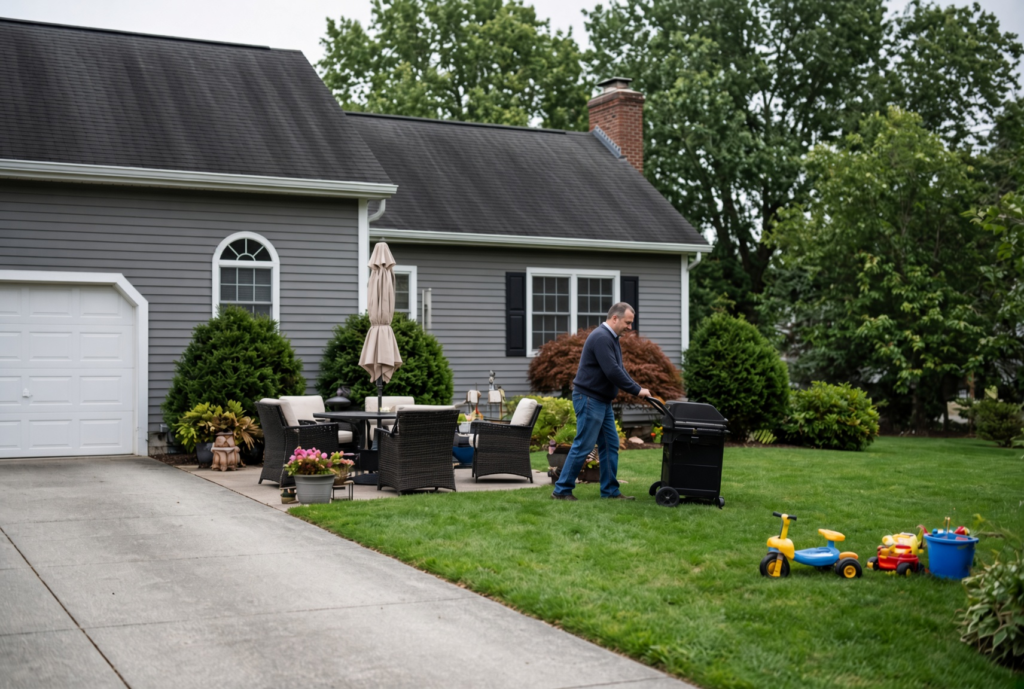
| 24 hours out | Move patio furniture, grills, toys, planters into the garage or shed | Mark and protect beds, shrubs, AC condenser |
| 24 hours out | Clear valuables out of the attic. Take mirrors, pictures and loose shelving off the walls, top floor first | Lay attic protection under an open deck, if attic access is in the scope |
| Night before | Park both cars on the street, not in the garage | Stage materials so the driveway stays usable |
| Morning of | Unlock the gates. Confirm the outdoor outlet works. Leave a phone number if you’re going out | Walk the property with you before tear-off |
| Day the crew leaves | Walk the roof line from the ground with the crew lead | Magnetic nail sweep, final photos, punch list |
Nothing in the right column is a favor. Being asked to board your own windows or tarp your own flower beds is a scope problem.
Our average install is a single day once the material is on site and the weather holds. Standard replacements run one to two days. A bigger or steeper roof runs longer, and our stage-by-stage roof timeline breaks that down by roof size.
Do the Paperwork Prep First, Before the Patio Furniture
The contract is the only part of your prep that can save you thousands of dollars, and it has hard rules in this state.
Under Massachusetts General Laws chapter 142A, any residential contracting agreement over $1,000 has to be in writing. The same statute caps your advance deposit at the greater of two figures: one third of the total contract price, or the actual cost of special-order materials that have to be ordered before work starts. A roofer asking for half up front on a stock asphalt job is asking for something the law does not allow.
The state also spells out what has to be in the document. Start and completion dates. A detailed description of the work and the materials. The total price and the payment schedule. A three-day cancellation notice, which applies if you signed somewhere other than the contractor’s place of business. Who is obtaining the permits. A statement that work cannot begin before you’ve signed and received a copy. And no clause letting the contractor demand early payment because they feel insecure about getting paid.
Before you sign, Massachusetts tells homeowners to interview at least three contractors. Get references in writing for the three most recent projects, with names and phone numbers. Ask to see the Home Improvement Contractor identification card the state issues. The state’s own warning is blunt: if the contractor or subcontractor is not registered, you are not protected by the Home Improvement Contractor Law.
That protection is worth real money. The state runs an arbitration program and a Guaranty Fund that pays eligible homeowners up to $25,000 on an unpaid judgment. It only exists if the registration does.
We put the full list of questions to ask a roofing contractor on our site because I’d rather field fifteen hard ones than none.
Who Should Pull the Permit on Your Roof Replacement?
Your contractor should, and this is not a small detail. Massachusetts publishes an eight-point warning for homeowners who apply for the building permit as the owner. One of those points is a single sentence: you have waived all rights to the Guaranty Fund.
Pull your own permit and you become personally responsible for all work on the project, for meeting the state building code, and for calling your building department to schedule every inspection. An injured worker can also sue you directly if you don’t carry workers compensation insurance. Some contractors will suggest it anyway. It saves them a step and moves the exposure onto you. Read the state’s homeowner warning for owner-pulled permits before you agree to it.
The Guaranty Fund rules say the same thing from the other side. To be eligible for a claim, the contractor and not the homeowner has to have secured the building permit, and the contractor has to have been registered on the day you signed.
The building code itself is statewide, 780 CMR. What varies is how your city administers it, so confirm the process with your own building department in Quincy, Brockton, Taunton or wherever you are. What matters at the prep stage is whose name goes on the permit.
What Happens if They Find Rotted Wood After the Tear-Off?
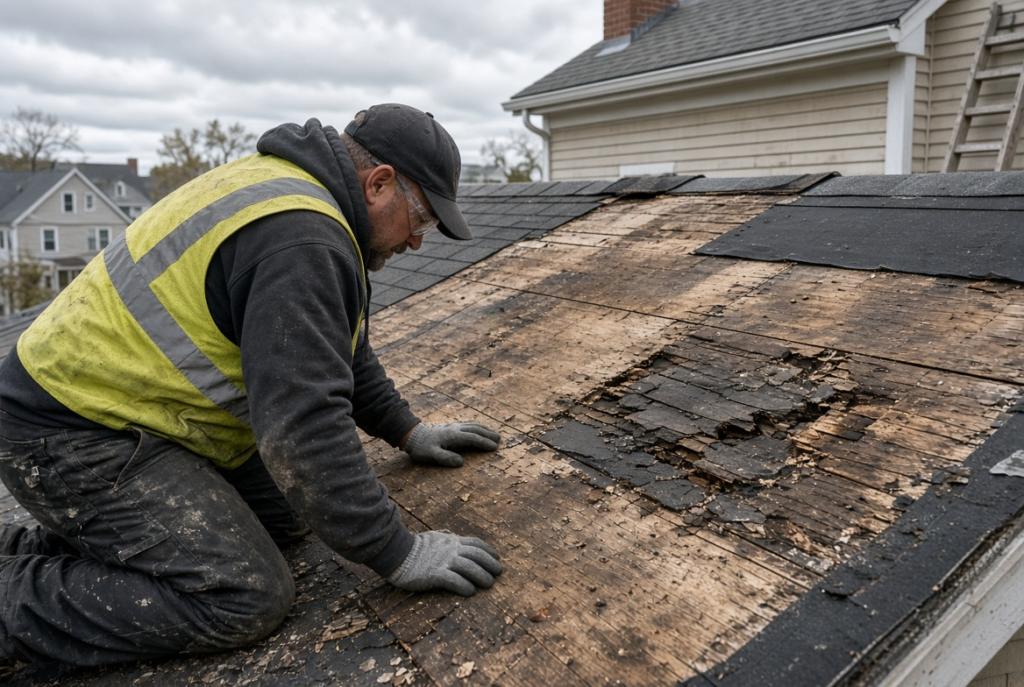
Somebody finds rotted decking, and then somebody decides who pays for it. Settle that before the tear-off, not while three guys are standing on your roof waiting.
Across the roofs we do, the problem is usually not the shingle. It’s flashing, ventilation, reused pipe boots, bad nail placement, a missing ice-and-water barrier, or soft decking nobody mentioned until the old roof came off. Rotted sheathing is common enough in older Massachusetts housing stock that a contract with no line for it is a contract with a hole in it.
Ask for the price per sheet in writing before day one, and ask who makes the call. We photograph it and show the homeowner first, because a surprise on a roof is a surprise about money.
This is also where a lowball quote reveals itself. No two Massachusetts roofs price the same. Size, pitch, the number of layers coming off, chimney and skylight flashing, ventilation and how easy the house is to work around all move the number. So when one bid sits far below the rest, the gap is almost never efficiency. Something got left out, usually decking, flashing, ventilation or cleanup. Still deciding between a fix and a tear-off? The repair versus replacement math comes first.
How Do You Prepare the Inside of Your Home?
Take everything off the walls on the top floor, clear the attic, and expect dust. Replacing a roof means thousands of nails driven into the structure of your house, and the whole building moves a little.
Wall decor comes down first: mirrors, framed pictures, wreaths, loose shelving, anything hanging on a nail. Be thorough on the upper floor, because it moves more than the ground floor. In cabinets, separate the glass and the china so nothing is touching anything else.
The attic collects the most dust of any room in the house. If you have finished attic storage, move the sentimental boxes downstairs and lay drop cloths over what stays. On an open-framed attic you will get granules and dust between the boards no matter how carefully the crew works.
A built-in garage needs its own pass. Garage ceilings often have no insulation, so granules and grit drop straight through onto whatever is stored underneath. Granules scratch paint. Cover the tool bench, the bike, the collectibles, and park both cars on the street.
Roof accessories come off and go back on. Satellite dishes, skylights and solar arrays all get handled, so expect your TV to cut out for part of the day.
The roof work itself happens outside. The attic is the one reason a crew asks to come in, either to lay protection under an open deck or to look at ventilation and a suspected leak. Settle attic access when you sign, not with a knock on install day, and remember that the ventilation question really belongs in a proper roof inspection.

Pets and Kids on Install Day
Get them out of the house if you can. This is the one piece of prep where being generous with yourself pays off.
Roofing is loud, and it’s loud for hours. NIOSH recommends an occupational limit of 85 A-weighted decibels over an eight-hour shift, and halves the allowed time for every 3 decibels above it. Four hours at 88 dBA. One hour at 94. That’s a workplace limit written for the crew, and NIOSH says outright it isn’t meant to measure noise outside of work. It’s why our guys wear hearing protection all day. I’m not going to quote you a decibel figure for your own house. It depends on the tool, the deck, and how far you’re standing from it. Anyone who hands you a precise number is guessing.
Infants don’t nap through it. Dogs and cats react to the hammering and to strangers walking the perimeter all day. A kennel, a daycare, or a day at a family member’s is money well spent when the whole thing is over in a day or two.
Say everyone stays home. Keep pets indoors, crated or in a back room with their toys. Walk the dog beforehand. And keep shoes on the kids for a few days afterward. Stray nails are the reason, and they’re why the cut-the-grass conversation matters at all.
What Happens to Your Solar Panels During a Roof Replacement?
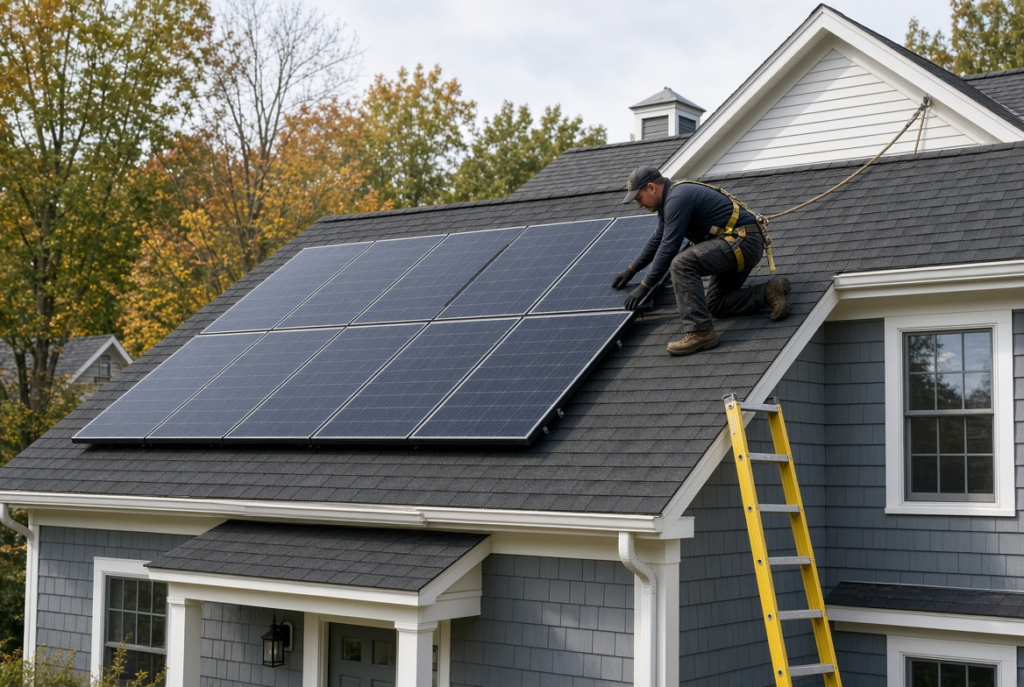
The array has to come off and go back on, and that timeline usually runs longer than the roof itself. It’s the most underestimated item in roof prep.
Start with your solar contract, not your roofer. Tesla’s published removal and reinstallation policy is a useful example of what these agreements actually say. Tesla quotes roughly seven to ten business days just to respond to a request. If permits are needed, their own guidance says that can take up to two months on average. After the roof is finished, they require 30 days with no additional work before reinstallation begins.
Three more things in that policy matter before you schedule anything. Your energy contract stays active during the downtime, so lease or loan payments keep coming while the panels are off. Use a third-party contractor for the detach and Tesla says it isn’t responsible for that workmanship, leaving you to pay for any damage. And if codes changed since your install, required upgrades are at your cost.
Other installers write it differently, so read yours. The questions are the same no matter who put the panels up. Who physically detaches the array? Does an electrician need to be involved? Does the system need re-permitting or re-inspection? What happens to monitoring while it’s down, and who pays if something breaks?
Then bring that answer to your roofer before you pick a date. We handle roof projects that have to coordinate with solar, and we stay the point of contact from the inspection through the final walkthrough so you’re not the one relaying messages between two companies. Be clear about the sequence, though. The roof itself is still one to two days. The solar detach and reset schedule belongs to your solar provider, and that is the part that sets your real calendar.
The Yard and Driveway, in Short
Clear a 15-foot ring, move anything breakable, and mark anything the crew could trip over or step into.
Patio furniture, grills, toys, planters, statues, path lights, bird feeders, wind chimes. Mark sprinkler heads, well caps, septic covers and any water feature hidden behind plantings. Mow short, because nails are findable in short grass and invisible in long. Unlock the gates so the crew can work all four sides.
The long version, including who is liable when a roofer damages your landscaping, is a separate post. If you have mature plantings or hardscape you care about, read how to protect your yard during a roof replacement first.
What Massachusetts Adds to Your Roof Prep
Two things: the eaves, and the calendar.
Massachusetts publishes ice barrier guidance covering asphalt shingles and other roof coverings, and it matters because the eave is where New England roofs leak. The state’s answer calls for two layers of underlayment cemented together, or a self-adhering polymer-modified bitumen sheet. It runs from the lowest edge of the roof to at least 24 inches inside the exterior wall line. On a slope of 8:12 or steeper it also has to reach 36 inches from the eave edge, so the two measurements stack rather than replace each other.
One caveat. That guidance was written under the Ninth Edition of the residential code, and the Tenth Edition took over in 2024. Ask which edition your city enforces, and ask to see the eave detail on your own scope. On our jobs it’s GAF WeatherWatch, with FeltBuster synthetic underlayment above it, Pro-Start starter strip at the edges, Timberline HDZ shingles, a Cobra ridge vent and Seal-A-Ridge cap.
The calendar matters because material delivery and weather drive the schedule, not your preference. A dry stretch in September books out. A January install can be done, but sealing behaves differently in the cold. Book earlier than you think you need to, and expect a real date only once material is on site. If you’re weighing materials for snow load and ice, we compared metal against asphalt for New England winters in a separate post.
Half This Checklist Is Your Roofer’s Job, Not Yours
Here is the position most roofing companies won’t put on their website. Say your prep list runs ten items long, and eight of them involve protecting your own property from your own contractor. That’s a scope problem, not a chore list.
Boarding windows, tarping beds, protecting the AC condenser, running the magnetic sweep, hauling debris. Those are line items in a real scope, and the state requires your contract to carry a detailed description of the work and materials. Site protection that isn’t in the description isn’t in the price. It’s step four of our six-step process, before tear-off, because it belongs to us.
The cheapest roof is not the best deal. A couple of dollars more feels high in the moment, but you’re getting the house renovated the right way, once.

What to Check the Day the Crew Leaves
Walk the property with the crew lead before they pull out, then walk it again yourself the next morning.
Look at the ridge line and the valleys from the ground. Check the driveway for oil, scuffs and dropped nails. Check the gutters and the beds. Then get your paperwork: warranty registration, final photos, an invoice matching the scope you signed. We install a full GAF system and the roof carries a GAF-backed warranty, and coverage only works if the registration actually gets filed. Ask for the warranty tier and the exact terms in writing, from us or from anyone else you’re weighing. Material coverage and workmanship coverage are two different things with two different terms, and a roofer who blurs them is telling you something.
If something looks wrong, call that week. Weather can lift a shingle before it seals, and a missed ridge cap happens. Any roofer worth hiring wants to hear about it. Our new-roof punch list walks through what to inspect zone by zone.
Recent exteriors we’ve finished nearby: a full roof with gutters and PVC fascia and soffit in Taunton, and a roof, gutters and siding package in Randolph. We also tied a roof and windows project together in Dorchester.
Frequently Asked Questions
How do I prepare for a roof replacement if I have solar panels?
Call your solar company before you pick a roof date. Tesla’s published policy is one example. It says permits alone could take up to two months on average, then requires 30 days after the roof work before panels go back on. Your lease or loan payments continue the whole time the array is down. Get the detach timeline in hand first, then schedule the roof around it.
What should I take down inside my house before a roof replacement?
Everything hanging on a nail, starting with the top floor, because it moves more than the ground floor. Mirrors, framed pictures, wreaths and loose shelving all come down. Separate glass and china inside cabinets so nothing is touching, and move sentimental boxes out of the attic.
Do roofers need to come inside my home?
The roof work happens outside. The attic is the exception, either to lay protection under an open deck or to check ventilation and a suspected leak. Agree on attic access when you sign the contract, so nobody is knocking on your door the morning the crew arrives.
Should my pets stay home during a roof replacement?
A kennel, a daycare or a friend’s house is the better call, since most standard installs finish in one to two days. Hammering runs for hours at levels loud enough that the crew wears hearing protection, and a stray nail in the yard is a real risk for a dog. If they stay, keep them indoors in a back room with their crate and toys.
Who should pull the building permit for a roof replacement in Massachusetts?
Your contractor. One line of the state’s homeowner warning is a single sentence. Apply as the owner and you have waived all rights to the Guaranty Fund, which covers eligible homeowners for actual loss up to $25,000. Guaranty Fund eligibility separately requires that the contractor, not the homeowner, secured the permit.
How far in advance should I prepare for a roof replacement?
Start 48 hours out for the physical work, and weeks earlier for the contract, the permit and any solar coordination. Our average install is a single day once material is on site and the weather holds, so the physical prep window is short. The paperwork window is not.
That’s how to prepare for a roof replacement without paying for the parts you weren’t warned about. Want a scope you can compare line by line instead of a number on a business card? That’s what our roof installation work in Quincy is built around. Send us the address and we’ll show you photos of what we find.