Home / Worcester / Roofing Services / Leaky Roof Repair
Leaky Roof Repair In Worcester, MA
The Stain on Your Ceiling Is Almost Never Under the Hole
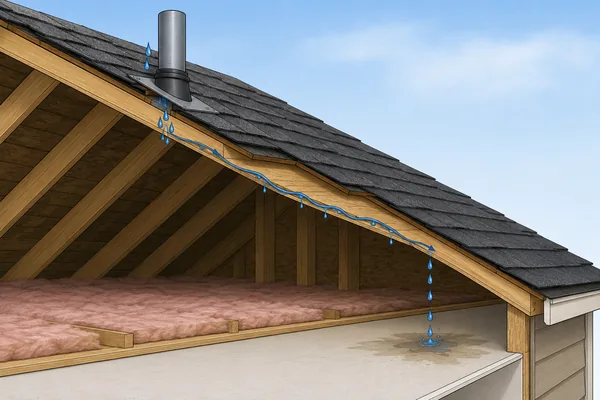
Water enters at a flashing joint, a vent boot, a lifted course, or past the ice barrier at the eave, then runs along the framing until something stops it. We trace it from the attic side first, photograph the entry point, and repair the detail that is letting water in. Serving Worcester and Worcester County.
The short version
Leak Repair Is 2 Jobs, and the First One Decides the Second
Leak repair is finding where water enters, then fixing that specific detail. The finding is the harder half, and it is the half most repairs skip. Roofs rarely fail across the open field of shingles. They fail at the interruptions: where the roof meets a chimney or a wall, where a plumbing vent comes through, where 2 planes drain into a valley, and along the cold overhang at the eave where Worcester snow melts and refreezes. In the last 180 leaks we traced across Massachusetts, 4 causes accounted for 82% of them, and none of those 4 was a worn-out shingle field.
A traced repair is small, permanent and documented. An untraced patch relocates the water. That is why the same ceiling gets painted 3 times and leaks again on the fourth storm. Powersol Roofing works Worcester and Worcester County from 100 Hancock St in Quincy. If water is coming in right now, call (617) 631-5435 or see emergency roof repair. If what you have is a stain from the last thaw, book the trace this week, before the next one reopens it.
Match your symptom
What the Stain Is Telling You
Every leak announces itself differently, and the symptom narrows the cause before anybody sets a ladder. Here are the 8 we hear most on the phone, what each one usually turns out to be, and how fast it actually needs somebody.
Finding the source
The Two-Side Trace: Following the Evidence From Damage to Cause
We start inside. The wet track on the attic sheathing points uphill toward the entry point. The ceiling stain points nowhere useful, because by the time water reaches drywall it has already chosen the path of least resistance along a rafter, a wire, or a nail.
Why Worcester leaks differently
A Worcester Leak Usually Starts at the Eave
Worcester roofs carry more snow than almost anywhere else in Massachusetts, and the building code says so in writing. That one fact explains why the local leak pattern shows up at an exterior wall during a February thaw rather than mid-slope in an August downpour.
| Worcester | Boston | Quincy | |
|---|---|---|---|
| Average annual snowfall | 72.9 in | 49.2 in | No NOAA normals station |
| Ground snow load, code design value | 50 psf | 40 psf | 40 psf |
| Minimum flat roof snow load | 35 psf | 30 psf | 30 psf |
| Design wind speed | 117 mph | 120 mph | 121 mph |
Snowfall: NOAA 1991 to 2020 climate normals, Worcester Regional Airport and Boston stations. Loads and wind: Table 301.2(2), Massachusetts Residential Code, 780 CMR 10th edition.
Worcester takes roughly 24 more inches of snow a year than Boston does, on a structure the code sizes for 25% more load. Snow sits longer here. It melts off a warm attic, runs to a cold overhang, and refreezes into a ridge of ice that the next round of meltwater cannot get past. Shingles shed water running downhill. They cannot hold back water sitting still and being pushed uphill, so it goes under the courses.
The code answer to that is the ice barrier, and it carries a measurement almost no roofing page in this market states out loud. Massachusetts requires a self-adhering polymer-modified bitumen sheet, or 2 cemented layers of underlayment, that extends “from the lowest edges of all roof surfaces to a point not less than 24 inches (610 mm) inside the exterior wall line.” On roofs at 8:12 or steeper it also has to reach at least 36 inches measured from the eave edge.
Read where that measurement starts and where it has to finish. It starts at the roof edge and it has to end 24 inches past the wall, which means the overhang does not count toward it. A Worcester Victorian with a 24 inch overhang needs more than 4 feet of membrane at the eave to comply, and that is wider than a single 36 inch roll. Plenty of roofs in this city were laid with 1 course and called done. Those are the roofs that leak at the wall line in a thaw.
Source: 780 CMR R905.1.2, Massachusetts Residential Code, 10th edition. Quoted from the ice barrier requirements FAQ published by the Board of Building Regulations and Standards.
The eave-line test
If your leak shows at an exterior wall in winter there are only 4 answers. We check which one before quoting anything, because 3 of the 4 mean the repair is the barrier rather than the shingles.
| What we find at the eave | What it means | What the repair is |
|---|---|---|
| No ice barrier at all | The roof predates the requirement, or it was skipped | Strip and rebuild the eave courses with barrier to the code dimension |
| Barrier present, stops at or before the wall line | 1 course laid on a deep overhang. Short of the 24 inch rule | Extend the barrier up-slope past the wall line |
| Barrier present and correct, water entering above it | Not an eave problem. The dam grew tall enough to push water past the protected zone | Attic heat and ventilation, plus repair of whatever the water opened |
| Barrier correct, no ice, water still arriving | Not an ice dam at all. Usually condensation or a separate entry uphill | Trace it properly before anybody buys shingles |
Ask any roofer quoting your eave 2 questions: how many inches of barrier, and measured from where. If the answer is a brand name instead of a number, ask again.
The numbers behind the page
Why We Measure the Eave Before We Quote
Two public datasets and one number from our own job records. All 4 are checkable, and none of them appears on a competing page in this market.
Our own numbers
What 180 Traced Leaks Actually Showed
Across the last 180 leaks we traced in Massachusetts, flashing was the single largest cause and worn-out shingles were nowhere near the top. Most roofing pages tell you leaks come from many places. Here is the actual distribution from our own job records.
| Where the water was getting in | Share of traced leaks | Typical repair |
|---|---|---|
| Step, counter and wall flashing | 31% | New metal integrated into the courses and the masonry |
| Vent boots and pipe penetrations | 19% | New boots and collars on every aged penetration, not just the failed one |
| Ice dam backup at the eave | 17% | Barrier to the code dimension, plus the attic work that caused it |
| Lifted, cracked or missing shingles | 15% | Matched replacements woven into the surrounding courses |
| Valleys | 8% | Rebuilt valley lining where the water concentrates |
| Skylight units and curbs | 6% | Curb flashing, or the unit itself when the seal has failed |
| Everything else | 4% | Nail pops, ridge vent terminations, back-pitched gutters |
Three numbers out of the same set are worth more than the table. The entry point sat somewhere other than directly above the ceiling stain in 78% of cases, with a median horizontal distance of 6 feet 4 inches and a longest of 31 feet. That is the whole argument for tracing rather than patching, in 1 figure.
And 88% of those 180 ended in a repair at 1 or more details. 12% led to a replacement recommendation. We publish that split because the honest version of it is the thing a homeowner most wants to know before letting a roofer into the attic, and because a roofer whose answer is always the same answer is not diagnosing anything.
The cost of waiting, in deck
What a Small Leak Does to the Wood Under It
A leak never stays the size it started, and in Worcester it usually restarts every thaw. This is the path we see when a wall-line stain gets left alone, and why the early repair is the small one.
A mark at the wall
Meltwater gets past the barrier and follows a rafter until it finds drywall, often a room away from where it entered. At this stage the fix is usually one eave detail or a length of flashing.
Wet insulation, softening deck
Every thaw reloads the same path. Insulation compacts and stops insulating, which makes the attic warmer, which makes next year’s dam bigger. The sheathing in that bay starts to hold moisture between events.
Rot spreading past the wet mark
Sustained moisture feeds mold on the attic side of the deck and rots the sheathing itself. The rot runs wider than the stain, so what you can see from inside is no longer the size of the problem.
A different license class
An RF Construction Supervisor License covers replacing up to a quarter of the sheathing. Past that, the job needs a broader class. The leak has stopped being a roofing repair and become a structural one.
The line most pages skip
When a Leak Stops Being a Roofing Job
A long-running leak rots the deck under it, and there is a point where the repair legally stops being roof covering work in Massachusetts. It is written into the license classes, and almost nobody publishes it. An RF Construction Supervisor License covers “construction, reconstruction, alteration, repair, or removal of roof covering, including repair and replacement of 25% of sheathing and 25% of sistering roof rafters.” Past that share, the job needs a CSL for 1 and 2 family dwellings, or an Unrestricted CSL.
Rot is how a leak repair crosses that line, and you usually cannot see it until the shingles come off. On a roof that has been leaking for 2 winters into the same bay, the sheathing has often gone soft well beyond the wet mark on the ceiling. So the question to ask, before the tear-off, is which license class the contractor holds and what happens if the rot runs past a quarter of the deck. We tell you where your roof sits on that line at the trace, with the photograph that shows it, and we quote both outcomes when both are possible.
Source: Construction Supervisor License types, Massachusetts Board of Building Regulations and Standards. Home Improvement Contractor registration is separate and applies to contractors performing work “on an existing, owner-occupied residential property with one to four units.” Both are checkable on the state lookup, including ours.
What it depends on
What Moves the Price of a Leak Repair
A leak repair is quoted after the trace, not before it, because the same ceiling stain can be a 2 hour job or a 2 day one and nothing on the phone tells you which. What we can tell you is exactly what moves the number, so you can read 2 quotes on the same terms.
Two of those cannot be judged from a photograph, which is why we ask questions on the phone rather than quote off one. The estimate comes back as a written scope with the line items visible, so a lower number from somebody else can be read against it item by item instead of on the total.
We Fix the Leak. We Do Not Invent a Roof Replacement.
Most leaks end with a repair measured in hours. Across our own traces, 88% ended in a repair at 1 or more details and 12% led to a replacement recommendation, and we publish that split rather than describe ourselves as honest. A roof is a system: the part you see is the shingle, but the leak is almost always in the parts you do not see, the flashing, the boots, the barrier at the eave and the ventilation above it. If the trace shows the roof is at the end of its life we say so, show you the photographs that prove it, and quote both paths against a replacement. A chimney flashing leak needs new flashing. It does not need a sales pitch, and you will not get one.
Before you file
What Insurance Covers, in the State’s Own Words
Sudden damage is usually covered. Wear and neglect are not. The Massachusetts Division of Insurance puts it plainly: “Generally damage to both the exterior and interior of a home resulting from weight of ice and snow or ice dams is covered under a homeowners policy. However, only the area damaged in the loss will be covered. Further damage sustained due to wear and tear or neglect will not be covered.”
The middle sentence is the one that costs people money. The area damaged in the loss is the claim. The rooms that got wet over the following weeks, because the water was never stopped, are where the adjuster starts asking when you first noticed the stain. A dated photograph of a small stain is worth more than a paint receipt for a big one.
What helps a claim, in order: photographs taken before anything is moved or cleaned; a dated record of the roof from before the loss, which is what a documented roof inspection produces; the itemized scope naming the cause; and prompt notice to the carrier. For wind and hail losses the documentation runs differently, and that is covered on the storm damage roof repair page. We photograph the cause and the finished repair and hand you the file. We will not tell you a claim is there when it is not, and we do not promise approvals.
Source: Massachusetts Division of Insurance, frequently asked questions about homeowners insurance.
Our limits, in advance
What We Will Not Do
A leaking ceiling is one of the easiest places in this trade to sell somebody a roof they do not need. Here is where our limits sit, so you can hold us to them.
Who traces it
The Person Behind the Ladder
Where we work
Leak Tracing Across Worcester and Worcester County
Worcester’s housing stock shapes the work. 59% of the city’s homes were built before 1960 and only 7.7% in the last 20 years, which means deep overhangs, steep Victorian pitches, and eaves laid long before the current ice barrier rule existed. There are 20,923 units in 3 and 4 family buildings, where a single eave detail can put water into 2 apartments at once.
Housing figures: City of Worcester Housing Needs Assessment, drawing on American Community Survey 2018 to 2022. Powersol Roofing, a trading name of Powersol Solutions LLC. 100 Hancock St, Quincy, MA 02171. (617) 631-5435. Office hours Monday to Sunday, 9:00am to 6:00pm. Emergency line answered 24/7.
Straight answers
Frequently Asked Questions
Why is my ceiling stained when it has not rained for weeks?
Two causes account for most of them in Worcester: an ice dam and attic condensation. An ice dam pushes meltwater back up under the shingles on a sunny day after a snowfall, so the drip arrives with no rain in the forecast. Attic condensation is warm indoor air hitting cold sheathing, freezing there, and running down the rafters when it thaws. From the living room they look identical. In the attic they do not: an ice dam leaves a wet track that starts at the eave, and condensation leaves frost or staining spread evenly across the underside of the deck. The fixes are different, so the diagnosis has to come first.
How do you find where a roof leak is actually coming from?
We run the two-side trace. Attic first, because the water path on the sheathing points uphill to the entry and the ceiling stain does not. We mark the wet rafter bay, measure it off a known reference such as a chimney or a gable end, then go up the slope and open the matching zone from above. Across the last 180 leaks we traced in Massachusetts, the entry point sat somewhere other than directly above the stain 78% of the time, and the median horizontal distance between the two was 6 feet 4 inches. That is why guessing from the driveway produces repeat leaks.
My leak only shows up at an exterior wall in February. What does that mean?
That pattern usually means water is getting past the ice barrier at the eave. Massachusetts code requires the barrier to run from the lowest edge of the roof to a point at least 24 inches inside the exterior wall line. On a house with a deep overhang, hitting that measurement takes more than one 36 inch course of membrane, and a roof installed short of it will leak at exactly that spot in a thaw. We check where the barrier ends before quoting anything, because if it stops at the wall line the repair is the barrier, not the shingles.
Can I just patch it myself with roof cement?
A surface patch treats the symptom. Cement smeared over the shingle nearest the stain often diverts water to a new path while the real entry, usually a flashing joint or a vent boot, keeps feeding the deck. It also makes the eventual proper repair harder, because cement has to be cut out before new flashing can be set. Add the fall risk on a wet or iced Worcester roof and the arithmetic stops working. Have it traced once and the repair is small.
Will my homeowners insurance cover a roof leak?
It depends on the cause. The Massachusetts Division of Insurance states that damage from the weight of ice and snow or from ice dams is generally covered, that only the area damaged in the loss will be covered, and that further damage from wear and tear or neglect will not be covered. Read the middle clause twice. The room that got wet in the storm is the claim. The three rooms that got wet over the following weeks because nobody stopped the water are where the argument starts. We photograph the cause and the repair and hand you the file. We do not promise an approval.
How long does a leak repair take once you find the source?
Most single-source repairs are one visit. A vent boot, a length of step flashing, a section of shingles, a valley termination: all of that is a morning once the material matches. What extends it is rotted sheathing, because the deck has to come off before anything can be fastened to it, and matching an older shingle line can add a day of sourcing. We tell you which one you have before we start, with the photograph that shows it.
What happens if the leak has rotted the roof deck?
There is a hard line in Massachusetts licensing at that point, and it is worth knowing. An RF Construction Supervisor License covers roof covering work including repair and replacement of 25% of sheathing and 25% of sistering roof rafters. Past that share the job needs a CSL for 1 and 2 family dwellings or an Unrestricted CSL. A long-running leak is the most common way a roof repair crosses that line. If your deck is beyond it, ask which license class the contractor holds before the tear-off starts. Afterwards is too late.
Do I need a permit for a leak repair in Worcester?
Ordinary repairs do not need a permit application. Work that opens the deck or changes structure does, and it goes to the City of Worcester Department of Inspectional Services at 25 Meade Street, 508-799-1198. If water is actively entering, the code does not make you wait: emergency work can begin, with the permit application filed by the next working business day. We tell you which category your job falls into before we quote it.
Is a leak worth repairing, or should I just replace the roof?
Most leaks are a repair. Across the traces in our own numbers, 88% ended in a repair at one or more details and 12% led to a replacement recommendation. The test we use is evidence, not age: one identifiable cause, sound shingles around it, a dry deck, and this being the first or second problem rather than the fifth this year. Fail two or more of those and a repair buys a season. We show you the photographs either way and quote both paths when both are real.
Why does the same spot leak again every winter?
Because the repair addressed the roof and the cause is in the attic. An ice dam forms when heat escaping into the attic melts the snow above it, the meltwater runs to the cold overhang and refreezes, and the ridge of ice pushes the next round of water back up under the shingles. Replace the damaged courses and you have fixed February. Fix the insulation and the ventilation and you have fixed the reason. A house that had a dam last year almost always has the same one this year, in the same bay.
Stop chasing the stain. Find the source.
We trace it from the attic side, photograph the entry point, and repair the detail that is letting water in. Worcester and Worcester County.