Home / Worcester / Roofing Services / Commercial Roofing
Commercial Roofing In Worcester, MA
Built For 50 PSF Snow. Documented For Your Board.
EPDM and TPO systems, sectional repair, and scheduled maintenance for the buildings Worcester works out of: storefronts, downtown office and mixed-use, light industrial off Route 20, and multifamily across the city. Core cut before the quote. Priced line by line. Staged around your operating hours instead of through them.
Commercial roofing in Worcester is a structural question before it is a waterproofing question. The Massachusetts building code assigns Worcester a 50 psf ground snow load. Boston and Quincy get 40. That one number moves the deck loading, the fastening schedule and the drainage design, and on some buildings it decides whether a second layer of insulation can go on at all. What a building owner buys from a roofer is a dry interior, a paper trail that holds up, and a replacement date far enough out to budget for. We quote it that way: system, drainage and documentation, each on its own line. Powersol Roofing runs commercial work across Worcester and Worcester County. Call (617) 631-5435 or request an assessment.
The number nobody publishes
Worcester Is a 50 PSF City. Most Commercial Quotes Are Written For 40.
Massachusetts publishes a design snow load, wind speed and seismic value for every city and town in the state, in Table 1604.11 of 780 CMR Chapter 16. Worcester’s ground snow load is 50 psf. Its minimum flat-roof snow load is 35 psf. Boston and Quincy sit at 40 and 30. A contractor who works the coast and drives out for a Worcester job is carrying the wrong numbers, and on a low-slope roof with parapets, 25 percent more design snow is the gap between an attachment schedule that holds and one that does not.
| City or town | Ground snow Pg | Min flat-roof Pf | Wind, Risk Cat II |
|---|---|---|---|
| Worcester | 50 psf | 35 psf | 117 mph |
| Auburn | 50 psf | 35 psf | 118 mph |
| Holden | 50 psf | 35 psf | 116 mph |
| Millbury | 50 psf | 35 psf | 118 mph |
| Shrewsbury | 50 psf | 35 psf | 118 mph |
| West Boylston | 50 psf | 35 psf | 117 mph |
| Boston | 40 psf | 30 psf | 120 mph |
| Quincy | 40 psf | 30 psf | 121 mph |
Who this is for
Roofing By Building Type, Because They Fail Differently.
A restaurant roof dies at the grease exhaust. A garage roof dies at the drains. Knowing the pattern is half the inspection, and it is why the first visit to any building starts with questions about how the building gets used, before anyone looks at the membrane.
What the money buys
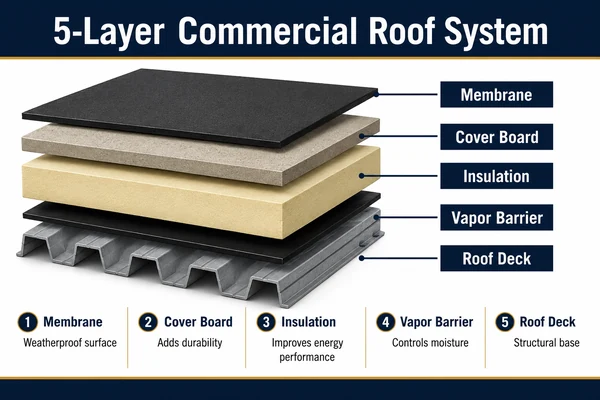
A Commercial Roof Is Five Layers. Cheap Quotes Thin One Of Them.
The membrane everyone sees is the last of 5 layers. Each does a different job, each fails differently, and each gets its own line on our quote with the manufacturer, the thickness and the attachment method named.
That is why 2 quotes for the same roof come back far apart. Compare them layer by layer. If a number is lower, something specific is thinner, missing or being reused, and you are entitled to know which before you sign. On a full replacement the insulation line is usually where the gap hides, because Massachusetts pulls that layer up to current code on a replacement and leaves it alone on a recover.
What the code says
Recover Or Tear Off: The Question That Decides Your Budget.
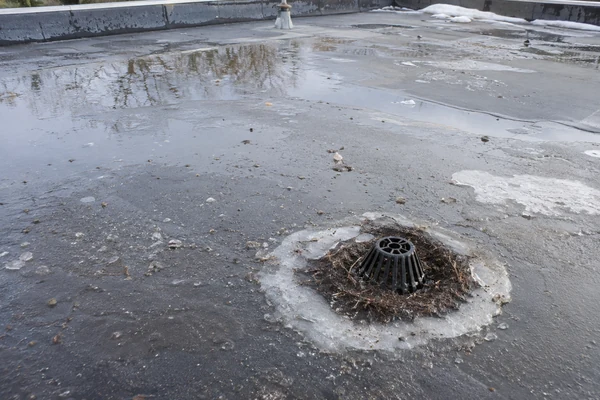
Massachusetts runs on the 2021 International Building Code through 780 CMR Chapter 15, and reroofing lives in Section 1512. Recover is not permitted where the existing roof is water-soaked or deteriorated past serving as a base, where the covering is slate, clay, cement or asbestos-cement tile, or where the roof already carries 2 or more applications. Where any of those are true, the job is a replacement, and replacement means removing every layer down to the deck.
Our own numbers
What 41 Core Cuts Told Us About Worcester Roofs.
Over the 12 months to July 2026 we opened 41 commercial roofs across Worcester and Worcester County before quoting any of them. 17 came back with saturated insulation under a membrane that read sound from the surface. 14 were already carrying 2 applications. 5 buildings were both. Counting the overlap, 26 of the 41 could not legally take a recover once the assembly was open, and on 12 of those the owner had already been given a recover price by somebody who never opened the roof.
Recovers are not the problem. A dry single-layer roof is the exact case the code allows, and it is the cheaper, faster, less disruptive job every time it is legal. The problem is that the verdict is invisible from the ground, and on 63 percent of the roofs we opened last year the building did not have the roof its owner thought it had. A core cut costs a morning. Finding out in week 2 costs a change order and a schedule.
The clause nobody quotes
Your Membrane Guarantee Has A Maintenance Condition.
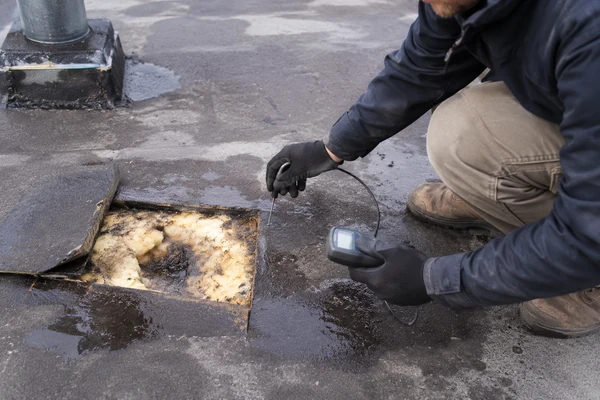
Single-ply guarantees are not unconditional. Every major manufacturer we install under makes documented inspection and record retention an owner obligation, and names failure to maintain as grounds for voiding coverage. This is the real argument for a maintenance program: without the records, a 20-year guarantee is 20 years of paper.
We read the guarantee before writing the maintenance scope, so the cadence and the records match what your manufacturer requires. If your building already carries a guarantee from another installer, bring us the document. The obligations are in it whether or not anyone has been meeting them.
Three ways to engage us
From One Repair To A Roof On A Documented Schedule.
Most owners meet us at the leak. The ones who spend the least over a decade are the ones on the program, and it has nothing to do with any single repair being better. On a maintained roof, problems get found while they are still 20-minute fixes on a scheduled visit, instead of arriving as a phone call from the tenant on the top floor. Same crew, same standards, 3 ways in.
Repair
Leak tracing, seam and flashing repair, drain and scupper work, puncture patches and storm response, with the source photographed before and after.
Maintenance program
Semiannual inspections timed to your manufacturer’s guarantee obligation, drains cleared, seams and flashings checked, minor repairs done on the spot, and a photo-documented condition report after every visit.
Replacement
Full system replacement, EPDM or TPO, staged in sections so the building keeps operating and nothing is left open overnight.
Check your own building
The Worcester Commercial Roof Check.
Five questions. It returns the design snow and wind load the code assigns your address, whether a recover is legal on your roof, whether the insulation requirement gets triggered, how the permit is calculated, and what your guarantee needs from you. Every output is built from published Massachusetts code and the City of Worcester fee schedule. No email, nothing stored, nothing sent anywhere.
Planning guidance built from 780 CMR 10th edition, the 2021 International Building Code as adopted in Massachusetts, and the City of Worcester schedule of fees effective 1 March 2024. It is not a structural calculation or a code ruling. Your building’s actual design load, drainage sizing and permit path get confirmed against the stamped drawings and with Worcester Inspectional Services.
A public record worth reading
Five Contractors Bid The Same Worcester Roof. The Spread Was 11.6 To 1.
In 2025 the City of Worcester put the Memorial Auditorium roof out to public bid: adhered PVC membrane at 80 mils minimum, 6 inches of isocyanurate in 2 layers, air barrier, metal flashings, walkway pads, blocking and sheathing. One scope, one specification, 5 bidders. The highest bid came in at 11.6 times the lowest. The city did not take the low number. It awarded the second-lowest bidder, at 3.8 times the low bid. The tabulation is public on the city purchasing site.
That is a municipal procurement with a published specification, an architect of record and a bid tabulation anyone can pull up. If a scope written that tightly can produce an 11.6 to 1 spread, a scope written in 3 bullet points for a private building will produce worse. The low number is not information. What is inside it is.
So ask the 4 questions that make 2 bids comparable, and ask them of us too. How many existing layers are on the roof, and how was that determined. Which line carries the insulation, and at what R-value. Does the number assume a recover or a tear-off. What happens to the price if the core cut comes back wet. A quote that cannot answer those is a quote for a different roof than the one you own.
For owners, managers and boards
Documentation Built To Be Forwarded.
A commercial roof decision rarely belongs to 1 person. Whoever you answer to, the file we leave behind is dated, photographed and written in plain English rather than roofing shorthand.
Managers tell us this is the part that saves them time. The roof gets fixed either way. What stops is chasing a contractor for paperwork, re-explaining the building’s history to whoever shows up, and defending a budget line with nothing behind it.
How a Worcester job runs
Core Cut, Quote, Permit, Stage, Close Out.
Worcester requires a permit for roofing work, and the fee is published rather than negotiated. The Department of Inspectional Services at 25 Meade Street calculates it at $12.00 per $1,000.00 of construction value or fraction thereof, dropping to $9.00 per $1,000.00 above $1,000,000.00, with a $100.00 minimum, on a fee schedule effective 1 March 2024. Filing goes through the city’s OpenGov portal. We pull it.
Where we work
Commercial Roofing Across Worcester and Worcester County.
Powersol Roofing runs commercial work across Worcester and the surrounding county. Worcester County towns share Worcester’s 50 psf ground snow load with few exceptions, so one set of design numbers covers most of the territory and nobody is re-learning the code by town. See what else our Worcester roofers handle across the city, or the full range of roofing services we run in Worcester, or start with a documented roof inspection. Wind damage after a storm goes to storm damage repair, and a single failed detail goes to roof repair.
Who writes the assessment
Manny Reynoso, Owner.
Manuel “Manny” Reynoso is the owner of Powersol Roofing, roofing across Massachusetts since 2020. He reviews every commercial condition report before it goes out, and he is the one who decides whether a roof gets called a repair or a replacement.
“The cheapest roof is not the best deal, and on a commercial building it is usually not even the same roof. If a number comes in low, something specific is missing. Ask which layer. Ask how many roofs are already on the deck and how they know. We open the assembly and show you a photo of the core, because the alternative is telling you in week 2 that the price changed.”
Straight answers
Frequently Asked Questions
What types of commercial roofs do you install in Worcester?
Single-ply membrane, EPDM and TPO, over the flat and low-slope roofs most Worcester commercial buildings carry, plus modified bitumen on smaller sections and metal on pitched commercial roofs. The system choice follows the building’s use rather than a preference. Kitchen exhaust rules EPDM out at the fans. Heavy rooftop foot traffic changes the cover board. Worcester’s 50 psf design snow load changes the attachment schedule on all of them. More on membranes on our flat roofing page.
Can you repair our roof without shutting down the business?
Almost always. Most membrane repairs happen entirely on the roof with no interior access. On replacements we stage the work in sections sized so nothing is open overnight, set crane and delivery windows against your operating hours, and keep entrances, loading docks and HVAC service running. Tenants and staff get notice before anything loud happens.
How often should a commercial roof be inspected?
Twice a year, spring and fall, plus after any major storm. That is not our suggestion. It is written into the manufacturer guarantee sitting on your roof. Johns Manville’s Peak Advantage guarantee directs the owner to inspect at least semi-annually in the spring and the fall. Carlisle’s care and maintenance guide says every six months, preferably spring and fall, and immediately after excessive rainfall, high winds or hail. Missing it puts the coverage at risk.
How long does a commercial EPDM or TPO roof last?
They are not the same number, and most pages still quote one figure for both. The EPDM Roofing Association raised its published position on 20 March 2026: properly installed and maintained EPDM membranes routinely deliver at least 38 years, with installations exceeding 40, 45 and 50. That came out of a survey of 569 roofing professionals plus 2025 laboratory testing at the German SKZ institute. TPO has no equivalent industry figure. The industry-wide environmental product declaration covering the major TPO manufacturers states that a reference service life is not specified. TPO’s practical ceiling is the manufacturer guarantee, which tops out at 35 years and only on a full tear-off system.
Can we put a new membrane over the roof we already have?
Sometimes, and it is a code question rather than an opinion. Under Section 1512 of the 2021 International Building Code, as adopted in Massachusetts through 780 CMR, a recover is not permitted where the existing roof is water-soaked or deteriorated past serving as a base, where the covering is slate, clay, cement or asbestos-cement tile, or where the roof already carries 2 or more applications. You get 1 recover. A roof with 2 existing layers cannot take a third, and nobody knows the count from the ground, which is why we take a core cut before quoting.
Does a reroof have to bring the insulation up to current code?
A replacement does. A recover does not. That single distinction moves a commercial roof budget more than the membrane choice. Massachusetts sits in climate zone 5, where R-30 continuous above the deck is the benchmark for insulation entirely above a low-slope commercial deck. The code carries a relief valve where added thickness would conflict with parapet height, equipment curbs, window sills or door thresholds, in which case the new insulation can match what was there. We confirm the applicable path with Worcester Inspectional Services on every job rather than assuming it.
Do we need a permit for a commercial reroof in Worcester?
Yes. Roofing falls under the repair and replacement permit category at the Worcester Department of Inspectional Services, 25 Meade Street. The fee schedule effective 1 March 2024 calculates it at $12.00 per $1,000.00 of construction value or fraction thereof, dropping to $9.00 per $1,000.00 above $1,000,000.00, with a $100.00 minimum. Applications go through the city’s OpenGov portal. We pull the permit as part of the job.
Does Massachusetts require a cool roof or a reflective membrane?
No, and this one gets repeated a lot. The model energy code’s roof solar reflectance section applies to climate zones 0 through 3, and Massachusetts is zone 5A. The Massachusetts commercial stretch and specialized code goes further and replaces that section outright with a rooftop solar-readiness requirement. A reflective membrane on a Worcester building is a design choice, not a mandate. The City of Worcester specified reflective gray PVC on the Memorial Auditorium roof because it wanted one.
Do you provide documentation for owners, boards and insurers?
Every inspection and repair produces a dated, photo-documented report: current condition, work performed, what to watch, and a replacement horizon for capital planning. Boards use it for reserves. Massachusetts law requires every condominium to maintain an adequate replacement reserve fund and does not define adequate, so a dated condition report with a remaining-service-life estimate is what makes the reserve figure defensible. Insurers use the dated pre-storm photos when a storm claim gets argued.
How much snow can a Worcester commercial roof take?
The design figure for Worcester is a 50 psf ground snow load with a 35 psf minimum flat-roof snow load, published in Table 1604.11 of the Massachusetts building code. Boston and Quincy sit at 40 and 30, so a Worcester roof is built for roughly 25 percent more snow than a coastal one. The 35 psf figure is a floor rather than a ceiling: the code says to use the larger of the table value or the load calculated for your building, and parapets, roof steps and rooftop equipment add drift and sliding surcharge on top of it. Design wind speed for an ordinary Worcester commercial building is 117 mph, rising to 127 mph for assembly buildings and schools.