Most Massachusetts roof problems don’t start with the shingles. They start with the flashing, the ventilation, an old pipe boot, or a valley where water has been sneaking in for two winters. That’s the part homeowners rarely see from the driveway.
Massachusetts roof maintenance is really about catching those small failures before a February ice dam or an October nor’easter turns them into a ceiling stain. This guide covers what we check on real roofs across the South Shore, Brockton, Taunton, and Dorchester, what you can safely handle yourself, and what needs a roofer up top. A roof is a system, not a layer of shingles. Treat it that way and it lasts. Ignore the parts you can’t see and you pay for it later.
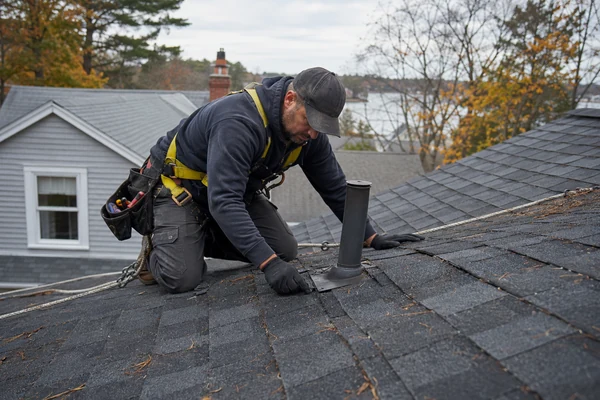
What Does Roof Maintenance Involve in Massachusetts?
Massachusetts roof maintenance means inspecting the roof twice a year, keeping gutters clear, treating algae and moss, checking flashing and pipe boots, confirming attic ventilation, and watching for leaks inside the attic. The goal is simple: find small problems in spring and fall before New England’s freeze-thaw winters and coastal storms turn them into interior damage.
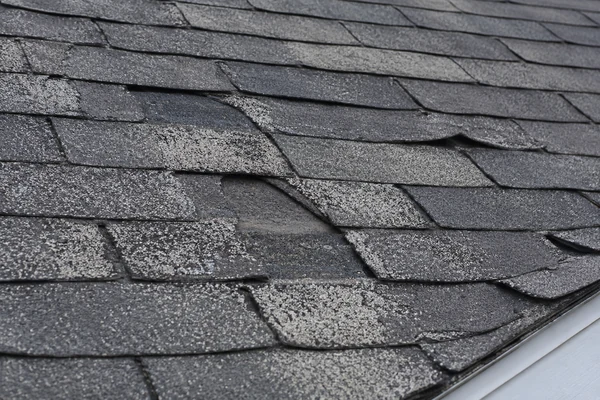
Why Massachusetts Roofs Fail Faster Than the Brochure Says
New England weather is hard on a roof in ways a national checklist skips. We see three big stressors here. Freeze-thaw cycles that work water into every crack and open it wider. Winter snow that melts and refreezes into ice dams. And wind-driven rain from nor’easters that pushes water sideways, up and under the shingles. Add salt air near New Bedford and Fall River, and the edges, flashing, and fasteners corrode faster.
Here’s what years of tear-offs have taught us: the shingle is usually the last thing to fail. The first is the stuff around it. Bad flashing, reused pipe boots, sloppy nailing, no proper ice-and-water barrier at the eaves, and rotted decking nobody mentions until the old roof comes off. If you want to understand how a roof is built, start there, not with the color of the shingle.
Start From the Ground, but Know What You’re Missing
You can learn a lot from the ground with binoculars, and you should look after every big storm. Scan for lifted or missing shingles, dark streaks, sagging lines, and debris piled in the valleys. But be honest about the limit. From the ground, a roof can look fine while the real trouble hides up close.
Once we’re on the roof, we find what the driveway view never shows. Granule loss that sands off in your hand. Nail pops. Cracked boots around the plumbing vents. Flashing pulled away from the chimney. Decking that feels soft underfoot. Those are the failures that let water in, and they are exactly what an aging roof hides until it leaks. A yearly professional roof inspection exists to catch them while they’re cheap to fix.
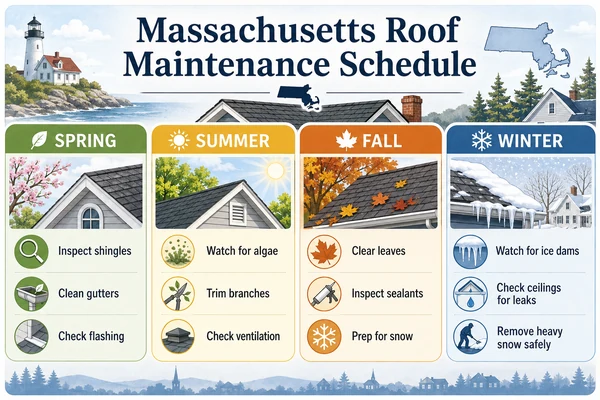
Your Massachusetts Roof Maintenance Schedule, Season by Season
The best maintenance follows the New England calendar. Right task, right season, and you stay ahead of the damage. Here’s the schedule we hand homeowners.
| Season | What to do | Why it matters here |
|---|---|---|
| Spring | Inspect after winter, clear gutters, check for lifted shingles and nail pops, look for ice-dam damage at the eaves | Freeze-thaw and ice dams do their worst by March; catch it before spring rain finds the gaps |
| Summer | Treat algae and moss, trim overhanging branches, check attic temperature and airflow | Humid stretches grow algae; a hot, under-vented attic bakes shingles from below |
| Fall | Clean gutters again after the leaves drop, check flashing and pipe boots, clear soffit and ridge vents | Clogged gutters plus the first freeze equal ice dams; this is the year’s most important cleaning |
| Winter | Watch for ceiling stains and icicles along the eaves, safely rake snow off low sections when it piles deep | Icicles and stains are early ice-dam warnings; acting fast keeps water out of the attic and drywall |
If you only do two things a year, make them the spring inspection and the fall gutter cleaning. Those two catch most of what we get called about.
Which Jobs Can You DIY, and Which Need a Roofer?
Some of this list is genuinely fine for a homeowner. Some of it puts you on a steep, wet surface or voids a warranty if you get it wrong.
| Task | Do it yourself | Call a roofer |
|---|---|---|
| Ground inspection with binoculars | Yes | — |
| Clearing gutters from a stable ladder | Yes, if you’re steady on a ladder | Second story or steep pitch |
| Trimming small overhanging branches | Yes | Large limbs over the roof |
| Treating algae from the ground | Sometimes | Full-roof cleaning, high or steep roofs |
| Replacing shingles, flashing, pipe boots | — | Every time |
| Anything that means walking the roof | — | Every time |
| Attic ventilation and ice-dam fixes | — | Every time |
The rule we give people is short: if the job means standing on the roof, call someone. A roof repair that runs a few hundred dollars is cheaper than an ER visit or a warranty you void by accident.
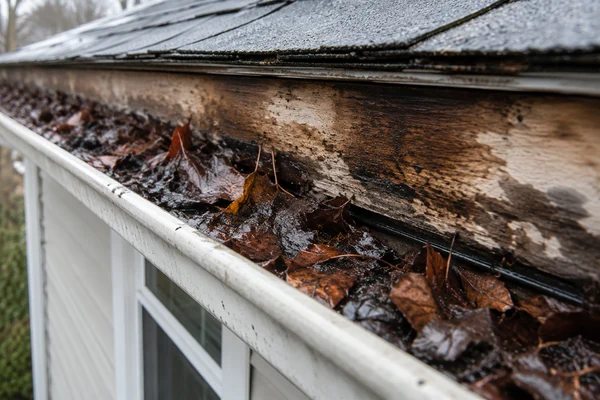
Clean the Gutters Before They Cost You a Fascia Board
Clogged gutters are the quiet cause of some of the priciest damage we see. When water can’t drain, it backs up under the first row of shingles, spills behind the gutter, and rots the fascia and soffit. In winter, that trapped water freezes and feeds the ice dam.
Clean them at least twice a year in Massachusetts, and always after the leaves drop. If the gutters are pulling away from the house or you spot stains on the fascia, the wood behind them may already be soft. That’s when a gutter cleaning turns into fascia and soffit work, which we handle on the same visit.
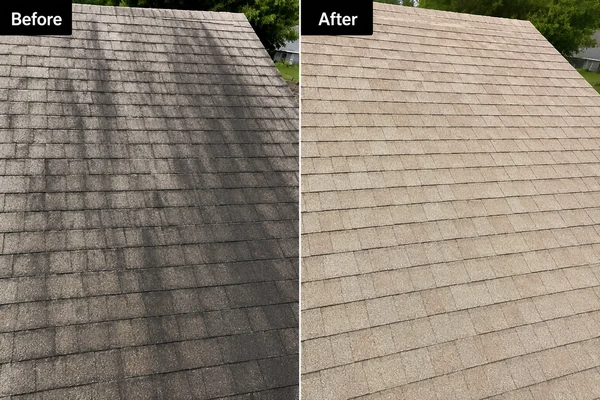
How Do You Get Algae and Moss off a Roof Without Wrecking It?
Those black streaks are blue-green algae, and the fix is gentler than most people think. The Asphalt Roofing Manufacturers Association recommends a 50-50 solution of laundry-strength chlorine bleach and water, sprayed on, left to sit 15 to 20 minutes, then rinsed at low pressure. Never pressure-wash asphalt shingles. High pressure blasts off the granules that shield the shingle from UV, and it can void the warranty. Wet your plants before and after so the runoff doesn’t kill the landscaping.
Here’s the part most checklists leave out: the smart play is prevention, not an annual bleach ritual. Zinc or copper strips near the ridge release metal ions that wash down the slope and stop algae, though they work best installed with a new roof, not nailed onto an old one. Better yet, algae-resistant shingles solve it at the source. The GAF Timberline HDZ shingles we install carry StainGuard Plus, with time-release copper granules and a 25-year algae warranty. If black streaks keep coming back every year, you’re treating a symptom the roof itself could handle.
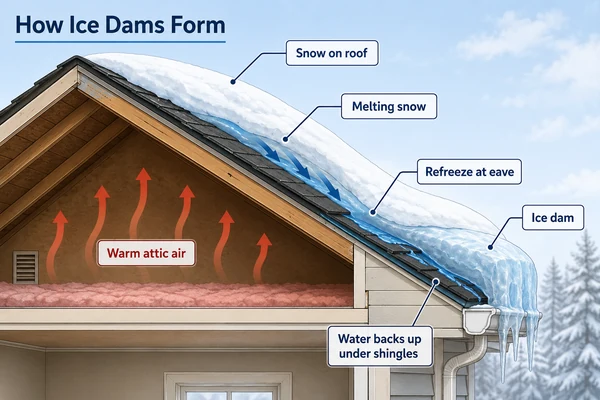
What Are Ice Dams, and How Do You Stop Them?
Ice dams are the New England roof problem, and almost everyone blames the wrong thing. Here’s the mechanism, straight from University of Minnesota Extension research: heat escaping from your house warms the underside of the roof deck, which melts the snow sitting on top. That meltwater runs down to the cold eaves and refreezes into a ridge of ice. Water pools behind the ridge, backs up under the shingles, and ends up in your attic, walls, and ceiling.
The cause is warm air leaking into a cold attic, not the weather itself. So the permanent fix follows an order: air-seal the ceiling first so warm air stops rising, add insulation second, and improve ventilation third. Roof rakes and salt socks help you survive a bad week, but they don’t touch why the dam formed. If you get ice dams every winter, the answer is in your attic, not on your roof.
Attic Ventilation and the 1/150 Rule Most Homes Fail
Attic ventilation does two jobs: it keeps the attic cold in winter so snow doesn’t melt unevenly, and it lets heat and moisture out in summer so shingles don’t cook from below. Most Massachusetts attics we open up are under-vented.
The code baseline is the 1/150 rule: at least 1 square foot of net free vent area for every 150 square feet of attic floor, split between intake vents at the soffits and exhaust at the ridge. You can move to a 1-in-300 ratio with a vapor barrier and balanced venting, the standard the Asphalt Roofing Manufacturers Association spells out. In plain numbers, a 1,500 square foot attic needs about 10 square feet of working vent area. If your attic feels like an oven in July, or your upstairs rooms swing hot and cold, the venting is probably blocked by insulation or just too small.
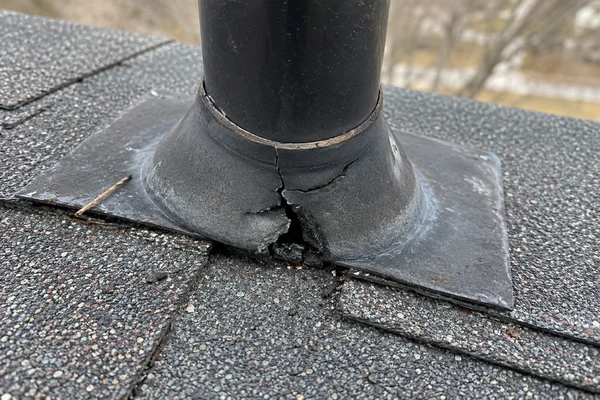
Check the Flashing, Pipe Boots, and Skylights
Flashing and pipe boots fail before shingles do, and they cause most of the leaks we chase. Flashing is the metal that seals the joints where the roof meets a chimney, a wall, or a valley. When it rusts, lifts, or was never set right, water walks straight in. The rubber boots around plumbing vents dry out and crack, usually within 10 to 15 years, which is why “water coming in by the chimney” is one of the most common calls we get.
Skylights are another weak point. Check the seals and flashing around any skylight after storms. Rust, peeling, or a line of daylight where there shouldn’t be one all mean it’s time to get it looked at before the next rain.
Look for Leaks From Inside Your Attic
The best place to find a roof leak is inside, not on top. Go into the attic with a flashlight on a dry day and look for water stains on the underside of the deck, dark rings around nails, damp insulation, or a musty smell. Those show up long before a stain reaches your ceiling.
Trace any stain uphill, because water runs along the framing before it drips. If you find active moisture, don’t sit on it. A small roof leak repair now beats replacing soaked insulation and drywall later, and it keeps mold out of the house.
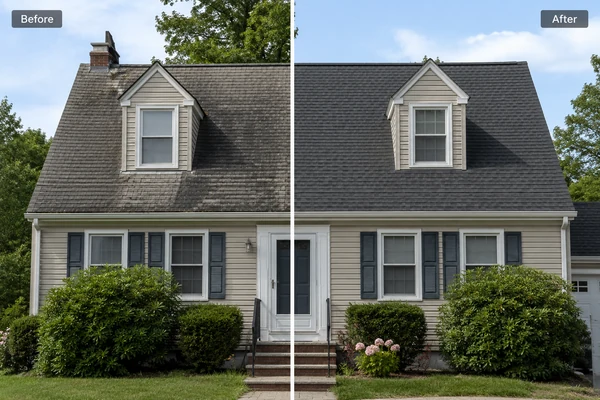
When Repair Beats Replacement, and When It Doesn’t
Maintenance buys you years. Every roof still reaches the end. The honest answer on repair versus replacement depends on what we find, not on what’s easiest to sell. If the shingles are sound and the problem is one flashing detail or a cracked boot, we repair it and say so. If the deck is failing, the granules are gone across whole slopes, or the roof is past 20 years and leaking in more than one spot, a full roof replacement is the better money. We’ll show you the real benefits of a new roof against another patch, so the call is yours.
We don’t sell fear. If a roof has good years left, we tell you that. When replacement is the right move, many Massachusetts asphalt roofs come in under $10,000, and larger or more complex homes run $15,000 to $20,000 or more, depending on size, pitch, layers to tear off, and any rotted wood we uncover. Most of our replacements go on in one to two days once the material is on site, and they’re backed by our GAF-certified workmanship and a GAF system warranty that covers both the materials and the labor.
Good Massachusetts roof maintenance isn’t complicated. It’s a spring inspection, a fall gutter cleaning, and a roofer who tells you the truth about the rest. If you’re not sure where your roof stands, get a written scope with real photos, and decide from there.
Frequently Asked Questions
How often should you do roof maintenance in Massachusetts?
Inspect twice a year, in spring and fall, and clean the gutters at least twice a year. Spring catches ice-dam and freeze-thaw damage from winter, and fall clears leaves before the first freeze. After any major nor’easter or wind storm, do a quick ground check for lifted or missing shingles.
Can I do my own roof maintenance, or should I hire a roofer?
Ground inspections, gutter cleaning from a stable ladder, and trimming small branches are reasonable to do yourself. Anything that puts you on the roof, replacing shingles, flashing, or pipe boots, or fixing ventilation should go to a roofer. Walking a wet or steep roof is how people get hurt and how warranties get voided.
How do you get black streaks and algae off a roof?
The Asphalt Roofing Manufacturers Association recommends spraying a mix of equal parts chlorine bleach and water, letting it sit 15 to 20 minutes, then rinsing at low pressure. Never pressure-wash asphalt shingles, since it strips the protective granules. A professional roof cleaning runs about $300 to $600.
What causes ice dams on Massachusetts roofs?
Heat leaking from the house into the attic melts snow on the roof, and that meltwater refreezes at the cold eaves into a dam that forces water under the shingles. The fix is in the attic, not on the roof: air-seal the ceiling, add insulation, then improve ventilation. Roof rakes only help in an emergency.
How much attic ventilation does a roof need?
Building code sets a baseline of 1 square foot of net free vent area for every 150 square feet of attic floor, split between soffit intake and ridge exhaust. A 1,500 square foot attic needs about 10 square feet of working vent area. Most homes we inspect are under-vented.
Should I repair or replace my roof?
If the shingles are sound and the issue is one flashing detail or a cracked pipe boot, a repair is enough. If the deck is failing, granules are gone across whole slopes, or the roof is past 20 years and leaking in several spots, replacement is the better spend. Most Massachusetts asphalt roof replacements come in under $10,000 for simpler homes and $15,000 to $20,000 or more for larger ones.