New roof construction vs roof replacement comes down to one thing, whether the house already exists. New construction puts a roof on a bare frame during a build. Replacement strips the old roof off a house that’s already standing and rebuilds it on the deck underneath.
If you own a home in Massachusetts, that’s probably not your decision to make. The state permitted 14,338 new housing units in all of 2024, against a stock of 3,072,289 housing units. Even if every one of those permits were a single-family house, new construction would touch under half a percent of Massachusetts homes this year.
So I’m going to answer the question, and then I’m going to tell you what you’re really choosing between.
What Is the Difference Between New Roof Construction and Roof Replacement?
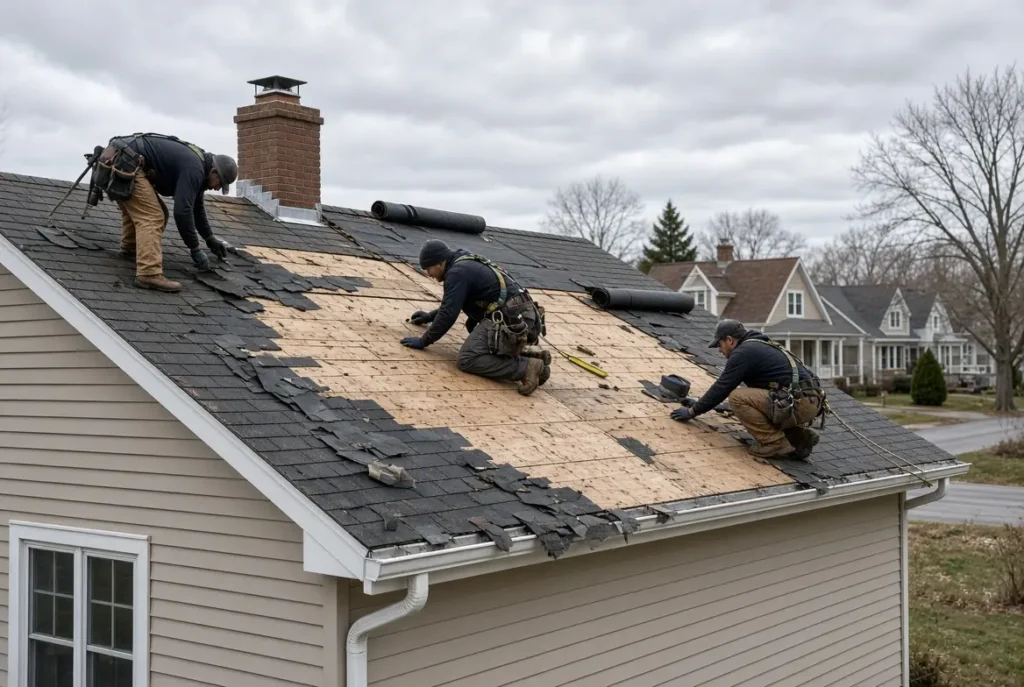
New roof construction is the roof built on a house that doesn’t have one yet, installed from the framing up during the build. Roof replacement strips an existing roof down to the wood deck and rebuilds it on the structure already there. One happens once. The other happens every few decades for the life of the house.
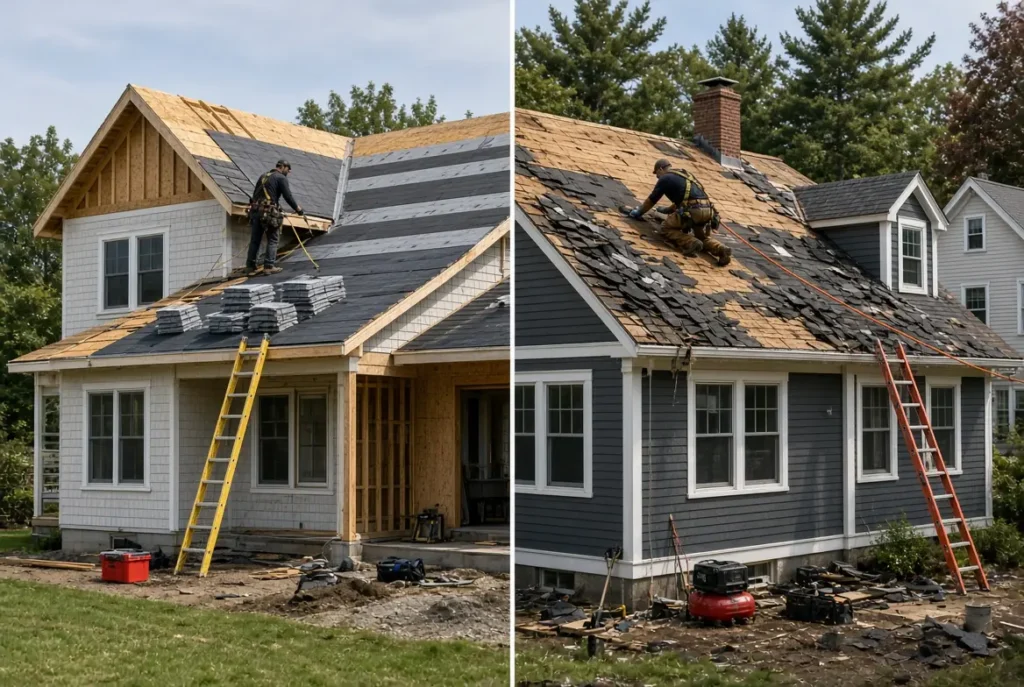
The sequence on a new build runs framing, then sheathing, then underlayment, then shingles and flashing and ventilation. Nothing gets torn off because nothing is there yet. The builder picks the pitch, the layout, the material, and the ventilation before a single bundle lands on site.
A replacement inherits all of that. The pitch is set. The roof line is set. What’s still open is everything underneath the shingle, and that turns out to be most of what matters.
Why this is almost never a Massachusetts decision
Massachusetts has old houses. The median owner-occupied home in this state is 59 years old, second oldest in the country behind New York, against a national median of 42 years according to the National Association of Home Builders’ analysis of Census data.
Pair that with the permit numbers and the picture gets clear fast. About 40 percent of the units Massachusetts permitted between 2013 and 2023 were single-family homes. Run that share against 2024’s 14,338 permits and you land somewhere near 5,700 new single-family roofs statewide, in a state with more than three million housing units.
New Roof Construction vs Roof Replacement: The Choice That Actually Matters
Here’s the fork that’s real on an existing Massachusetts home: full tear-off, roof-over, or targeted repair. Every competitor article on this topic skips it.
| New roof construction | Full tear-off replacement | Roof-over (recover) | |
|---|---|---|---|
| Starting point | Bare framed structure | Existing roof, stripped to the deck | Old shingles left in place |
| Who it’s for | New builds only | Most Massachusetts homes | Whoever’s chasing the lowest number |
| Wood deck inspected | Not needed, the deck is new | Yes, every square foot | No |
| Ice barrier at the eaves | Built in during construction | Can be installed | Cannot be installed |
| Flashing, pipe boots, drip edge | All new | All replaced | Usually reused |
| Typical install time | Weeks, staged around the build | 1 to 2 days once material is on site | About a day |
| Relative cost | Part of the build budget | Higher than a roof-over | Lowest today, most expensive later |
If your roof has a few lifted shingles and one bad pipe boot, you may not need any of this. We tell homeowners when a roof can be repaired instead of replaced, because selling somebody a roof they don’t need yet is how you lose a customer for twenty years.
What Changes the Size of a Roofing Quote
Every roof is a different house, and a made-up range helps nobody standing in their driveway trying to compare two bids.
What moves a quote, roughly in order: roof size, pitch, how many layers are coming off, and how much decking is rotted. After that, chimney and skylight and flashing work, ventilation, whether a truck can get near the house, and whether gutters or fascia and soffit are in the scope.
That’s also why two quotes on the same house come back far apart. They’re usually not quoting the same job. Ask what the tear-off includes, what happens if there’s rot underneath, and what’s specifically excluded. Our list of questions to ask a roofing contractor covers the rest of it.
What Does Massachusetts Code Require on a Roof Replacement?
Two things that surprise most homeowners, and neither one is about shingles.
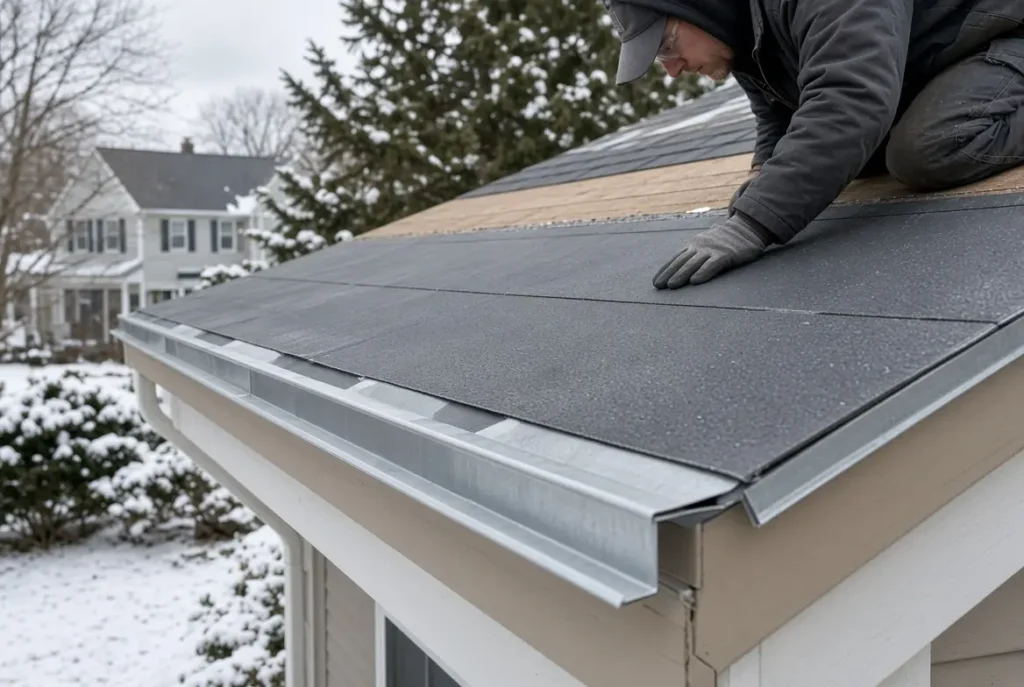
First, the ice barrier. Massachusetts runs on the 2021 International Residential Code with state amendments, which the state lays out in its tenth edition building code handbook. That code calls for a barrier at the eaves reaching from the lowest edges of all roof surfaces to a point not less than 24 inches inside the exterior wall line, and at least 36 inches from the eave edge on roofs at 8:12 or steeper. Massachusetts left that section unamended. It is a self-adhering membrane, not felt, and it exists because of exactly the ice damming a New England winter produces.
Second, energy code. The Massachusetts amendment to R901.1 in the Tenth Edition residential roof assemblies chapter reads: “In roofing and reroofing, the energy conservation requirements of Chapter 11 of 780 CMR 51.00 Massachusetts Residential Code shall also be satisfied.” Reroofing here isn’t only a roofing job. It has to clear the energy chapter too, which is where attic ventilation stops being optional.
Now put those two next to a roof-over. You cannot install an ice barrier at the eaves without taking the old roof off. The membrane has to bond to the wood deck. Leave the old shingles in place and the single most important detail on a Massachusetts roof stays exactly as bad as it was.
The Part of the Job That Decides the Whole Job
The same Massachusetts amendment has one more line in it, and it’s the one I’d tape to every homeowner’s fridge. R905.1 says: “Where there is a discrepancy between the requirements of this section and the manufacturer’s printed instructions or code evaluation report, the manufacturer’s printed instructions or code evaluation report shall govern.”
In Massachusetts, the shingle manufacturer’s install instructions carry legal weight.
So when a bid comes in a few thousand dollars under everyone else and it quietly drops the starter strip, or reuses the pipe boots, or skips the ridge vent, that homeowner isn’t buying the same roof cheaper. They’re buying an install that departs from the document the state code defers to.
We install the GAF system as a system: WeatherWatch ice and water leak barrier, FeltBuster synthetic underlayment, Pro-Start starter strips, Timberline HDZ shingles, Cobra ridge vent, Seal-A-Ridge ridge cap, plus drip edge, flashing, and new pipe boots. Not because it’s a nicer package. Because those components are what the printed instructions describe.
Across the roofs we do, the problem is almost never the shingle. It’s flashing, ventilation, a bad previous install, old pipe boots, valleys, rotted decking, or the edges of the roof where water has been getting in for years. The shingle is the part you can see from the street. Everything that actually fails is underneath it.
If You Already Own a New Construction Roof
A builder’s roof was specced by somebody who was buying hundreds of them and who does not own your house. It met code the day it passed inspection. That’s the whole promise.
Three things worth checking on a home built in the last fifteen years:
- The eaves. Ask whether an ice barrier went in, and how far up. Twenty-four inches inside the exterior wall line is the floor, not a target.
- The attic. Look for intake at the soffits and exhaust at the ridge. A ridge vent with blocked soffits moves almost no air, and it cooks shingles from below.
- The penetrations. Pipe boots are the cheapest part of a roof and the first thing to crack. On a fifteen-year-old builder roof they’re usually due.
If you’re not sure what you’re looking at, our Massachusetts roof inspection checklist walks through it, and we’ll photograph the whole thing for you either way. There’s also a longer piece on what to check on a new roof once work is finished.
How Long Does a Roof Replacement Take?
Most standard roof replacements we do go on in one to two days once material is on site and the weather holds. Our average is closer to one day.
That number does move. A steep roof, a big cut-up roof with a lot of valleys, two layers coming off, or rotted decking we find at tear-off will all add time. So will a house we can’t get a dump truck near. We tell homeowners what’s coming before install day: when material lands, what to clear out of the driveway, and what the noise is going to be like. There’s more detail on how long a roof install takes if you want the full breakdown.
Compare that to a new build, where the roof is one staged step inside a project measured in months.
Which One Your House Needs
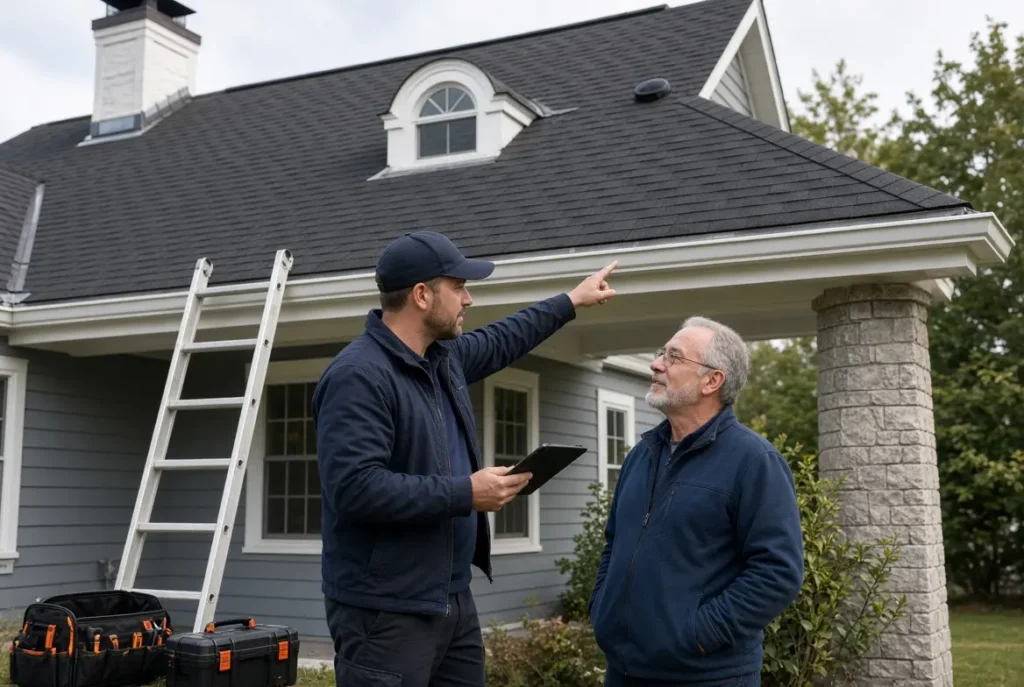
If you’re building, new roof construction is part of the build and your general contractor owns the schedule. If you own a house in Massachusetts, you’re choosing between a full tear-off, a roof-over, and a repair, and the honest answer depends on what the deck and the flashing look like, not on what a salesman wants to sell.
We’ve done full exterior projects in Taunton with roof, gutters, and PVC fascia and soffit; in Randolph with roof, gutters, and siding; and in Dorchester tying a roof into a window replacement. Different scopes, same approach at Powersol Roofing. Get on the roof, take photos, show the homeowner what’s there, and put a written scope in front of them instead of a number.
So new roof construction vs roof replacement is the wrong question for almost every house in this state. The right one is easier anyway. Get somebody on the roof, look at the deck and the flashing and the eaves, then decide. If you want us to do that looking, book a roof inspection in Quincy or ask about new roof installation. If the roof has another five years in it, that’s what we’ll tell you. And if you’re already seeing the signs the roof is done, the sooner we look, the fewer surprises are waiting under the shingles.
Frequently Asked Questions
Is a roof replacement faster than new roof construction?
Yes, by a wide margin. Most standard roof replacements we do install in one to two days once material is on site and the weather holds, and our average is closer to one day. New roof construction is one staged step inside a build measured in months, so the roof waits on framing and sheathing before it can start.
Does new roof construction cost more than a roof replacement?
Generally yes, because the new build is paying for framing, sheathing, and the full assembly rather than reusing a structure that’s already standing. That comparison rarely matters to a homeowner though. If your house exists, your real cost question is full tear-off versus a roof-over, and the roof-over is the one that costs more over the life of the roof.
Can you put a new roof over an old one in Massachusetts?
It’s sometimes possible, and we usually advise against it here. A roof-over leaves the old shingles in place, which means the wood deck never gets inspected and no ice barrier can be installed at the eaves. Massachusetts requires that barrier to run at least 24 inches inside the exterior wall line, and the membrane only bonds to a bare deck.
What does Massachusetts code require on a roof replacement?
An ice barrier at the eaves extending not less than 24 inches inside the exterior wall line, and at least 36 inches from the eave edge on roofs at 8:12 or steeper. Massachusetts also amends its code so that reroofing has to satisfy the energy conservation requirements in Chapter 11 of 780 CMR 51.00, which is where attic ventilation comes in.
What happens if the crew finds rotted decking after tear-off?
We stop, photograph it, and show you before anything gets covered. Rotted decking is one of the most common things we find once the old roof comes off, usually around valleys, chimneys, and the roof edges. Bad sections get replaced before the new system goes on, and you see the photos either way.
Should I get a roof inspection on a newly built home?
Yes, and most people don’t. A builder’s roof met code on inspection day, which is the floor and not the ceiling. On homes built in the last fifteen years we most often find blocked soffit intake, cracked pipe boots, and ice barrier coverage that stops short of what a New England winter asks for.
Does Powersol Roofing do new construction roofing?
We focus on residential roof replacements, repairs, inspections, gutters, fascia and soffit, ventilation, and roofs that have to coordinate with solar, across Greater Boston, the South Shore, and southeastern Massachusetts. If you’re building new, talk to your general contractor about who’s carrying the roof scope.