TPO roofing is a white single-ply membrane for flat and low-slope roofs. Its seams are heat-welded, so they fuse into a single continuous sheet, and its reflective surface cuts summer heat gain. At Powersol Roofing, we install TPO, EPDM rubber and modified bitumen on the flat and low-slope roofs Quincy and the South Shore run on. TPO is the system you’ll hear pitched hardest on energy savings. In Massachusetts, the seams and the spec on your quote matter more.
What Makes a TPO Roof Different?
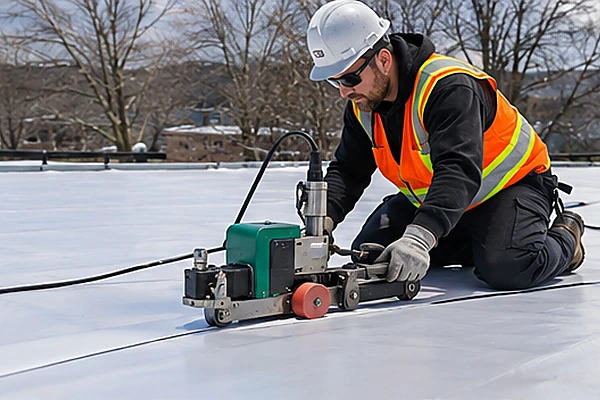
A TPO roof uses a white single-ply membrane on a low-slope roof, the kind below a 2:12 pitch. The membrane goes on as a single continuous waterproof layer. Its seams are heat-welded, so they fuse together instead of being glued, and its reflective white surface cuts summer heat gain over living space.
That seam is the big difference from EPDM rubber. We prime, tape and roll EPDM seams. TPO seams get heat-welded and probe-tested, and welded seams remove the most common flat-roof failure point.
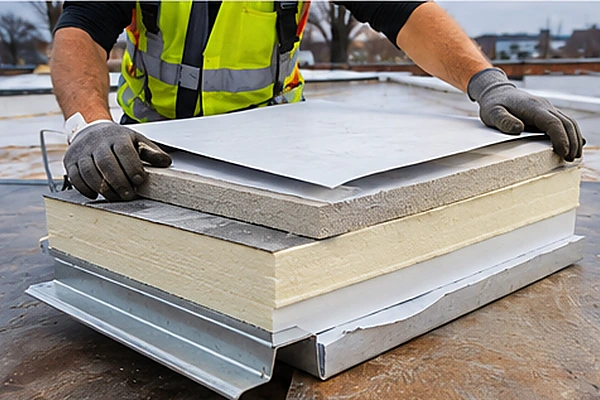
With almost no slope to move water, the seams, flashings and drains do all the waterproofing on a flat roof. Under the membrane sits insulation. On our commercial systems, that’s polyiso built to current Massachusetts energy code, tapered to kill ponding.
Where TPO Roofing Fits on a Massachusetts Building
TPO belongs on low-slope roofs. The International Building Code treats anything at or below a 2:12 slope as low-slope, and the International Residential Code calls for at least 1/4 inch of slope per foot on membrane roofs. Around here, that means three-deckers, porch roofs, storefronts and mixed-use buildings.
This is three-decker country, and the flat roofs on those buildings are a specialty of ours, not a sideline. We replace and repair three-decker flat roofs across Quincy and the South Shore. We also install EPDM and TPO systems on storefronts, and a full replacement gets staged in sections so the building keeps operating and nothing is left open overnight.
We pick by roof: EPDM for three-deckers, where freeze-thaw and cold flexibility matter, and TPO where summer heat gain matters, like a white roof over bedrooms and offices. Modified bitumen suits small porch roofs and patch-in work.
TPO vs EPDM for Massachusetts Roofs
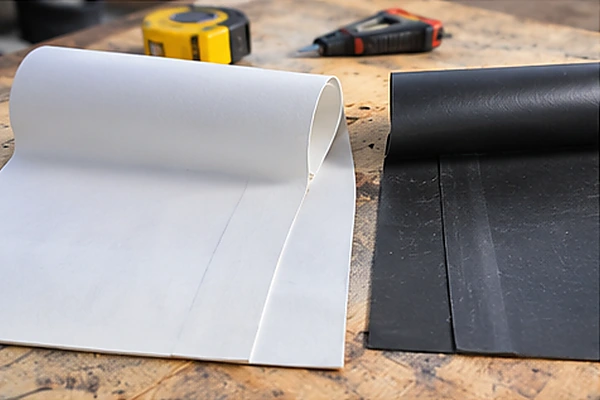
Both last 20 to 30 years in New England when they’re installed right, so the choice comes down to the building. EPDM is a rubber membrane, usually black, and it stays flexible when it’s 12 degrees out. That’s why it’s our default for low-slope South Shore buildings and the black roof on most Quincy and Dorchester three-deckers.
TPO is white and reflective, and its heat-welded seams remove the most common flat-roof failure point. It makes sense where summer heat gain matters.
Restaurants need a third option. PVC shrugs off animal fats, oils and chemical exhaust, which is why it’s the membrane we steer restaurants and commercial kitchens toward. On a restaurant roof, standard membrane breaks down years early at the grease exhaust fan. Our guide to commercial roofing types covers PVC, modified bitumen and the rest.
Why the Word TPO on a Quote Tells You So Little
2 quotes can both say “TPO” and describe different roofs. A commercial roof is a system of 5 layers: the membrane everyone sees, a cover board that takes the abuse, insulation tapered to kill ponding, a vapor retarder where the building needs one, and the structural deck underneath.
When a bid comes in low, something on that list is thinner, missing or reused, and you deserve to know which layer before you sign.
Thickness is part of it. TPO typically runs 15 to 30 years by membrane thickness, and a 60-mil sheet holds up to rooftop foot traffic far better than a thin one. Ask for the mil thickness in writing before you compare it to anything.
Then ask each bidder to name the manufacturer, the mil thickness and the attachment method on every line. If a quote won’t break down that way, that is your answer. Ours do. Every layer gets its own line, with the manufacturer, the thickness and the attachment method named, so when a lower bid leaves a layer off, thins it or reuses it, the gap shows up right there.
Does a White TPO Roof Save Money in Massachusetts?
Some, in summer, and less than it would in a hot climate. The reflectivity is real. The Department of Energy says a cool roof can shave at least 5 to 20% from the cooling costs on a home’s energy bill, and the EPA’s cool roof guidance puts the cut in peak cooling demand at 11 to 27% in air-conditioned homes.
But Massachusetts spends most of the year heating, not cooling, so that summer number does less for your bill here. The EPA also notes that cool roofs may raise energy use in winter in cold climates, though summer cooling savings typically offset that heating penalty. In Quincy, that trade is closer than it is in Phoenix.
So buy TPO for the right reasons: heat-welded seams, and a white surface over bedrooms and offices where summer heat gain matters. In a Massachusetts winter, the bigger issue is always drainage.
Seams, Flashing and Edges Decide Whether TPO Leaks
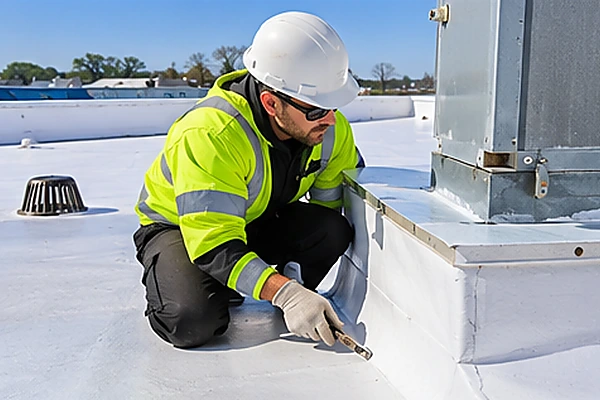
Flat roofs fail at the details, never in the middle. They leak at 4 places: standing water, the seams, the flashing where the roof meets a wall or a pipe, and the edges.
Every seam is a future leak if it’s rushed, so our TPO seams get heat-welded and probe-tested. Seam work is where installers separate, and you can’t see it from the ground.
Where the membrane meets a parapet, chimney, vent or HVAC curb is where most leaks start. Each spot needs its own flashing detail, terminated and sealed, not a smear of roof cement. At the perimeter, drip edge, termination bars and fastened edge metal keep a nor’easter from turning a corner of membrane into a sail.
Water still sitting on a roof 48 hours after the rain stopped is ponding. We correct slope with tapered insulation and make sure drains and scuppers move water where it should go. When we finish, every seam and penetration is detailed, the drains are cleared, and you get a photo record of the finished work. Our post on why flat roofs leak walks through each failure point.
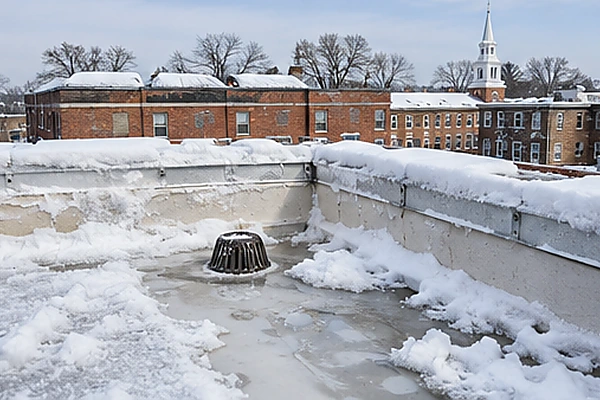
TPO in a Massachusetts Winter: Snow, Ice and Shovels
Freeze-thaw is the quiet killer of flat roofs here. Water slips into a hairline seam gap, freezes overnight, expands and pries it wider. Snow that sits for weeks and iced-over drains add standing water on top of that.
Shoveling a TPO roof usually does more harm than the snow. On a rubber or TPO membrane, a metal shovel edge will open a seam in a single pass, and that repair is worse than anything the snow was going to do.
A roof framed to current Massachusetts code isn’t in danger from an ordinary storm, so watch for the signs instead of the snow depth: doors or windows that suddenly stick, new cracks in ceilings or interior walls, a sagging line in the ceiling, creaking. If snow does have to come off, it comes off with a roof rake from the ground or by a crew, and it never comes off to bare membrane.
Clogged drains are the big winter risk on a flat roof, which is why our fall visit includes clearing them. Our flat roof maintenance guide covers the rest of the year.
How Long Does a TPO Roof Last?
We plan on 20 to 30 years for EPDM and TPO in New England when they’re installed right and maintained. The charts run lower. InterNACHI’s life expectancy chart lists TPO at 7 to 20 years, and the Defense Department’s roofing criteria say a properly built heat-welded membrane “may last 15 years or more.” Fannie Mae’s lender tables budget 20 years for EPDM, TPO and built-up roofs.
Every roof system has a lifespan on paper, and almost none of them reach it. A flat roof lasts 25 years or leaks in 3, and the membrane rarely decides which. Inspect it twice a year, spring and fall, plus after major storms. The 2 anchor visits are early October and late March, and regular checks of seams and flashings after year 10 extend the life.
When a TPO roof wears out, repair or replacement depends on whether the layers under the membrane are still dry. Dry insulation and decking usually mean a section repair holds. Once water has soaked in, a surface patch hides the problem for a season, and the residential code bars a new roof over one that’s water-soaked or deteriorated (section R908.3.1.1). Our flat roof lifespan post explains why the numbers disagree.

The TPO Quote Check: 7 Lines to Compare
Put 2 TPO quotes side by side and check these 7 lines. If a line is missing, ask for it in writing.
- The manufacturer, named on the line.
- The mil thickness, in writing.
- The attachment method.
- The seams: heat-welded and probe-tested.
- Every layer on its own line, with membrane, insulation, flashing and edge metal each priced separately.
- The insulation: polyiso built to current Massachusetts energy code and tapered to kill ponding, after a moisture check of the old roof.
- The warranty in writing, and what it excludes. GAF’s EverGuard guarantee, for one, doesn’t cover leaks caused by traffic off GAF walkways.
A TPO roof earns its place in Massachusetts when the sheet, the seams and every layer under them are spelled out on paper. If you’re comparing TPO roofing quotes in Quincy or on the South Shore, we’ll moisture-check the roof and give you a line-item quote. Get a free roof estimate or call (617) 631-5435.
Questions About TPO Roofing
Is TPO roofing better than EPDM?
Neither wins on every roof. We plan on 20 to 30 years for either one in New England when it’s installed right. We pick EPDM for three-deckers, where freeze-thaw and cold flexibility matter, and TPO where summer heat gain matters. TPO’s heat-welded seams remove the most common flat-roof failure point.
How long does TPO roofing last?
We plan on 20 to 30 years for a TPO roof in New England when it’s installed right and maintained. InterNACHI’s chart lists TPO at 7 to 20 years, and our commercial roofing guide puts TPO at 15 to 30 years by membrane thickness. A flat roof lasts 25 years or leaks in 3, and the membrane rarely decides which.
What thickness of TPO should I get?
Get the mil thickness in writing before you compare it to anything. A 60-mil sheet holds up to rooftop foot traffic far better than a thin one, and TPO typically runs 15 to 30 years by membrane thickness. Ask each bidder to name the manufacturer, the mil thickness and the attachment method on every line.
Can TPO go on a house?
Yes, on a low-slope roof over living space, like the top of a three-decker. The International Residential Code calls for at least 1/4 inch of slope per foot on membrane roofs. For most South Shore homes, fully adhered EPDM rubber is our workhorse, and we use TPO where summer heat gain matters, like a white roof over bedrooms.
Should you shovel snow off a TPO roof?
Usually no. On a rubber or TPO membrane, a metal shovel edge will open a seam in a single pass, and that repair is worse than anything the snow was going to do. If snow has to come off, use a roof rake from the ground or a crew, and leave an inch or 2 rather than scraping to bare membrane.
How much does a TPO roof cost in Massachusetts?
We don’t post per-square prices, because a real number comes from seeing the building. Roof size and deck condition move it most. When a bid comes in low, something is thinner, missing or reused, so compare quotes that name the manufacturer, the mil thickness and the attachment method on every line.