Massachusetts commercial buildings run on about eight roofing types, and only a few of them earn their keep through a New England winter. The common ones are EPDM rubber, TPO, PVC, modified bitumen, built-up roofing, metal, roof coatings, and green roofs. On the flat and low-slope roofs that sit over most South Shore stores, offices, and garages, single-ply membrane does the real work, which usually means EPDM or TPO. Metal belongs on pitched roofs. The rest are situational, legacy, or oversold for our climate. This guide ranks the types of commercial roofing the way a Quincy roofer actually watches them fail and last, so you can match the system to the building instead of to a brochure.
What Counts As Commercial Roofing?
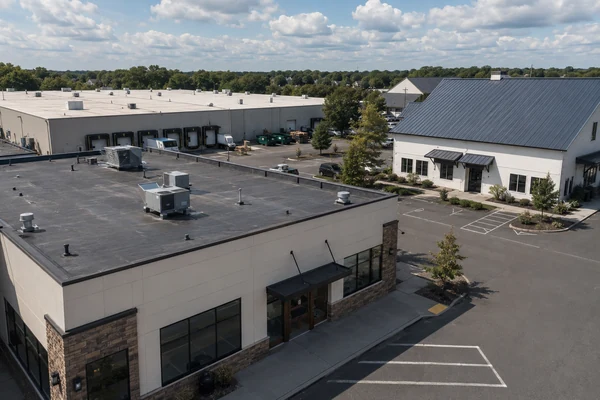
Commercial roofing covers the systems built for the flat and low-slope roofs on non-residential buildings: stores, offices, warehouses, garages, churches, and apartment blocks. A house roof sheds water fast down a steep slope. A commercial roof holds water on a nearly flat surface, so the membrane, the drainage, and the seams decide whether the building stays dry. That single difference drives almost every choice below.
How Is a Commercial Roof Different From a House Roof?
The short version: a house roof is about shedding water and looking good from the street, and a commercial roof is about moving water off a flat surface and proving the roof’s condition on paper. We install both, and the mindset is not the same. On a home, shingles do the job. On a warehouse, a clogged drain can pond thousands of pounds of water in one storm. That is why our quotes for flat and low-slope roofs start with drainage and the deck, not the color of the membrane. Owners, boards, and insurers also want dated photos and a replacement horizon, so documentation is part of the product, not an afterthought.
Commercial Roofing Types Compared
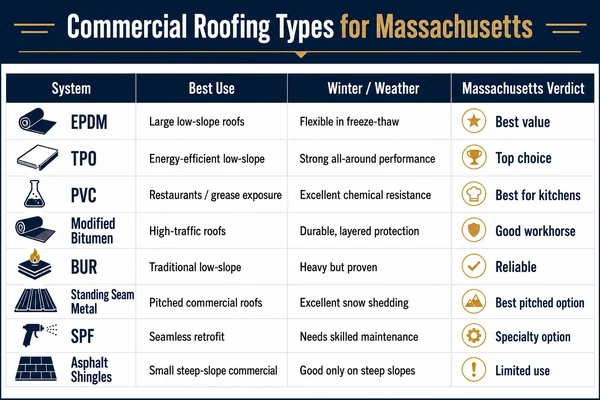
Here is the quick read before the detail. Service-life ranges assume a correct installation and real maintenance, which is the single biggest swing factor on every line.
EPDM Rubber: The New England Workhorse
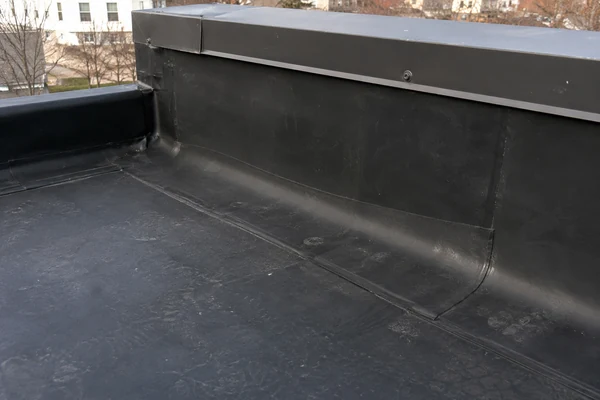
EPDM is a rubber membrane, and it is our default for low-slope South Shore buildings for one reason: it stays flexible when it is 12 degrees out. The EPDM Roofing Association puts the expected service life of a properly installed, maintained EPDM roof at 38 years. Here is the part they leave out. On the neglected roofs we get called to across Quincy and Braintree, EPDM often fails at 20 to 25 years, and the cause is almost never the rubber. It is a seam nobody checked, a drain nobody cleared, or flashing that was reused on the last job. The membrane earns its 38 years only if someone looks at it twice a year.
TPO: the Reflective Single-Ply Everyone is selling
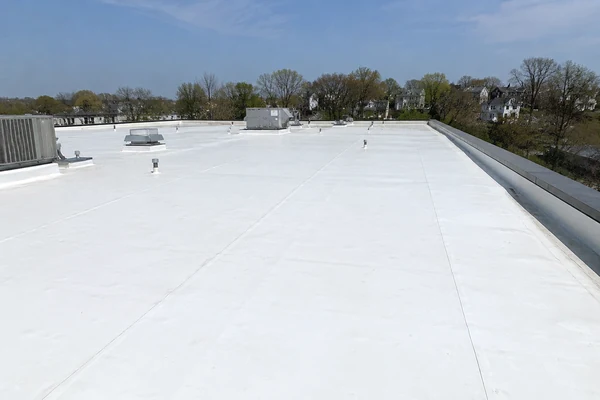
TPO is a white single-ply membrane, and it is the system you will hear pitched hardest on energy savings. The reflectivity is real. The U.S. EPA reports that a reflective cool roof can cut a building’s annual air conditioning energy use by 5 to 20 percent and stay as much as 50 degrees Fahrenheit cooler than a dark roof in peak summer. Now the honest part for our market: Massachusetts spends most of the year heating, not cooling, so that summer number does less for your bill here than it would in Phoenix. Buy TPO for the right reasons. It resists grease and UV, and a 60-mil sheet holds up to rooftop foot traffic far better than a thin one. Ask for the mil thickness in writing before you compare it to anything.
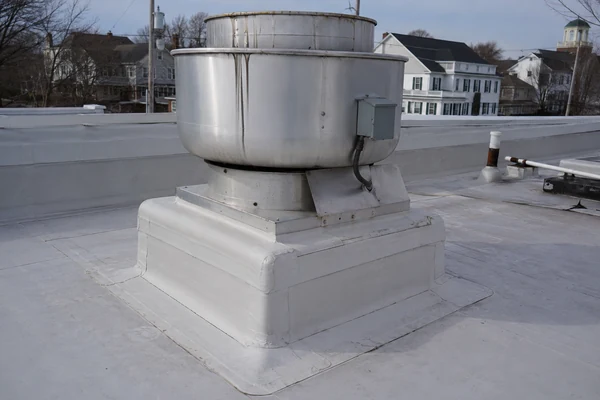
PVC: Built for Grease and Chemicals
PVC looks like TPO and behaves differently where it counts. It shrugs off animal fats, oils, and chemical exhaust, which is why it is the membrane we steer restaurants and commercial kitchens toward. A restaurant roof does not die of old age. It dies at the grease exhaust fan, where standard membrane breaks down years early. If your building vents oil onto the roof, PVC and a sacrificial pad at the fans will outlast a cheaper sheet by a decade.
Modified Bitumen: for Small, Cut-up, and High-traffic Sections
Modified bitumen is asphalt reinforced with rubber or plastic modifiers, rolled on in layers. We reach for it on smaller or complicated sections, a mechanical penthouse, a low addition, a roof carved up by curbs and equipment, rather than on a wide open span. It takes foot traffic well, which helps around serviced equipment. On a large flat roof, a single-ply membrane usually wins on cost and speed.
Built-up Roofing (BUR): the Gravel Roof you are probably Replacing
Built-up roofing is the old tar-and-gravel system, layers of asphalt and felt with stone on top. It can last decades, and some of the toughest old roofs in Boston are BUR. We install very little of it now. On most of our jobs it is what we are removing, because tear-off, weight, and repair access make it expensive to keep alive. If you have a sound BUR roof, maintain it. If it is failing, a modern membrane will cost less to run over the next 20 years.
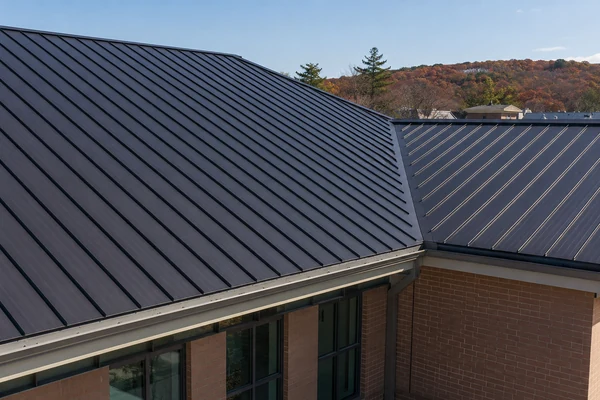
Metal: for Pitched Commercial and Long Horizons
Metal is the long-horizon system, 40 to 70 years when it is detailed right, and it belongs on pitched commercial roofs, not flat ones. If your building has slope, a standing seam metal roof is often the last roof you will buy for it. The trade-offs are upfront cost and the details: fasteners, expansion, and flashing have to be right, or a metal roof leaks at the penetrations the same way any other roof does.
Roof Coatings: Restoration, not a New Roof
Roof coatings are liquid systems, usually silicone or acrylic, rolled or sprayed over a roof that still has life in it. Applied to the right roof, a coating adds 10 to 20 years and reflects heat. Here is where we push back on how coatings get sold: a coating over a wet, failing roof just hides the problem and traps moisture. We coat roofs that pass an inspection first. If the deck is soft or the insulation is soaked, a coating is money spent to delay a replacement, not avoid one.
Green Roofs: Where they Fit in Massachusetts, and Where they don’t
Green roofs carry living plants in trays over a waterproof membrane, and their real strength is stormwater control, which matters in dense Boston zoning. They can last 30 to 50 years. They are also heavy, they need irrigation and upkeep, and they demand a structure built to hold the load. For most South Shore commercial buildings, a green roof is a design decision made at construction, not a retrofit we would recommend onto an existing deck.
Which Commercial Roofing Type is Right for your Building?
Match the system to how the building is used, because that is where roofs actually fail. A restaurant needs PVC at the grease exhaust. A garage or light-industrial building with big open spans needs drainage checked first, because one clogged drain ponds a lot of water fast. An office or mixed-use building needs the work sequenced around tenants and HVAC curbs. A condo or multifamily board needs the documentation as much as the repair, so the file survives the next board meeting. An institution on a tight budget needs an honest repair-versus-replace verdict in writing. We start every first visit with questions about how the building is used, not just what the roof looks like, because knowing the failure pattern is half the inspection.
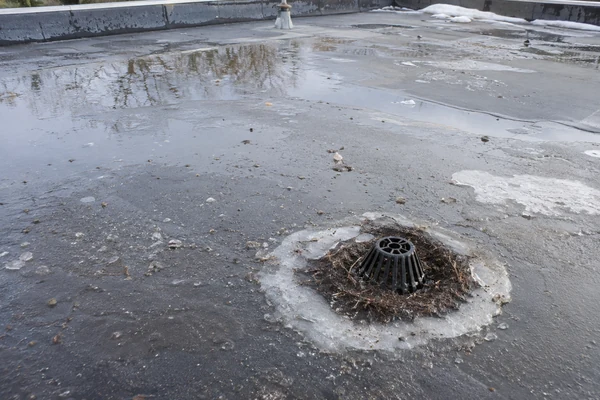
Why do Massachusetts Winters Decide which Roof Survives?
Freeze-thaw is the quiet killer of flat roofs here. Water gets into a small seam gap or a tired flashing detail, freezes, and expands about 9 percent, which widens the defect. It thaws, moves deeper, and refreezes. Boston runs through dozens of these cycles a winter, and each one pries a small problem a little wider. Add nor’easter snow load and coastal moisture, and the weak points are always the same: seams, penetrations, curbs, and drains. This is also why ponding matters so much. The National Roofing Contractors Association defines ponding as water still sitting on a roof 48 hours after rain, and the Asphalt Roofing Manufacturers Association recommends a minimum quarter-inch-per-foot slope so water actually leaves. On a New England roof, standing water that freezes is not cosmetic. It is a leak waiting for January. We design tapered insulation to move water to the drains for exactly this reason, and we clear those drains on a twice-a-year inspection.
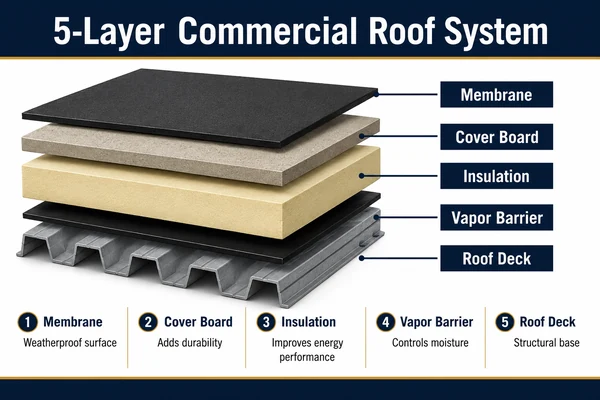
What Moves the Price of a Commercial Roof?
Roof size and deck condition move it most, followed by tear-off, drainage work, penetrations, membrane thickness, and how hard the roof is to reach with a crane. We do not post fake per-square prices, because a real number comes from seeing the building. What we will tell you is how to read two quotes. A commercial roof is a system of five layers: the membrane everyone sees, a cover board that takes the abuse, insulation tapered to kill ponding, a vapor retarder where the building needs one, and the structural deck underneath. When one bid comes in low, something on that list is thinner, missing, or reused, and you deserve to know which layer before you sign. Ask each bidder to name the manufacturer, the mil thickness, and the attachment method on every line. If a quote will not break down that way, that is your answer.
The One Thing that Decides your Roof’s Life
Every system above has a lifespan on paper, and almost none of them reach it. The gap between a 20-year EPDM roof and a 38-year one is not the rubber. It is whether anyone cleared the drains, checked the seams, and caught the small stuff on a schedule instead of after the ceiling stained. Pick the right type for your building and your climate, then treat the roof like the asset it is. If you want a straight read on which of these commercial roofing systems fits your building, or you have a leak right now, we answer the phone at (617) 631-5435 and work out of 100 Hancock St in Quincy. We will tell you what it needs, in writing, with photos, even when the honest answer is that it can wait.
Commercial Roofing Questions, Answered
What is the most common commercial roofing in Massachusetts?
Single-ply membrane, specifically EPDM rubber and TPO, covers most flat and low-slope commercial buildings across the South Shore. Both handle New England freeze-thaw well when installed and maintained correctly. Modified bitumen shows up on smaller or cut-up sections.
How long does a commercial flat roof last?
It depends on the system and the maintenance. The EPDM Roofing Association puts a properly installed and maintained EPDM roof at an expected 38 years, and TPO typically runs 15 to 30 years by membrane thickness. In practice, a neglected roof of either type can fail 10 years early at the seams and drains.
What is the difference between EPDM and TPO?
EPDM is a rubber membrane, usually black, that stays flexible in the cold and is our default for Massachusetts low-slope roofs. TPO is a white, reflective membrane that resists grease and UV. TPO reflects more summer heat, but that matters less in a heating-dominated climate like ours than sellers often suggest.
What is the best commercial roof for a restaurant?
PVC. It resists the animal fats, oils, and grease that vent onto a restaurant roof and destroy standard membrane years early. Pair it with a sacrificial protection pad at the grease exhaust fans and inspect those spots more often.
How often should a commercial roof be inspected?
Twice a year, spring and fall, plus after any major storm. New England freeze-thaw works on seams, flashings, and drains faster than most owners expect, and a 20-minute drain clearing in November routinely prevents a January ceiling collapse over inventory.
Can a commercial roof be replaced without shutting down the business?
Almost always. Most membrane repairs happen entirely on the roof with no interior access. For replacements, we stage the work in sections and schedule crane and delivery times around your operating hours, so entrances, docks, and HVAC service keep running.
Are roof coatings the same as a new commercial roof?
No. A coating is a restoration that adds 10 to 20 years to a roof that still passes inspection. Applied over a wet or failing roof, it traps moisture and hides the problem. We coat only roofs with a sound deck and dry insulation.