A sagging roof means something under the shingles has failed: the plywood deck, a rafter or truss, or the ties that keep the rafters from pushing your walls apart. When the sag shows up during heavy snow, or comes with creaking, popping or doors that suddenly stick, get everyone out of the house. FEMA’s Snow Load Safety Guide lists sagging roof members, cracked or split wood and doors that won’t open or close among the warning signs of an overstressed roof, and MEMA, the state’s emergency management agency, says to leave without touching light switches and call 911 from outside. Every other sag still gets inspected right away. At Powersol Roofing, we treat a sagging roofline as an emergency at any age, and the first job is finding out which part failed, because that decides the fix.
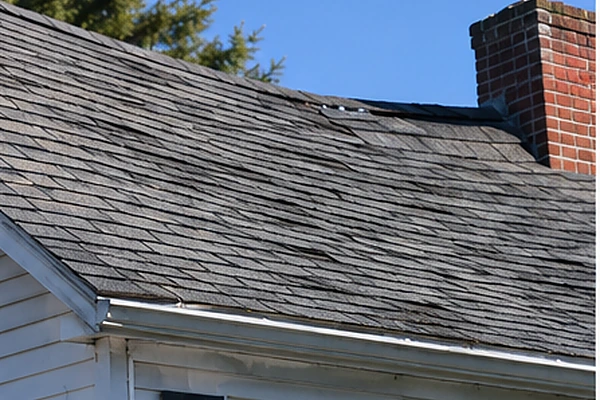
What Is a Sagging Roof?
A sagging roof is a roof plane or ridge line that dips, bows or waves instead of running straight. The dip starts in 1 of 2 places: the deck, meaning the plywood or boards under the shingles, has gone soft, or the frame that holds the deck up has cracked, bent or spread apart.
Our list of new roof signs puts it first: “If the ridge dips or the deck looks wavy from the street, that points to a structural problem, a failing truss, or wet, rotted decking under the shingles.” A soft deck gets cut out and replaced during a tear-off. A frame problem needs framing work, and sometimes an engineer, before new shingles go on.
When a Sagging Roof Means Leave the House Now
Leave when the sag is new and there’s snow on the roof, or when the house starts making noise. Everything else gets an inspection right away, not next season.
FEMA’s guide lists these signs of an overstressed roof:
- Popping, cracking and creaking noises
- Sagging roof members, including plywood sheathing
- Bowing truss members
- Cracked or split wood members
- Cracks in walls or masonry
- Doors and windows that can no longer be opened or closed
- Severe roof leaks
For those signs during a snow event, FEMA says the building “should be promptly evacuated and a qualified design professional should be contacted to perform a detailed structural inspection.” In plain terms, that means a structural engineer as well as a roofer. The full call-now list is in our post on what counts as a roofing emergency.
Where the Sag Is Tells You Why
Where the roof dips points to the part that failed, so start the inspection there.
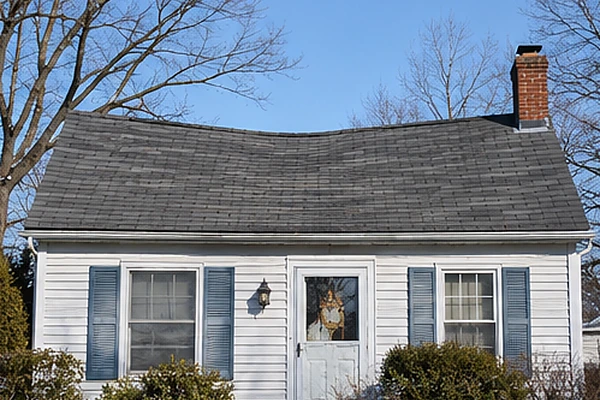
A dip in the middle of the ridge sends the check to the frame. Section R802.2 of the 2021 International Residential Code, which Massachusetts builds its residential code on, says the roof and ceiling “shall provide continuous ties across the structure to prevent roof thrust” from reaching the walls. Ceiling joists or rafter ties do that job, so a ridge dip means checking that they’re there, whole and fastened.
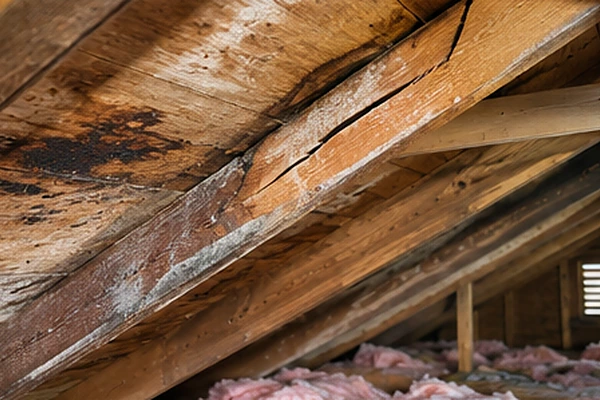
A deck that looks wavy can mean wet, rotted decking under the shingles. If a roofer’s foot presses into the roof, or you find soft wood in the attic, the deck under the shingles is compromised. Soft wood means the deck is wet and has been for a while.
A crack in a single rafter shows up from the attic. FEMA lists cracked or split wood members among its warning signs, and sistering is the rafter repair the state’s roof covering license names.
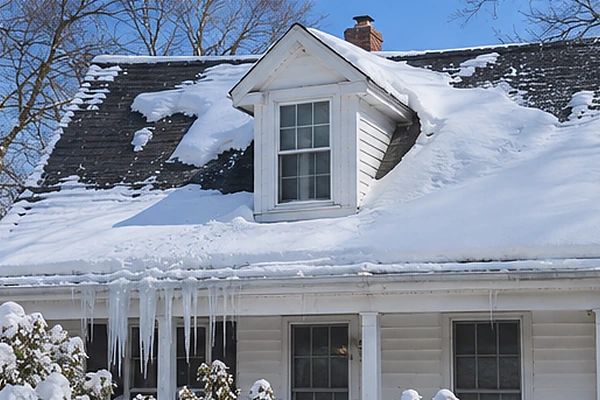
Porch roofs and the spots beside dormers can collect extra snow. FEMA’s guide notes that on houses, “chimneys, dormer windows, porch roofs, and skylights may collect snow drifts,” so check those areas first after a big storm.
A flat roof that holds water in 1 spot is its own warning. FEMA lists “excessive accumulation of water at nondrainage locations on low slope roofs” as a sign of overstress and says ponding “creates a concentrated load on the roof structural system.” MEMA adds that flat and low-pitched roofs are “at the greatest risk of buckling under heavy snow and ice accumulations.”
Why Do Older Massachusetts Roofs Sag?
Massachusetts houses are among the oldest in the country, and older framing wasn’t always built for the snow loads codes call for now. The median owner-occupied home here is 59 years old, against 42 nationally, tied with Rhode Island for 2nd-oldest, according to the National Association of Home Builders’ analysis of 2024 American Community Survey data. That median home went up before Massachusetts had a statewide building code, which took effect January 1, 1975.
FEMA’s snow guide makes the same point: “A building constructed 40 years ago may not have been designed for snow loads as they are understood today.”
Roofing stacks up, too. FEMA notes that a new roof laid over an old one “increases the weight of the roof assembly, thus reducing the structural capacity to carry the snow load.” Massachusetts code doesn’t allow a new layer over 2 or more existing ones, and our post on 3 layers of shingles covers what a stacked roof means at tear-off.
Remodels can change the frame as well. Cutting ceiling joists or rafter ties out to finish an attic removes the ties section R802.2 counts on.
How Much Sag Is Normal?
The residential code’s bend limits are for new rafters under snow, not for permanent sag in an existing roof. They cap how far a new rafter bends under a full snow load, and that bend is supposed to spring back when the snow melts.
The 2021 International Residential Code’s rafter span tables size rafters so they bend no more than their span divided by 180 when no ceiling is attached to them, or divided by 240 when one is. On a 14-foot rafter, that’s about 0.9 inch or 0.7 inch under the full design snow load.
Permanent sag is a different thing. The American Wood Council says wood under a long, steady load keeps bending, an effect called creep. For seasoned lumber, the expected deflection over time is about 1.5 times the first bend, and 2.0 times for unseasoned lumber, and long-term loading leaves “a permanent set of about 1/2 the creep deflection.” So an old roof can hold a dip that formed years ago.
That’s why 1 look doesn’t settle it. A sag that’s new, growing or paired with cracked wood needs a repair, and an old dip still gets inspected, because nobody can tell from the driveway which kind you have.
How to Check Your Roof Without Climbing on It
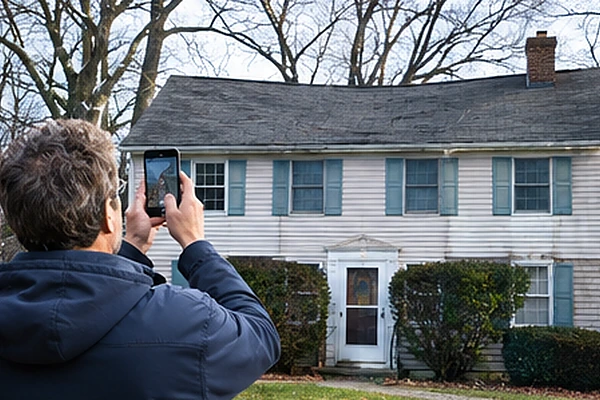
Look from the street, look in the attic, then keep a dated record. Stay off a roof you think is sagging.
From the street, stand where you can see the whole ridge, end to end, and take a photo from a spot you can find again. A roof should read as a straight line.
In the attic, if there’s a floor to stand on or you can stay on the framing safely, look for:
- Rafters that are cracked, split or pulled away from the ridge board
- Ceiling joists or ties that were cut or pulled loose from the rafters
- Stains, soft spots or daylight on the underside of the deck
Inside the house, watch for new cracks in the walls and doors that start sticking, since both are on FEMA’s list. Then start a record: pencil a short line across each end of a crack and write the date next to it, and retake the street photo every month and after every big storm. Call that day if a crack runs past your line or the ridge looks different in the photos.
Ceiling sag is a separate problem. A ceiling bulging with water is a leak first, and if the whole ceiling is sagging or cracking, don’t touch it.
A New Roof Won’t Fix a Sagging Roof
A new roof replaces the shingles and any rotted decking. It doesn’t replace the rafters, ties or ridge support that hold them up, and the code puts the job of holding a roof up on those parts.
Where ceiling joists or rafter ties don’t run across the house, section R802.3 says the ridge “shall be supported by a wall or ridge beam designed in accordance with accepted engineering practice.” Massachusetts’ amendments to that chapter change how rafters and ceiling joists are sized and leave R802.2 and R802.3 as written. Shingles and plywood aren’t part of either section.
So when the quote for a sagging roof is a roof replacement and nothing else, ask what happens to the frame: what failed, how they know, and what the fix for that part is.
On our side, we tear off to the deck and replace any rotted decking we find. We walk every sheet of plywood and show you photos first, soft or rotted sheets get replaced at the per-sheet price in your estimate, and the decking allowance is in writing, so rotted wood found after tear-off doesn’t become a surprise bill. If a repair solves it, we say that, even when a replacement would pay us more.
How a Sagging Roof Gets Fixed in Massachusetts
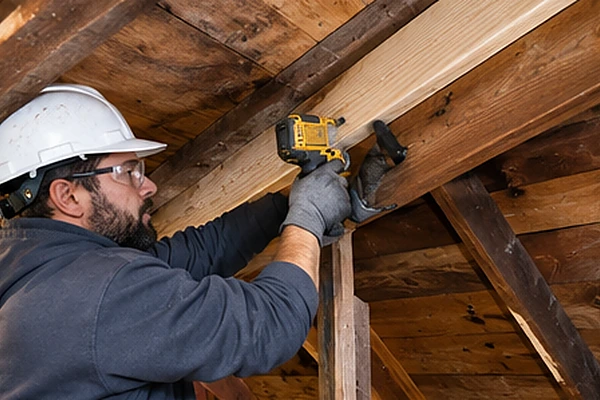
The fix follows the failed part: new sheathing for a soft deck, a sistered rafter for a cracked one, and ties or an engineered ridge beam for a frame without continuous ties.
Sistering means fastening a new rafter alongside the damaged one. Missing ceiling joists or rafter ties go back across the house, and where they can’t, a ridge beam takes over, designed by an engineer under R802.3. Permits apply, too. Massachusetts’ residential code makes it unlawful to repair a structure without a permit, it names pulling a structural beam or load-bearing support as work that always needs one, and roofing isn’t on its list of work exempt from permits.
Licensing draws its own line. Massachusetts’ roof covering license covers “repair and replacement of 25% of sheathing and 25% of sistering roof rafters.” Past that line, the job needs someone carrying broader licensing, and we break down the 25% rule in our post on what a licensed roofer covers. Ask which license is on the permit before the tear-off, not during it.
For structural concerns, FEMA’s guide points to “a qualified design professional, such as a Professional Engineer,” and warns that repairs “that are beyond the ability of the stakeholder or homeowner can cause additional damage.” Don’t jack up a ridge yourself.
Your Town’s Code Snow Load
Massachusetts sets a ground snow load for every city and town, from 25 to 60 pounds per square foot. Boston and Quincy sit at 40.
These figures come from the state’s residential snow load table, Table 301.2(2) in 780 CMR 51.00. Each line gives the ground snow load, then the minimum flat roof snow load, in pounds per square foot:
- Boston (Dorchester included), Quincy and Milton: 40 and 30
- Canton: 40 and 35
- Stoughton: 35 and 35
- Braintree, Weymouth, Randolph, Brockton, East Bridgewater, West Bridgewater, Taunton and Raynham: 35 and 30
- Bridgewater, New Bedford and Fall River: 30 and 30
- Worcester: 50 and 35
Each roof’s design snow load is the larger of 2 figures: the minimum flat roof snow load, or a flat roof load calculated from the ground snow load.
FEMA puts 1 foot of fresh snow at 3 pounds per square foot when it’s light and dry and up to 21 when it’s wet and heavy, and Massachusetts’ Department of Public Safety put wet snow at 12 to 18 pounds per cubic foot in a 2015 advisory. Even FEMA’s heavy end sits under the 30-pound flat roof minimum for every town on this list, which is why FEMA says “Most buildings are not at risk of snow induced failure.” Damage eats into that margin, since wood members “can split or rot, which can reduce the load-carrying capacity of the framing members.” Our post on roof damage after snow covers what to watch for after a big storm.
Does Homeowners Insurance Cover a Sagging Roof?
Usually not, unless something sudden caused it. Standard policy wording doesn’t count a roof that sags but still stands as a collapse.
The standard ISO homeowners form, HO 00 03 in its 2011 edition, says its collapse coverage doesn’t apply to “A building or any part of a building that is standing, even if it shows evidence of cracking, bulging, sagging, bending, leaning, settling, shrinkage or expansion.” The same form excludes “Wear and tear, marring, deterioration” and settling of roofs, and hidden decay counts toward a covered collapse only “unless the presence of such decay is known to an ‘insured’ prior to collapse.”
The Massachusetts Division of Insurance says damage from the weight of ice and snow or ice dams is generally covered under a homeowners policy, with a catch: “Further damage sustained due to wear and tear or neglect will not be covered.”
Our guide on how to document roof damage covers what to photograph so a claim reads as sudden storm damage, not wear that built up over years. We’re not a public adjuster and we’re not a law firm, and no roofer can promise you a carrier will approve anything. Read your policy’s collapse section and ask your agent.
Sagging Roof Repair Cost: What Moves the Number
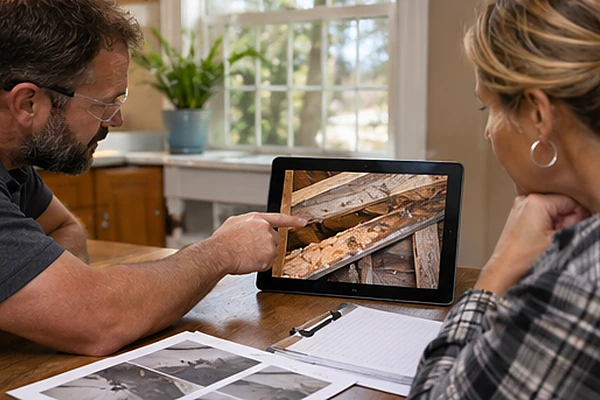
I don’t like throwing fake prices online, because every roof is different. What a repair costs is decided by what sits under the shingles, and nobody knows that from the driveway.
Prices in Massachusetts move with roof size, pitch, how many layers come off, rotted decking, chimney and skylight flashing work, ventilation, and access around the house. If anything needs work, the repair is quoted line by line, valid whether or not we do the work. A number over the phone is a guess dressed up as a quote.
Your sagging roof won’t fix itself, and it doesn’t always mean a whole new roof. A Powersol roof inspection is a photo-documented look at your roof from above and your attic from below, and every finding is photographed and explained in plain English. With new sag and snow on the roof, get everyone out first and call 911. Our phone is answered 24/7 at (617) 631-5435.
Questions About Sagging Roofs
Is a sagging roof dangerous?
It can be: a sag that’s new or growing, or that shows up during heavy snow with creaking, cracked wood or sticking doors, matches FEMA’s warning signs of an overstressed roof. FEMA says to evacuate and have a qualified design professional inspect the structure. Any other sag still needs an inspection right away.
What causes a roof to sag in the middle?
A dip in the ridge points to a structural problem, a failing truss, or wet, rotted decking under the shingles. Section R802.2 of the residential code requires ties across the house to prevent roof thrust, and R802.3 requires a wall or engineered ridge beam when those ties don’t run across. An inspection looks at the roof from above and the attic from below.
How much roof sag is acceptable?
The residential code’s bend limits are for new rafters, not for permanent sag in an existing roof. It sizes new rafters to bend no more than their span divided by 180 or 240 under a full snow load, about 0.9 or 0.7 inch on a 14-foot rafter. The American Wood Council says long-term loading leaves a permanent set of about 1/2 the creep deflection, so the test is whether a sag is growing.
Will a new roof fix a sagging roof?
Only if the deck was the problem. A replacement swaps the shingles and any rotted sheathing, while the code puts the job of holding the roof up on ties, rafters and ridge support. Those need their own repair when they fail.
Does homeowners insurance cover a sagging roof in Massachusetts?
Usually not, because standard ISO policy wording says a building that’s still standing isn’t in a state of collapse even if it shows sagging, and it excludes wear and tear. The Massachusetts Division of Insurance says damage from the weight of ice and snow is generally covered, so call your agent if a storm caused it.
Can a roofer fix a sagging roof in Massachusetts?
Up to a point: Massachusetts’ roof covering license covers repair and replacement of 25% of the sheathing and sistering of 25% of the rafters. Work past that line calls for broader licensing. Framing work needs a building permit, and an engineered ridge beam needs an engineer.
How much snow can a Massachusetts roof hold?
The state code sets a ground snow load for every town, from 25 to 60 pounds per square foot, with Boston and Quincy at 40. FEMA puts 1 foot of fresh snow at 3 to 21 pounds per square foot, depending on how wet it is. A sound roof built to code carries that, but rot or a cracked rafter cuts into the margin.