Most hail damage on a roof in Massachusetts doesn’t come from the storm that makes the news. It comes from the small stuff nobody reports.
Here’s the short version. Check your gutters, downspouts, AC fins and window screens for dents first. Then look at the shingles for dark spots and bare black asphalt. Then look for a pile of granules where the downspout drains. If soft metal around your house is dented, get the roof looked at. If nothing is dented, your roof probably took granule loss instead of impact damage.
That second outcome is the one almost nobody tells you about. A peer-reviewed study published in September 2025 explains why.
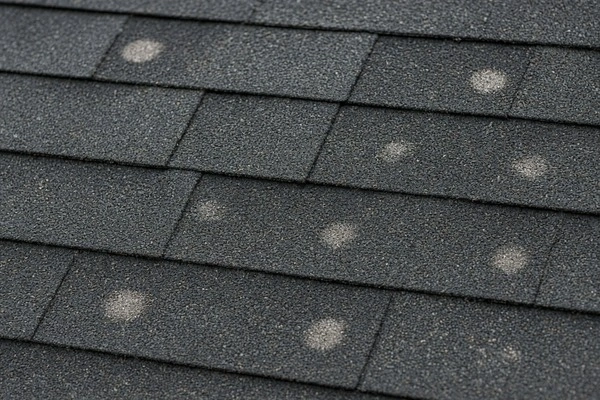
What Is Hail Damage On A Roof?
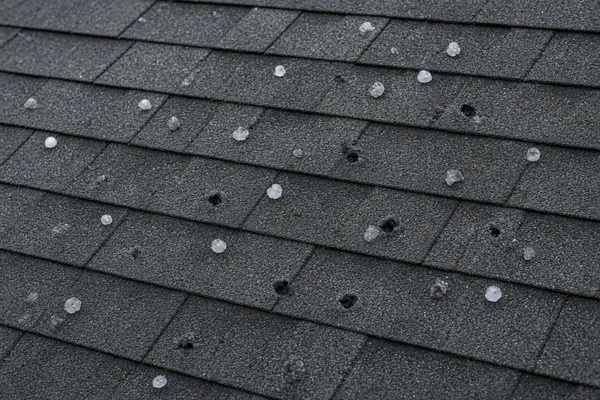
Hail damage on a roof is any impact from falling ice that strips granules, bruises the shingle mat, cracks the shingle, or dents the metal parts of the roof. It ranges from cosmetic granule loss to a fractured mat that lets water through. Damage that doesn’t leak on day one can still shorten the roof’s remaining life.
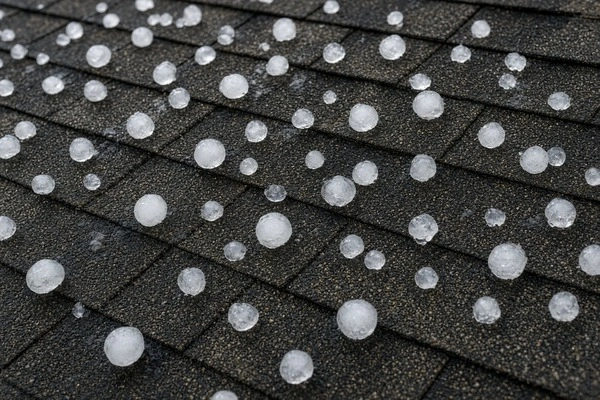
What Size Hail Damages A Roof?
Smaller hail than the industry assumed. The National Weather Service only calls hail “severe” at 1 inch across, a threshold it raised from 3/4 inch effective January 5, 2010. Under that line, no warning goes out and the storm mostly doesn’t get logged. Most roofers have treated anything under an inch as harmless.
That assumption broke last year.
| Hail diameter | NWS treats it as | Where the number comes from |
|---|---|---|
| 0.7 in | not severe, rarely reported | IBHS sub-severe test size |
| 1.0 in (quarter) | severe, triggers a warning | NWS threshold since January 5, 2010 |
| 1.25 in | severe | UL 2218 Class 1 impact |
| 1.5 in | severe | UL 2218 Class 2 impact |
| 1.75 in | severe | UL 2218 Class 3 impact |
| 2.0 in | severe | UL 2218 Class 4 impact, and the IBHS control size |
Researchers at the Insurance Institute for Business and Home Safety fired 1,000 ice spheres at asphalt shingles, 0.7 inch and 1 inch, and compared the result to a single 2 inch strike. Their findings ran in Frontiers in Materials on September 29, 2025.
Two numbers stood out. The granule loss from the small hail added up to more than the loss from one 2 inch hailstone. And shingles that had both weathered normally and taken sub-severe hits were about 10 times more likely to be damaged in a later severe storm. The paper’s own multiplier table puts a new shingle at 1x and a weathered, small-hail-exposed shingle at 9.6x.
So the storm that didn’t make the news is setting up the one that will.
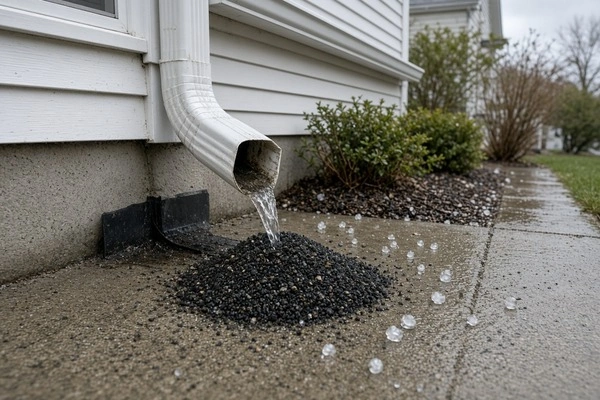
Why Granule Loss Is The Thing To Watch
Granules aren’t decoration. The Asphalt Roofing Manufacturers Association describes them as coloring plus protection for the asphalt underneath from UV degradation. Strip the granules and the sun starts working on the asphalt directly.
A roof that loses granules doesn’t leak that week. It leaks in year 14 of a roof you expected to get 25 out of. That’s the part homeowners find hardest to accept, and I don’t blame them. Nothing looks wrong.
Some granule loss is normal aging. A fresh pile at the downspout after a storm, on a roof that was fine last month, is not.
Massachusetts Is Not A Hail State, And That Changes The Math
Not for the big hail, anyway. Massachusetts doesn’t appear anywhere in the Insurance Information Institute’s 2025 ranking of the top 10 states for major hail events, meaning hailstones 1 inch or larger. Texas topped that list with 902. We’re not in that conversation.
Small hail is a different story. The IBHS researchers noted that sub-severe hail falls more often than large hail, and it’s the size that doesn’t get reported or warned on. Which means the storms most likely to be aging your roof in Quincy or Weymouth are the ones that never showed up in a single forecast.
That flips the usual advice. In Texas you watch for the big storm. Here you watch the gutters after the small ones.
If you’re worried about what actually wrecks roofs in this state, ice dams do more damage in a single February than most hail we see all year, and they’re the reason so many Massachusetts roof leaks start at the eaves rather than in the middle of the slope.
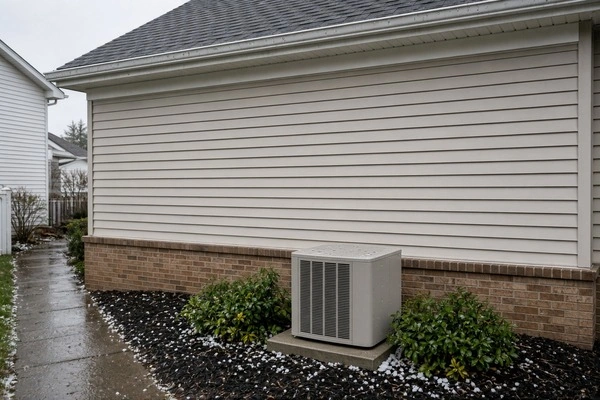
The Ground Check I Run After A Storm
Stay off the roof. I mean that. Wet shingles plus loose granules is how people get hurt, and walking on hail-struck shingles adds damage that wasn’t there before.
Work the soft metal first, because metal records the hit and shingles hide it:
- Gutters and downspouts, looking along the length at an angle
- The AC condenser fins on the side of the house
- Window screens and any vinyl trim
- Roof vents, chimney caps, and the metal flashing you can see from the ground
- Your car, if it was in the driveway
Dents in soft metal tell you the hail was big enough and hard enough to be worth a roof inspection. No dents anywhere, and you’re most likely looking at granule loss, not impacts.
Then check where water leaves the roof. Granules collect at downspout exits, on patios, and in the first 3 feet of the driveway. Photograph the pile before it washes away. Documenting roof damage properly takes 10 minutes and it’s the difference between a claim that goes somewhere and one that doesn’t.
Last, go in the attic with a flashlight during daylight. You’re looking for light coming through, wet sheathing, and stains around anything that penetrates the roof. Past that point a proper roof inspection is the only way to separate impact damage from ordinary wear.
Do Impact-Resistant Shingles Stop Hail Damage?
Class 4 is a UL 2218 rating. A 2 inch steel ball gets dropped on the shingle twice in the same place, and the shingle passes if there’s no opening visible on the back. When IBHS ran its own UL 2218 testing across basic and impact-rated shingles, none of the products it tested, impact-rated ones included, got past Class 2 impacts without at least one double-impact location failing.
The 2025 study found the same pattern with small hail. Impact-resistant shingles lost 16,191 square millimeters of granules on average. Conventional shingles lost 17,989. That’s about a 10 percent difference, and the authors say the sample was small enough that it needs more testing.
There’s also a gap in the test itself that IBHS points out: steel balls crush granules, and real hailstones aren’t hard enough to do that. The lab is measuring a failure mode that doesn’t happen on your roof.
I’m not telling you Class 4 is worthless. I’m telling you that if somebody sells you a hail-proof roof in Massachusetts, they’re selling you something the testing doesn’t support.
What I Actually Find When I Get Up There
The shingle is usually not the problem. Across the roofs we work on, the issues come from flashing, ventilation, bad previous installs, reused pipe boots, valleys, rotted decking, and the edges of the roof where water has been getting in for years.
That matters for a hail inspection, because a lot of what looks like storm damage from the driveway isn’t. Blisters from manufacturing look like impact marks. So does foot traffic from whoever installed the satellite dish. So does a roof that’s just old.
A pipe boot is the part most roofers reuse, and a cracked one will leak whether or not it ever saw hail. When somebody calls me about hail and I find a failed boot, I tell them it’s a failed boot. That’s a repair, not a claim, and not a replacement.
When A Massachusetts Hail Claim Is Worth Filing In 2026
File when you have dented soft metal, visible mat damage, or a roof already near the end of its life that just took a measurable hit. Skip it when all you have is light granule loss on a roof that’s only a few seasons old, because you’ll likely spend your deductible and get nothing back.
Two Massachusetts specifics worth knowing.
Under Massachusetts General Laws Chapter 175, Section 99, the standard policy form says no suit against the insurer will be sustained unless it’s commenced within 2 years from the time the loss occurred. That’s the deadline to sue, not the deadline to report. Your carrier’s notice requirement is separate and much shorter. Read your policy.
And your adjuster decides coverage, not your roofer. I’ll document what I see, take photos, meet the adjuster, and explain the condition. I won’t promise you an approval, and anyone who does is telling you what you want to hear.
The deductible math is easier once you know what a roof runs here. A lot of Massachusetts asphalt shingle roofs land under $10,000, and many run $15,000 to $20,000 and up. Roof size, pitch, how many layers come off, rotted decking, chimney and skylight work, ventilation and access around the house all move that number. Most of the storm damage repair we handle around Quincy traces back to wind and ice rather than hail.
The Knock On Your Door After A Storm
If somebody shows up uninvited offering a free inspection two days after hail, slow down. Massachusetts isn’t a hail state, and out-of-town crews follow hail. The storm chaser pattern costs Massachusetts homeowners real money, and the pitch is always the same: urgency, a clipboard, and a signature today.
A real contractor will show you photos of your own roof, put a written scope in your hands, and let you think about it. Ask them what happens if they find rotted wood after tear-off. Ask what exact system is going on. Ask who’s managing the job after you sign.
We install the complete GAF roofing system and back new roofs with a 25 year guarantee on top of the manufacturer coverage. Powersol Roofing inspects storm-hit roofs across Quincy, Braintree, Weymouth, Milton, Randolph, Hingham and Dorchester, and we’ll tell you what we find either way. Call (617) 631-5435. Somebody answers 24/7.
Frequently Asked Questions
Can hail smaller than 1 inch damage a roof?
Yes. A study published in Frontiers in Materials in September 2025 found that cumulative granule loss from repeated sub-severe hail, meaning under 1 inch, exceeded the granule loss from a single 2 inch hailstone. Shingles that had weathered and taken small-hail hits were about 10 times more susceptible to damage in a later severe storm.
How do I tell hail damage from normal granule loss?
Timing and quantity. Every asphalt roof sheds granules slowly as it ages. A sudden pile at the downspout after a storm, on a roof that showed nothing a month earlier, is storm-related. Dents in nearby soft metal like gutters and AC fins confirm the hail was forceful enough to matter.
Does Massachusetts get hail damage on roofs often?
Not from large hail. Massachusetts doesn’t appear on the Insurance Information Institute’s 2025 ranking of the top 10 states for hail events of 1 inch or more, where Texas led with 902. Small hail is more common here, and it’s the size that doesn’t get reported or warned on.
Do Class 4 impact-resistant shingles prevent hail damage?
Not reliably. IBHS testing to the UL 2218 standard found that none of the shingles it tested, impact-rated products included, passed beyond Class 2 impacts without at least one double-impact failure. In the 2025 small-hail study, impact-resistant shingles lost 16,191 square millimeters of granules on average against 17,989 for conventional shingles.
How long do I have to file a hail damage claim in Massachusetts?
Massachusetts General Laws Chapter 175, Section 99 sets a 2 year limit from the date of loss to bring suit against your insurer under the standard policy form. That’s separate from your carrier’s own notice requirement, which is usually much shorter. Check your policy for the reporting window.
Should I get on the roof to check for hail damage?
No. Wet shingles and loose granules make a roof more dangerous than it looks, and walking on damaged shingles causes more damage. Everything useful can be checked from the ground, from a window, or from inside the attic.
Will hail damage on a roof in Massachusetts show up right away?
Usually not. Granule loss and mat bruising don’t open a hole. They shorten the roof’s remaining service life, and the leak shows up a season later, or years later, when freeze-thaw cycles and UV exposure finish the job the hail started.