A licensed and insured roofing contractor has met the state’s requirements to do the work legally and carries coverage for what can go wrong while the crew is on your property. That’s the short version. The longer one matters more. Those 2 words hide 5 separate credentials. They mean different things in different states. And the one most homeowners never ask about is the one that decides what happens when the tear-off finds rotted wood. Here’s all 5 in plain language, for Massachusetts homeowners about to collect quotes.
What Does “Licensed and Insured” Mean for a Roofing Contractor?
A licensed and insured roofing contractor holds a state credential to do the work and carries 2 policies. General liability covers damage to your property. Workers compensation covers injuries to the crew. In Massachusetts, most residential roofing also requires Home Improvement Contractor registration. That’s a separate credential from the license itself.
Count the pieces. License. Registration. Liability coverage. Workers comp. That’s already 4, and 2 more get folded into the same phrase. A contractor can honestly say “licensed and insured” while holding a thinner version of all of them than you pictured.
Two Words, Five Credentials
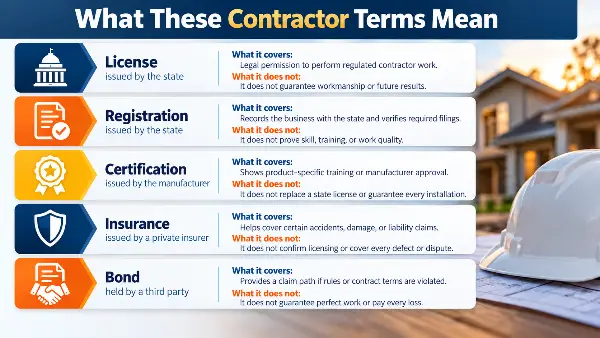
Here’s the separation nobody makes. It’s worth understanding before you compare quotes.
A license is permission from the state to perform a category of construction work. In Massachusetts that’s the Construction Supervisor License, and it comes in an unrestricted version and several narrower specialty ones.
A registration is different. Home Improvement Contractor registration isn’t a skill credential at all. It’s an entry in a state database plus a set of consumer protections that attach to the contract. You can hold one without the other.
A certification comes from a manufacturer, not a government. Most major shingle makers run one. It says a company met that manufacturer’s standards. It also controls which warranties that company can offer you at all.
Insurance is 2 policies doing 2 unrelated jobs, and we’ll get to what each one actually pays.
A bond is a financial guarantee held by a third party. A homeowner can sometimes claim against it. Bonding and insurance get used interchangeably in ads, but they aren’t the same instrument.
Five things. Two words. When a roofer says “we’re licensed and insured,” the useful follow-up isn’t “can you prove it.” It’s “which ones.”
Does Massachusetts Require a Roofing License in 2026?
Yes, and the answer is more specific than most homeowners expect. Massachusetts issues a specialty Construction Supervisor License for roof covering work, and separately requires Home Improvement Contractor registration for work on owner-occupied homes of 1 to 4 units.
The state’s own guidance is direct about the division. A licensed construction supervisor or a registered design professional must oversee construction on 1 and 2 family homes and on buildings under 35,000 cubic feet of enclosed space. For existing owner-occupied homes of 1 to 4 units, that same requirement applies and the contractor also has to register with the home improvement program. Massachusetts also states plainly that it does not recognize out of state contractor licenses, which matters more than it sounds like it does after a storm.
The registration side carries its own rules. State law requires home improvement contracts over $1,000 to be in writing. It also limits the deposit taken before work starts. Under Chapter 142A, that deposit can’t exceed the greater of 2 figures: one third of the contract price, or the actual cost of special order or custom made materials. Read that twice. It isn’t a flat one third cap. A bigger deposit can be lawful when special order material explains it, and a roofer asking for one should be able to name that material. No written scope and a half-down request with nothing special ordered? That’s 2 problems at once, and neither is about shingles.
Want the step-by-step on pulling a contractor’s record and reading what comes back? Our guide to spotting a storm chaser walks through the lookup field by field.
The 25% Rule Almost Nobody Explains
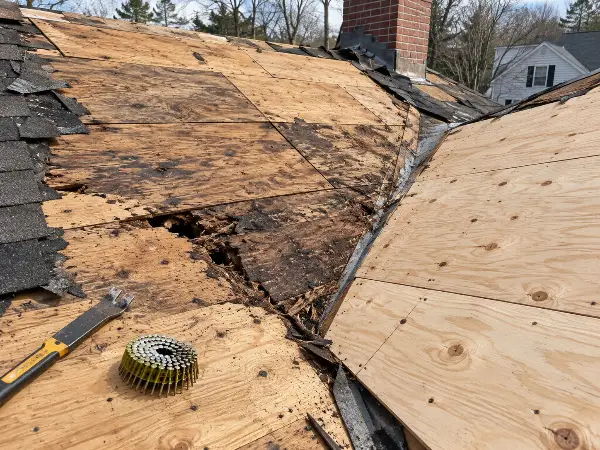
The specialty roof covering license, the RF designation, has a published scope limit. Under the state building code it covers construction, alteration, repair or removal of roof covering, including repair and replacement of 25% of sheathing and 25% of sistering roof rafters.
That percentage is the part to sit with. It isn’t a suggestion about quality. It’s the edge of what that credential authorizes.
Now put it against what actually happens on job sites. Across the roofs we do, the problem usually isn’t the shingle. It’s flashing, ventilation, a bad previous install, old pipe boots, valleys, and decking that went soft years ago under a roof nobody had looked under. You don’t find out until the old roof comes off. Every homeowner we quote asks some version of the same question: what happens if you find rotted wood after the tear-off?
Here’s why the credential and the rot are the same conversation. A crew working under the specialty roof covering license can replace sheathing up to that 25% line. Past it, the work has moved beyond what that license covers, and the job needs someone carrying broader authority. Never asked which license is on the permit? You find out on day 2, roof open, rain in the forecast.
Ask before the tear-off, not during it. A roofer who answers clearly, and puts the decking allowance in writing, has thought about this before. A proper roof inspection catches most of it while you still have options, and our inspection checklist covers what belongs on one.
What Does a Roofer’s Insurance Actually Pay For?
General liability pays for damage the crew does to your property. Workers compensation pays for injuries the crew suffers on your roof. They’re separate policies with separate purposes, and a contractor can carry one without the other.
General liability is the one homeowners picture. A ladder goes through a window, a dumpster cracks the driveway apron, a bundle of shingles comes off the edge and lands on the fence. That’s liability territory.
Workers comp matters more and gets checked less. Roofing crews work at height all day. When someone on an uninsured crew is hurt, the question of who pays doesn’t disappear. It moves toward the property owner. That’s the exposure most homeowners never price into a cheaper quote.
Some contractors also carry commercial auto, which covers the trucks and trailers on your street. It’s worth knowing it exists, though it’s a smaller piece of the picture than the first 2.
What neither Policy Covers
Neither general liability nor workers compensation is a warranty on your roof.
This is the piece that surprises people, and it’s worth being blunt about. Those policies handle damage and injury. They are not a promise that the roof was installed correctly. Say flashing was cut wrong. Or the ventilation is short. Or the nails went in at the wrong depth and shingles start lifting in year 3. None of that is an insurance claim. You’re looking at your workmanship warranty, and at whether the company that signed it still answers the phone.
So the standard advice, “make sure they’re insured,” is right but incomplete. Insurance protects you during the job. The warranty and the certification protect you after it. Most homeowners spend all their diligence on the first one.
That’s also the quiet reason a cheaper quote can cost more. When a number comes in well under the others, the gap is usually scope, not profit. Look at tear-off, decking allowance, ventilation, flashing, drip edge, pipe boots, cleanup, and what the warranty actually says. Our breakdown of what to ask before you sign puts those into 15 questions you can work through on a driveway.
A Certificate of Insurance Is a Snapshot, Not a Promise
A certificate of insurance proves coverage existed on the day it was printed. It doesn’t prove coverage exists on the day your roof gets torn off.
Policies lapse. They get cancelled for non-payment. A certificate handed over in March says nothing certain about June. So ask for something better. Have the contractor’s insurer send the certificate directly, with your name listed as certificate holder. That way you get notified if the policy changes.
It takes one phone call and it closes a gap that a printed PDF leaves wide open.
How Is a Manufacturer Certification Different From a License?
A license comes from the state and authorizes the work. A certification comes from the shingle manufacturer and controls which warranties the contractor can offer you. Neither substitutes for the other.
GAF’s published residential warranty structure shows how much this matters. Their basic Shingle and Accessory Limited Warranty has no contractor requirement at all. The Roofing System and System Plus warranties require a GAF Certified, Certified Plus or Master Elite contractor. Silver Pledge requires Certified Plus or Master Elite. Golden Pledge, the only tier carrying lifetime workmanship coverage with a 25 year non-prorated period on Timberline HDZ, is available only through Master Elite contractors.
Read that ladder again. The warranty you’re offered is a direct readout of the installer’s certification tier. A company that can only write the base warranty is telling you its tier, whether it says so or not. And the gap between tiers isn’t marketing. It decides whether the manufacturer covers workmanship at all. System Plus, for one, includes no workmanship coverage.
When a roofer names a warranty, ask which tier it is and what certification level it requires. The 2 answers have to match.
Why the Safety Rules Show Up in Your Driveway
Federal rules require fall protection for roofing work at 6 feet, and the cost of following them is built into a legitimate quote.
The OSHA standard is specific. 29 CFR 1926.501 covers any employee on a steep roof with unprotected edges 6 feet or more above the level below. They have to be protected 3 possible ways: guardrails with toeboards, safety nets, or a personal fall arrest system. The same 6 foot trigger applies to residential construction generally.
The numbers behind the rule aren’t abstract. The Bureau of Labor Statistics recorded 1,032 fatalities among construction and extraction workers in 2024, including 370 fatal falls, slips and trips. Roofing sits at the sharp end of that.
Harnesses, anchors, and the time to set them up are real line items. A quote well below the others sometimes reflects a crew that skips them. That decision gets made on your property, by people you didn’t hire directly, under a policy you never saw.
The Five Credentials Side by Side
| Credential | Who issues it | What it actually does | What it does not do |
|---|---|---|---|
| Construction Supervisor License | Massachusetts | Authorizes the construction work; specialty roof covering version caps sheathing and rafter work at 25% | Does not register the contractor for consumer protections |
| Home Improvement Contractor registration | Massachusetts | Attaches contract rules and consumer remedies to the job | Does not certify skill or code knowledge |
| Manufacturer certification | The shingle manufacturer | Controls which warranty tiers can be offered, including workmanship coverage | Carries no legal authority to perform work |
| General liability insurance | Private insurer | Pays for damage the crew causes to your property | Does not cover defective installation |
| Workers compensation insurance | Private insurer | Covers crew injuries so exposure doesn’t land on the homeowner | Does not cover your property or your roof |
Where This Leaves You
Hiring a licensed and insured roofing contractor is the floor, not the finish line. The phrase is accurate and nearly meaningless on its own. It compresses 5 credentials into 2 words. And it leaves out the 2 things that decide how your roof ages: the workmanship terms, and the certification tier behind them.
Four questions get you most of the way. Which license is on the permit. What’s the decking allowance if the tear-off finds rot. Which warranty tier, and what certification does it require. And can the insurer send the certificate directly.
Any licensed and insured roofing contractor who answers those without flinching has had the conversation before. Most standard replacements go on in 1 to 2 days once material is on site and the weather holds. Short disruption, long tail. The tail is where those answers matter. If you’re at the quote stage on a Massachusetts home, see how we work and what a full scope includes. You can also reach the team to get the roof looked at before you compare numbers.
FAQs
What does it mean when a roofing contractor says they are licensed and insured?
It means they hold a state credential to perform the work and carry insurance covering the job. In Massachusetts that usually breaks into 3 separate things: a Construction Supervisor License, Home Improvement Contractor registration, and at least 2 insurance policies. A contractor can hold some and not others, so the useful question is which ones.
Do roofers need a license in Massachusetts?
Yes. Massachusetts issues a specialty Construction Supervisor License for roof covering work, and separately requires Home Improvement Contractor registration for work on owner-occupied homes of 1 to 4 units. The state does not recognize out of state contractor licenses, so a company licensed elsewhere is not licensed here.
What is the difference between a license and a registration?
A license authorizes the construction work itself and is tied to code knowledge and experience. A registration is an entry in a state database that attaches consumer protections to your contract. They are issued separately, and holding one does not mean holding the other.
What insurance should a roofing contractor carry?
Two policies at minimum. General liability covers damage the crew causes to your property. Workers compensation covers injuries to the crew while they are on your roof. Some contractors also carry commercial auto for the vehicles on your street.
Does a roofer’s insurance cover a bad installation?
No. Liability and workers compensation cover damage and injury during the job. A roof that was installed incorrectly is a workmanship question, handled through the contractor’s workmanship warranty and the manufacturer’s warranty tier, not through an insurance claim.
How does a manufacturer certification differ from a license?
A license comes from the state and lets a contractor legally do the work. A certification comes from the shingle manufacturer and determines which warranty tiers that contractor is allowed to offer. The stronger warranty tiers, including the ones covering workmanship, are restricted to higher certification levels.
Does a roofing license limit how much decking a contractor can replace?
In Massachusetts, yes. The specialty roof covering license authorizes roof covering work including repair and replacement of up to 25% of sheathing and 25% of sistering roof rafters. Work past that line calls for broader licensing. Agree on a decking allowance in writing before the tear-off so the scope is settled before anyone finds soft wood.