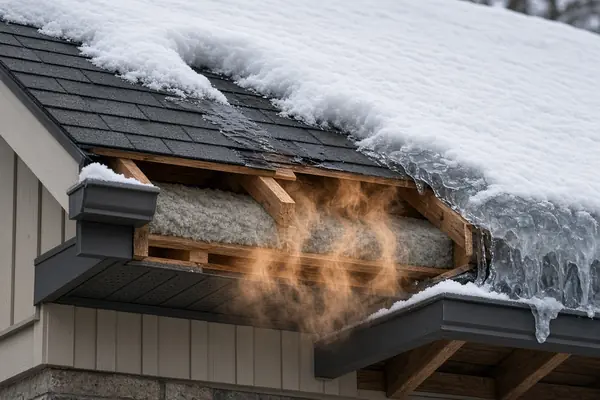
Ice dams in Massachusetts come from heat leaking out of your house into the attic. Not from your shingles. Warm air escapes through the ceiling, warms the roof deck, and melts the snow sitting on the upper part of the roof. That water runs down to the overhang, which hangs past the heated part of the house and stays cold. It refreezes there and builds a ridge of ice. The ridge traps the next round of meltwater, and that water pushes back uphill under the shingles until it finds a ceiling.
Fix it in this order: air sealing, insulation, venting, then a leak barrier at the roof edge. A new roof by itself won’t stop ice dams. Neither will a metal one.
What Causes Ice Dams on a Massachusetts Roof?
An ice dam is a ridge of ice that forms at the edge of a roof and stops melting snow from draining off. It forms when the upper roof surface is above 32 degrees while the lower surface stays below freezing, so meltwater runs down, refreezes at the cold eave, and backs up under the roof covering.
The University of Minnesota Extension puts the mechanism in one line: the higher parts of the roof surface have to be above 32 degrees while the lower parts stay below it. That temperature split is the whole problem. Everything else is a detail.
Three things have to line up. Snow on the roof. Freezing weather outside. And an attic that leaks heat. You can’t do anything about the first two.
It takes less snow than people think. The U.S. Department of Energy’s Building America program says an ice dam can form with as little as 2 inches of snow on a roof. And the snow itself makes the problem worse, because snow insulates. DOE puts it at roughly R-1 to R-2 per inch. So 10 inches of snow is a blanket sitting on your roof deck, holding in the heat your attic is losing, and melting itself from underneath.
Here’s the part I want you to sit with. Nothing in that chain involves the shingle. The shingle is a bystander.
Massachusetts Winters Are Colder Inland Than the Coast Lets On
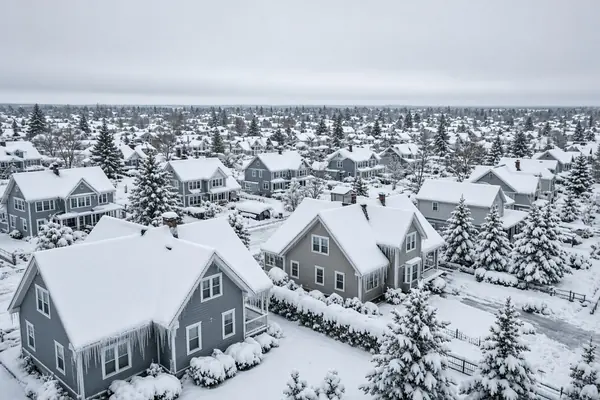
The thing that builds an ice dam isn’t one big storm. It’s how many nights the water on your roof gets a chance to refreeze. And that number changes a lot depending on where in this state you live.
Pull the NOAA 1991 to 2020 climate normals for two airport stations about 45 miles apart. Boston Logan averages 91.9 nights a year at or below freezing and 43.8 inches of snow. Worcester Regional Airport averages 127.0 nights and 64.1 inches. That’s 35 more freezing nights and 20 more inches of snow, in the same state, on the same insurance map.
So the same house built to the same spec has a harder job in Worcester than in Quincy. More nights below freezing means more chances for meltwater to lock up at the eave, and more snow means more fuel sitting there to melt. If you moved inland and brought your assumptions about winter with you, that gap is why your roof behaves differently now.
The coast still gets its winters. NOAA’s records for Boston Logan put the 2014 to 2015 season at 110.6 inches, which beat the 1995 to 1996 record of 107.6. Every roofer here still talks about that year. I still find the repairs from it.
Does Adding More Roof Vents Stop Ice Dams?
Not by itself, and it’s the fix people buy first. Massachusetts’ own guidance puts attic ventilation dead last.
The state’s ice dam guidance, published through Mass Save, walks through five prevention steps. Get a home energy assessment. Clear the gutters before winter. Reduce the attic temperature by sealing air leaks, adding insulation to the attic floor, and dealing with heat sources like ductwork and hot water piping. Install a waterproof membrane above where water collects. And stay off the roof.
Ventilation isn’t one of the five. It shows up after them, as a note, and the state’s wording is worth reading twice: speak with a building professional about possibly ventilating the attic if your building still has ice dams after following the steps above, and this should only be attempted as a last resort.
Last resort. That’s the state’s phrase, not mine.
Massachusetts says the same thing in a second place. The Department of Energy Resources runs a post on sealing an attic against ice dams that lists four fixes: seal the air leaks first, and make sure the contractor does the air sealing before insulating, then insulate to proper levels, then move or insulate heat sources like ductwork and hot water pipes above the insulation, then install a moisture barrier. Ventilation doesn’t appear on that list at all.
The building science agrees. Joseph Lstiburek at Building Science Corporation wrote a whole newsletter on de-icing ice dams and boiled the answer down to “air tightness, air tightness, air tightness. Not so much insulation.” Both matter. Order matters more.
Why does this go wrong so often? Because venting is the easy sell. A ridge vent is a visible thing a homeowner can point at. Sealing the gap around a bath fan housing, a recessed light, or the top plates isn’t. And if you add exhaust venting to an attic that’s still leaking warm, wet air from the house, you can pull more heated air up through the ceiling and make the problem worse.
One more reason to start where the state starts: Mass Save currently advertises 75 to 100 percent off approved insulation and air sealing work, with no-cost upgrades for income-eligible households. The step ranked first is the step somebody else helps pay for. Check masssave.com for your own number, because the programs change.
The Venting Rule Most Attics Quietly Fail
Here’s a code detail almost nobody checks, and it decides how much venting your attic legally needs.
The residential code sets attic ventilation at 1 square foot of net free vent area for every 150 square feet of attic. There’s an exception that cuts that in half, to 1 in 300, and most roofers design to the smaller number without confirming the house earns it.
Under the 2021 code Massachusetts adopted, you only get the 1 in 300 ratio if both conditions are met. The first one is a vapor retarder on the warm side of the ceiling, and it’s written to apply in climate zones 6, 7 and 8. Massachusetts is zone 5A, so that one isn’t a burden here. The second condition applies everywhere, and it’s the one that bites: not less than 40 percent and not more than 50 percent of the required vent area has to come from ventilators in the upper portion of the attic, no more than 3 feet below the ridge measured vertically, with the rest provided by eave or cornice vents.
Read what that means for a real house. An attic vented only at the ridge doesn’t qualify, because there’s no eave intake. Neither does one vented only at the soffits. Gable vents alone almost never work, for the same missing-intake reason. Those attics fall back to 1 in 150, which is twice the vent area, and I have never once seen a homeowner told that.
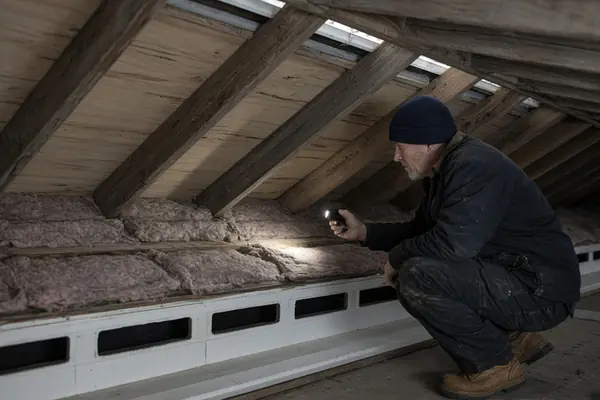
Intake is the half that gets skipped. A ridge vent with no clear path from the soffits is a chimney with no draft. Blocked soffits under blown-in insulation are one of the first things we look for on a roof inspection. I find them on a lot of the houses I climb into, and the homeowner has no idea, because from the street the roof looks fine.
Two more numbers worth having. DOE’s Building America guidance recommends R-60 or better for vented attics in climate zone 5 and above. And on the air gap above that insulation, code allows 1 inch, but DOE says a 2 inch unobstructed air space is more effective at preventing ice dams, and Lstiburek says flatly that the codes are wrong on this anywhere ground snow load tops 30 pounds per square foot. Most of eastern Massachusetts is at or above that. I build to 2 inches.
Massachusetts Code Requires an Ice and Water Barrier Statewide
Yes, on every house with a shingle-type roof, and it’s not optional. Massachusetts fills in the code’s ice barrier trigger with a single word: YES.
The state building code’s climate table marks “ice barrier underlayment required” as YES for all of Massachusetts. The Board of Building Regulations and Standards explains why in plain terms, that weather patterns over the years have shown Massachusetts homes are subject to ice forming at roof eaves that causes water backup. You can read it yourself in the Tenth Edition of the state building code, in the residential volume’s building planning chapter.
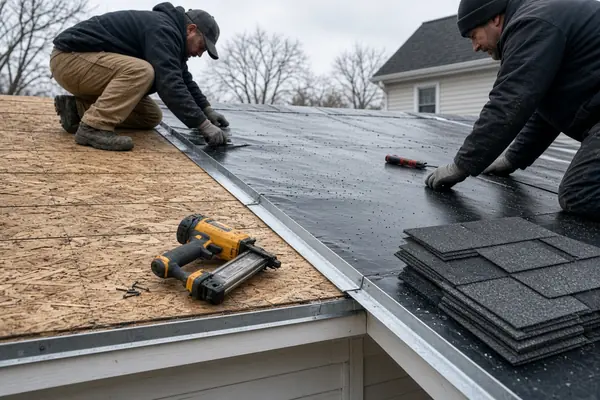
The dimension is what people get wrong. The barrier runs from the lowest edge of the roof to a point not less than 24 inches inside the exterior wall line of the building. Inside the wall line. Not 24 inches up from the gutter. On a house with a deep overhang, that measurement can run past a single 36 inch roll, and a crew working fast will stop at one roll and call it done. On roofs at 8:12 or steeper, the code adds that the barrier also has to run at least 36 inches measured along the roof slope from the eave edge.
The requirement names asphalt shingles, metal roof shingles, slate, wood shingles and shakes, and mineral-surfaced roll roofing. Standing seam metal panels sit in a different code section, so don’t assume a metal panel bid includes the same eave protection. Ask.
One more thing to know if you’re comparing bids: Massachusetts moved to the Tenth Edition of the building code on October 11, 2024, and since July 1, 2025 it’s the only edition you can pull a permit under. If somebody quotes you a spec from the Ninth, they’re behind.
We run GAF WeatherWatch leak barrier at the eaves and in the valleys on every roof we install, asphalt or metal. It’s the layer that decides whether a dam becomes a stain on your ceiling, and it’s the first thing I look for when I open up an old roof.
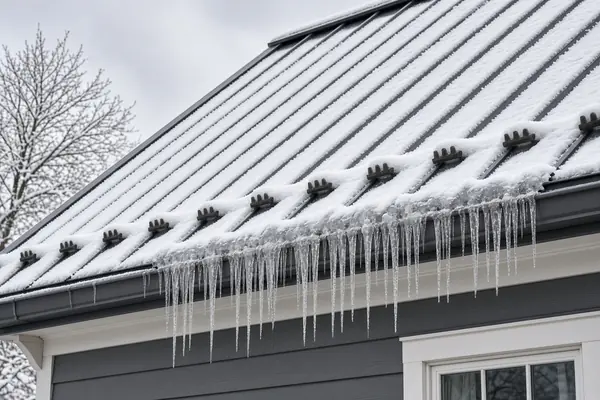
Do Metal Roofs Prevent Ice Dams?
No. A metal roof over a warm, leaky attic still gets ice dams.
Metal does shed snow better, and that’s real. Less snow on the roof means less material to melt. But shedding is not the same as preventing, and the roof edge doesn’t care what it’s made of. Warm deck above, cold overhang below, and you get a dam.
There’s a second problem the metal roofing ads skip. If your roof hangs over a door, a walkway, or a driveway, you need snow guards, because a sheet of snow coming off a steep metal roof all at once is a real hazard. Snow guards work by holding the snowpack in place. Which puts the snow back on the roof, at the eave, which is exactly where a dam forms. The benefit and the safety fix pull against each other, and most pages selling metal never mention it.
We install both asphalt and metal roofing, so I don’t have a horse in this race. If you’re weighing the two for a New England winter, I wrote the full comparison in metal versus asphalt for snow, including cost and lifespan.
Fix It in This Order
Ice dam work has four layers, and doing them out of order wastes money. Here’s the sequence and what each layer is actually for.
| Order | What you do | What it fixes | Who does it |
|---|---|---|---|
| 1 | Air sealing at the ceiling plane | Stops warm air from reaching the roof deck. The root cause. | Insulation contractor or energy audit crew |
| 2 | Attic floor insulation | Slows the heat that conduction still moves upward | Insulation contractor |
| 3 | Balanced intake and exhaust venting | Keeps the deck near outdoor temperature | Roofer, and it needs clear soffits |
| 4 | Ice and water barrier at the eaves | Stops a dam that does form from leaking into the house | Roofer, at roof replacement |
Step four is the only one that happens on the roof. Steps one through three happen in your attic. That’s why a full roof replacement alone doesn’t solve this, and why any roofer who tells you a tear-off will end your ice dams is selling you something.
Where a roof replacement does help is that it’s your one chance to get step four right and to open up blocked eave intake at the same time, with the shingles off and the edges exposed. If you’re already replacing, do them together.
How Do You Get an Ice Dam off a Roof Without Wrecking It?
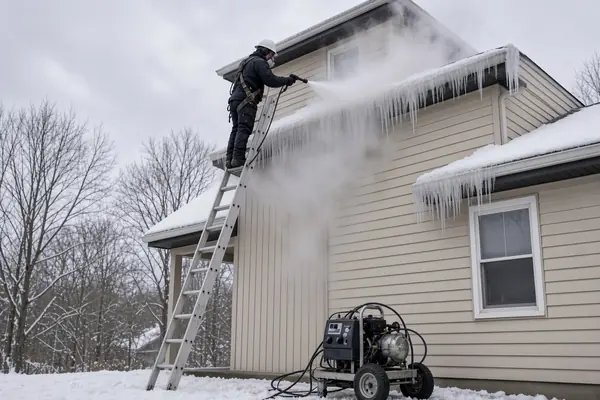
Steam. Not a hammer, not a chisel, not salt, and not a torch.
Chipping ice off a roof takes shingles with it. That’s not a theory, it’s what I get called to repair in March. Rock salt and calcium chloride are corrosive, and in my experience they shorten the life of metal flashing, gutters and fasteners, plus the runoff lands on whatever you’ve planted below. A torch is how houses catch fire. Low-pressure steam is what we use and what every crew I trust uses, because it melts the ice without cutting the roof.
If you’re doing anything yourself, do it from the ground. A roof rake on the first 3 to 4 feet takes the fuel away, and it belongs on your winter roof maintenance list alongside clearing the gutters in the fall. Massachusetts state guidance on roof snow removal says to shave the snow down to 2 or 3 inches rather than scraping the roof clean, which protects what’s underneath. The state’s ice dam guidance is blunter: stay off the roof and don’t chip at the ice.
Water already coming in? That’s an emergency roof repair call, and it’s one of the two ways the phone rings hardest here in February.
What Insurance Covers, and What It Doesn’t
The Massachusetts Division of Insurance published a consumer notice on February 20, 2025 urging homeowners to get a professional evaluation of their home’s insulation and ventilation, and adding that there is never a bad time to review your coverage to make sure winter weather damage is covered. The Division’s own winter guidance lists collapse from the weight of ice or snow as typically covered, and separately notes that interior water damage from a storm may not be covered when there’s no damage to the roof or walls. An ice dam pushing water under intact shingles is exactly the gray area between those two, which is why documentation matters so much.
That part I can do. We photograph what we find, write it up in the format adjusters expect, and meet the adjuster at the house when it helps. We don’t promise a carrier will approve anything, and we won’t tell you to file a claim on damage that isn’t there. If you want the paperwork side, see how we handle storm damage repair.
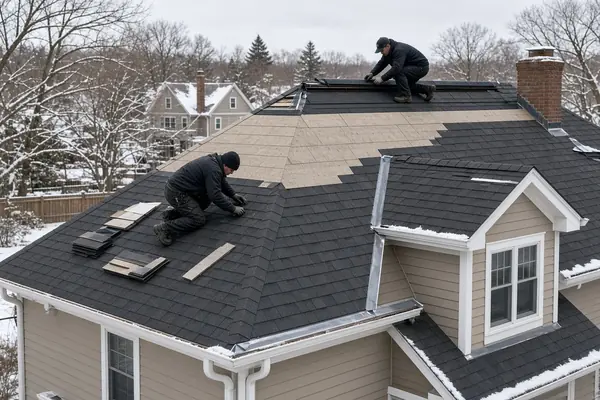
How We Build a Massachusetts Roof Against Ice Dams
Across the roofs we do, the problem usually isn’t the shingle. It’s old flashing, weak ventilation, reused pipe boots, rotted decking, and roof edges where water has been getting in for years without anyone knowing. That’s what we’re actually replacing, and it matches what we find on nearly every Massachusetts roof leak we chase down.
Here’s the system, and why each piece is here.
- GAF WeatherWatch leak barrier at the eaves and in every valley, run past the 24 inch line the code requires, not stopped at one roll.
- GAF FeltBuster synthetic roofing felt across the rest of the deck as a second layer.
- Decking checked and replaced where it’s soft. On an ice dam house the rot is usually in the first few feet above the eave, which is the part nobody sees until the old roof comes off.
- New drip edge, flashing, and pipe boots. Reusing an old pipe boot is one of the most common shortcuts I find, and it leaks.
- GAF Timberline HDZ architectural shingles over a starter strip.
- A cold, vented attic using the GAF Cobra SnowCountry Advanced ridge vent, whose Snow Guard filter resists blowing snow while it exhausts attic heat. And we confirm the soffits are actually open, because exhaust without intake does nothing.
Most of our standard replacements go on in one to two days once the material’s on site and the weather holds. Often one day. You’ll get photos of what we found under the old roof, a magnetic nail sweep, and a walkthrough at the end.
If you had ice dams last winter, the causes are still up there right now. Book a roof inspection before the snow, or call us at (617) 631-5435. We’ll show you photos of your own roof and tell you honestly whether this is an attic job, a roof job, or both.
Frequently Asked Questions
What causes ice dams in Massachusetts?
Heat escaping from the house into the attic warms the roof deck and melts the snow above it. That water runs down to the cold overhang, refreezes, and builds a ridge of ice that traps the next round of meltwater. The University of Minnesota Extension describes it as the upper roof surface being above 32 degrees while the lower surface stays below freezing. Roofing material isn’t the cause.
How do I prevent ice dams on my roof?
Work in order: seal air leaks between the house and the attic, add insulation, get balanced intake and exhaust venting, then protect the roof edge with an ice and water barrier. Massachusetts’ own guidance ranks attic ventilation after those steps and calls it a last resort. Mass Save currently advertises 75 to 100 percent off approved insulation and air sealing work.
Does a new roof stop ice dams?
Not on its own. A tear-off is the right time to install the code-required ice and water barrier and to open up blocked soffit intake, and both of those help. But the heat loss that creates the dam happens in your attic, below the roof. Fixing only the roof leaves the cause in place.
Do metal roofs prevent ice dams?
No. Metal sheds snow better than asphalt, which helps at the margin, but a metal roof over a warm attic still gets ice dams at the eave. Metal roofs over doorways and walkways also need snow guards, which hold snow at the eave and give back some of the shedding benefit.
Is an ice and water barrier required by Massachusetts code?
Yes, statewide, for shingle-type roof coverings. The state building code marks ice barrier underlayment as required for all of Massachusetts. It has to run from the lowest roof edge to at least 24 inches inside the exterior wall line, and at least 36 inches measured along the slope on roofs 8:12 or steeper.
How much attic insulation do I need in Massachusetts?
Massachusetts is climate zone 5A. DOE’s Building America guidance recommends R-60 or better for vented attics in zone 5 and above, with an unobstructed air space above the insulation. Code allows 1 inch there; DOE says 2 inches works better against ice dams. Air sealing comes first either way, because insulation over an unsealed ceiling still lets warm air through.
How do you remove an ice dam safely?
Low-pressure steam, done by a crew that does it for a living. Chipping takes shingles off, salt is corrosive, and a torch is a fire risk. From the ground, a roof rake on the first 3 to 4 feet removes the snow that feeds the dam. Massachusetts state guidance says to stay off the roof and not chip at the ice.