Home / Roofing Services / Flat Roofing
Flat Roofing In Worcester, MA
Worcester flat roofs are rated at 35 psf. The coast is rated at 30.
EPDM rubber, TPO, and modified bitumen for the low-slope roofs this city actually has: triple-deckers, rear additions, porch roofs, shed dormers, storefronts. Every one of them is designed against a higher snow number than the same roof in Boston or Quincy, and the number sits in the state’s own table. We fix the drainage and the perimeter first. That is what decides whether a membrane lasts 3 decades or leaves in a thunderstorm.
The short version
A Flat Roof Is Not Flat, and the Code Says So.
Flat roofing is a single-membrane system for roofs too shallow for shingles, which in practice means anything under a 2:12 pitch. That is the ceiling. Almost nobody tells you there is a floor. A low-slope membrane roof has to be designed with at least 1/4 unit of fall in 12 units of run, a 2 percent slope, whether the membrane is modified bitumen, EPDM or TPO. A dead-level roof does not meet code, because the water has to have somewhere to go.
Two percent is 10 inches of fall across a 40-foot triple-decker roof. Walk out onto most of them in Worcester and you will not find it. The building settled, or the insulation went down flat in 1994, or somebody built a rear addition straight across the drainage path. None of that is a membrane problem. It is a slope problem, and slope is fixable with tapered insulation while the roof is open.
Powersol Roofing installs and repairs low-slope membrane roofs across Worcester and Worcester County. Owner Manny Reynoso reads the moisture survey and prices the job himself. Estimates are free and itemized line by line. Call (617) 631-5435 or send the estimate form.
The number most quotes get wrong
Worcester’s Flat Roofs Carry 35 psf, Not 30.
Table 1604.11 of the Massachusetts State Building Code lists 2 snow numbers for every city, and on a flat roof the second one is the one that governs. Worcester’s ground snow load, Pg, is 50 psf. Its minimum flat roof snow load, Pf, is 35 psf. Boston and Quincy are 40 and 30. Note 1 under the table settles the argument: the design flat roof snow load is the larger of the load calculated from Pg or the tabulated Pf value.
Roofing pages quote Pg and round it. On a pitched roof that is survivable. On a flat one it is the difference between 2 specifications. A 1,600 square foot triple-decker roof designed at 35 psf has to carry 56,000 pounds of snow. At 30 psf it carries 48,000. Eight thousand pounds is why a detail copied off a Dorchester job does not belong on a Grafton Hill building, and it is why we write the governing load on the estimate instead of saying “built to code.”
| City | Ground snow load, Pg | Minimum flat roof snow load, Pf | Basic wind speed |
|---|---|---|---|
| Worcester | 50 psf | 35 psf | 117 mph |
| Boston | 40 psf | 30 psf | 120 mph |
| Quincy | 40 psf | 30 psf | 121 mph |
Why a 3-unit building is not on the residential table
The residential code covers detached 1 and 2-family dwellings and townhouses. A classic Worcester triple-decker is 3 stacked units on a common stair, which puts it in Group R-2 under the building code rather than the residential code. Same wood frame. Same 1905 carpentry. Different chapter, and the snow, wind and roof-assembly requirements come off the commercial side of 780 CMR. Ask a roofer which table they priced from. If the answer is a rounded number with no table behind it, you have learned something useful.
Wind is the other half, and it took a roof in May
Worcester’s basic wind speed is 117 mph at Risk Category II. Boston is 120 and Quincy is 121, which surprises people who assume inland means calm. It does not mean calm. On the evening of 19 May 2026 a severe thunderstorm tore a section of roof off a National Guard building on North Lake Avenue and left it in the street. Membrane roofs fail at the edge first, because the edge is where wind gets underneath and lifts. Drip edge, termination bar and fastener spacing are not trim work. They are the wind detail, and they are the cheapest part of the roof to do properly. Damage already done is storm damage roof repair.
What we install
Three Membranes, and the Service Life the Industry Actually Publishes.
There is no single best flat roof material, only the right one for the size, the drainage and what sits underneath. What changed this year is the number everybody quotes for how long these roofs last.
Nearly every roofing page in Massachusetts says 20 to 30 years for a membrane roof. In March 2026 the EPDM Roofing Association published a new figure: at least 38 years for a properly installed and maintained EPDM membrane, with installations running past 40, 45 and 50. It came out of a survey of 569 roofing professionals plus 2025 laboratory work by the German SKZ institute. Sixteen percent of those professionals had personally inspected EPDM roofs over 45 years old that were still doing the job.
Now read their caveat, because it is the entire point of this page. ERA’s own conclusion is that the 38 years holds only where the seams, flashings and penetrations are properly executed. The rubber is not the variable. The crew is.
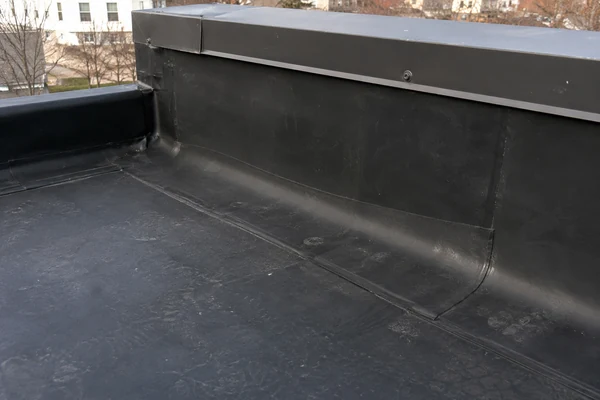
EPDM rubber
The black rubber sheet already on most three-deckers in this city, and there is a reason it stayed. It handles freeze-thaw without going brittle, it takes a patch cleanly 25 years in, and it is the most forgiving membrane on a roof full of penetrations. Fully adhered on a clean deck, seams primed and rolled, edges terminated to the wind detail.
- 38-year service life published by the industry body
- Best choice on roofs with a lot of penetrations
- Repairs and re-flashes cleanly decades later
- Proven across a century of New England multi-family stock
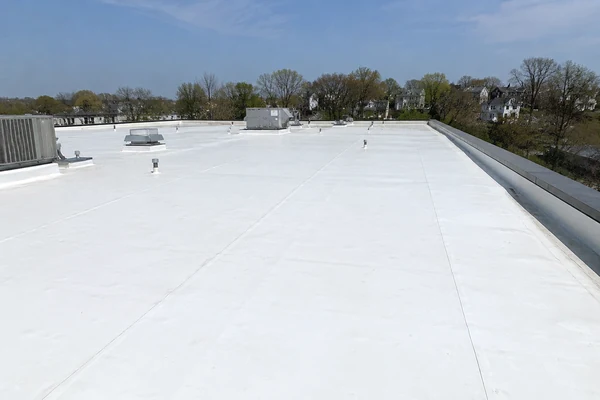
TPO
White, heat-welded, and the seams fuse into one continuous sheet instead of relying on adhesive. That removes the most common failure point on a flat roof. The reflective surface also drops top-floor temperatures in July, which on a triple-decker is the difference between a rentable third floor and a complaint.
- Seams welded and probe-tested, every foot
- 60-mil as standard on multi-family work
- Reflective white surface over occupied top floors
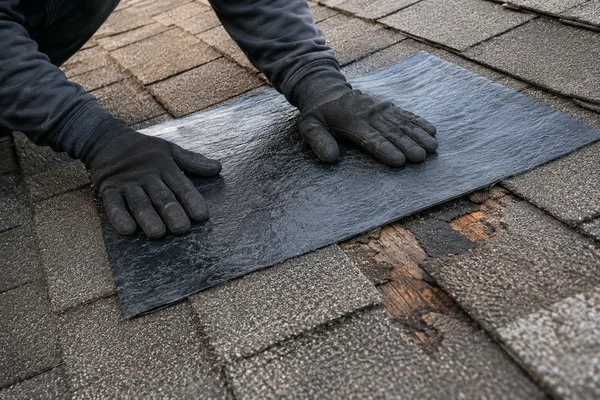
Modified bitumen
Asphalt-based rolled roofing with a polyester or fiberglass mat. Where it earns its place is the awkward small work: a back piazza roof, a bay window cap, a 200 square foot tie-in to an existing mod-bit surface where matching the material beats introducing a second system.
- Granulated surface takes foot traffic on porch roofs
- Compatible with what is already up there
Low-slope section on a new addition or dormer? See roof install in Worcester. Whole pitched roof coming off instead? That is new roof installation, and a slope steep enough for standing seam is metal roofing.
Where flat roofs actually fail
Ponding Has a Definition, and It Is 48 Hours.
NRCA’s criterion is precise: there should be no ponding water on the roof 48 hours after a rain, during conditions conducive to drying. That second clause is the half everybody drops, and dropping it makes the standard sound stricter than it is. A puddle the morning after a thunderstorm is not ponding. A puddle still sitting there on a dry Wednesday afternoon is, and it tells you the roof does not have its 2 percent of fall. We measure the depth, mark the extent and photograph it before we write anything down.
Standing water past 48 hours
Ages the membrane, finds every weak seam, and adds dead load to a roof already designed for 35 psf of snow. An inch of water across 1,600 square feet is roughly 8,300 pounds. We correct the slope with tapered insulation instead of chasing the leak around the roof for 3 years.
Seams done in a hurry
EPDM seams get cleaned, primed and rolled. TPO seams get welded at the right temperature and probed along their length. This is the part you cannot see from the sidewalk and the part that decides whether you get 38 years or 11.
Parapets, chimneys, drains and skylights
Most leaks start where the roof stops being a roof. Every penetration gets its own flashing detail, terminated and sealed. Interior drains get the clamping ring reset and the sump reworked when the slope around them is wrong. Curbs and skylights get flashed as assemblies, never caulked.
The perimeter, in a 117 mph city
Wind lifts a membrane from the edge inward. Corner and perimeter zones get a tighter fastener pattern than the field, drip edge gets fastened to spec, and the termination bar goes in mechanically rather than being glued and hoped for.
Already have water coming in? Leaky roof repair in Worcester covers how we trace an entry point, and there is a longer diagnosis with photos on the Worcester roofing blog.
Who this is for
Worcester Built More Than 6,000 Triple-Deckers. About 4,000 Are Still Standing.
Between the 1880s and the 1920s Worcester put up more than 6,000 three-deckers, and roughly 4,000 remain. In the decade from 1890 to 1900 they accounted for more than half of all construction in the city. Vernon Hill, Main South, Grafton Hill, Union Hill, Quinsigamond Village. The flat and low-slope roofs on those buildings are most of the flat roof stock in Worcester, and none of them were built with the drainage the code now asks for. That is why this is a specific job rather than a generic one.
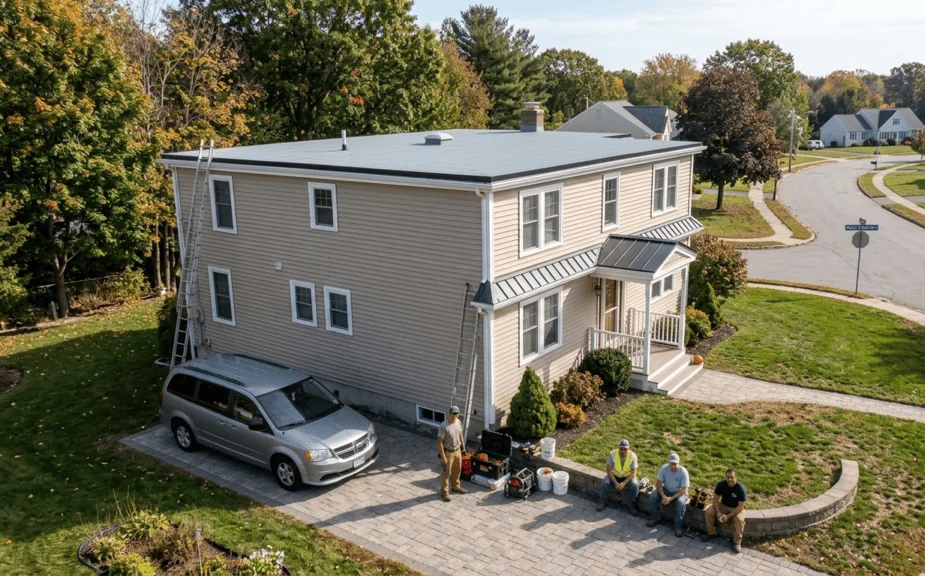
Triple-deckers and multi-family
We work with tenants in place and no interior access. Staging goes off the street, and on a zero-lot-line block in Main South that is what adds a day to the schedule. Rear additions and shed dormers that interrupt the original drainage get re-sloped rather than re-covered, because a dormer built across a drainage path is the most common reason a Worcester three-decker roof ponds where it never used to.
Storefronts and small commercial
Quoted the same way as the residential work: measured, itemized, scheduled around your hours where the job allows, 1 point of contact from estimate to walkthrough. Drains, scuppers, edge metal and HVAC curb flashing are separate lines rather than a lump sum. Buildings with several roofs to manage or a maintenance program belong on commercial roofing in Worcester.
How the job unfolds
The Moisture Map Comes Before the Quote.
The most important work on a flat roof happens before anything is unrolled. If the insulation under the membrane is saturated, a new surface hides the problem for a season and then you own both. If it is dry, we tell you it is a repair, not a replacement, and we lose the bigger sale. That has to be true or none of the rest of this page means anything.
Across the last 24 low-slope roofs we moisture-probed in Massachusetts, 13 came back with wet insulation over more than a quarter of the field. Those 13 were tear-offs. The other 11 were sectional repairs, and 4 of those were a single flashing detail.
Survey and probe on a 10-foot grid
Membrane, seams, flashings, drains and parapets, plus core probes on a 10-foot grid so the wet area is mapped rather than guessed. Every reading is photographed with its location. Ponding gets measured 48 hours after the rain stops.
Line-item quote with the load on it
Repair or replace, stated with the evidence for each. Membrane, insulation, tapered insulation, flashing, edge metal, deck allowance and the city permit are separate lines. The governing design snow load is written in psf at the top.
Tear-off, deck, and slope
Wet material comes out, deck repairs happen while the roof is open and get photographed, and tapered insulation corrects the slope that caused the ponding. On a typical triple-decker this is the bulk of the job. Weather moves it and we will not pretend otherwise.
Membrane, details & closeout file
Membrane installed, every seam and penetration detailed, drains cleared and tested with water. You get a photo record of each stage, the permit receipt, and the workmanship warranty in writing. Book a follow-up roof inspection at year 5 and we hold the file.
Repair or replace
The Wet-Field Test: 4 Readings Decide It.
Membrane roofs repair well, which is the main argument for them. What kills a repair is water already sitting in the layers under the surface. So we do not argue about it. We take 4 readings and let them decide. Four out of 4 and we quote a repair. Two or fewer and we quote a replacement and show you the readings. Three is a conversation, and the honest answer there is usually a repair with a written note that you are buying 4 to 6 years rather than 30.
Wet insulation under a quarter of the field
Mapped on the 10-foot probe grid, every reading photographed where it was taken. Above a quarter of the roof, patching the surface is money spent twice.
Deck sound where we probed
Soft or delaminated sheathing means the water has been up there long enough to matter, whatever the membrane looks like from above.
The failure traces to a specific detail
A seam, a pipe boot, a parapet flashing, a drain ring. A specific cause can be fixed. A field failing everywhere at once cannot.
Membrane still flexible, and under 20 years old
EPDM that cracks when you fold it back is done, whatever the calendar says. Flexible rubber at 22 years is worth repairing. We fold a corner and show you.
Not sure which one you have? Book a documented roof inspection in Worcester and you get the readings whether or not you hire us for the work.
Run the numbers on your own roof
Worcester Flat Roof Check: Load, Fall, and Permit.
Three inputs, four answers, all of them straight out of the state code table and the city fee schedule. Nothing here is a lead form and nothing gets sent anywhere. It runs in your browser and we never see it.
The permit arithmetic nobody publishes
Worcester’s Department of Inspectional Services fee schedule, in force since 1 March 2024, charges $12.00 per $1,000.00 of construction value or fraction thereof, minimum $100.00, dropping to $9.00 per $1,000.00 above $1,000,000. Two details are worth knowing before you sign anything.
“Or fraction thereof” rounds up. The city takes your construction value to the next full $1,000 before it multiplies. Small, and it is the difference between an estimate that matches the receipt and one that does not.
Paper costs $50.00 extra. The schedule adds a $50.00 processing fee to every paper permit, so filing through the city’s OpenGov portal costs $50.00 less than walking the application into 25 Meade Street. We file online, and the city fee lands on your estimate at cost with the receipt stapled to it.
If a roofer tells you a full tear-off on a 3-unit building needs no permit, ask them to put that in writing, then call Inspectional Services and ask the same question yourself. It is a 4-minute phone call and it is the cheapest due diligence on the whole project.
Local, licensed, accountable
Flat Roofs Last When Every Detail Is Done Right.
Anyone can roll out rubber. The roof that is still dry in 2060 belongs to the crew that primed every seam and flashed every pipe like it was their own building. Read more about the roofers behind the work in Worcester.
Before you call
When We Are the Wrong Call.
If the lowest number is the only thing that matters, hire somebody else and we will lose that comparison happily. We are also the wrong call in 4 specific situations, and it is cheaper for both of us if you know now.
You want a recover the code does not allow
Layer count and the condition of what is already up there decide this, and we will not quote around either. The limits are in the FAQ below.
Slope correction is out of scope
If the tapered insulation that fixes the ponding gets cut, we would rather lose the job than warranty a roof we already know where to find the leak on.
You want shingles on a low-slope porch
Shingles need 2:12 minimum. Under that they are a leak with a warranty exclusion attached, whatever anyone quotes you.
You want a truck 10 minutes away
We are based at 100 Hancock St in Quincy, about 48 miles east, and we run crews west into Worcester County. If you want somebody local for a 4pm question, that is a real reason to hire a Worcester company, and we would rather say it here than have you find out in week 2.
Where we work
Flat Roofing Across Worcester and Worcester County.
Low-slope and membrane work across the neighborhoods below, plus Shrewsbury, Auburn, Millbury, Holden, West Boylston, Leicester, Paxton and Grafton. Send the address and a photo of the roof from an upstairs window and we will tell you straight whether it is a job we should be quoting. See every service on our Worcester roofing services page.
Straight answers
Frequently Asked Questions
What is the minimum flat roof snow load in Worcester, MA?
35 psf, and it is the floor rather than the ceiling. The design load is whichever is larger, the load calculated from Worcester's 50 psf ground value or the tabulated 35, so a roof can be required to carry more but never less. Here is what to do with that. Ask whoever quotes your roof to write the governing load in psf at the top of the estimate. It costs them nothing and it takes 10 seconds if they opened the table. If the number comes back rounded, or as a range, or as "built to code," you have learned how the rest of the job will be specified.
How do I tell whether my flat roof is EPDM, TPO or modified bitumen?
Color and surface answer it from an upstairs window most of the time. EPDM is a matte black rubber sheet with wide seams you can usually see as faint lines. TPO is bright white or light grey with narrow welded seams. Modified bitumen looks like the top layer of a shingle rolled out flat, granulated and usually grey or dark brown. If it is black and shiny with gravel embedded in it, you have an older built-up or tar-and-gravel roof, which changes the tear-off entirely. Send us a photo from the third floor and we will tell you which one you have before anybody climbs anything.
Do I need a permit to replace a flat roof in Worcester, MA?
Yes for anything that opens the deck, adds insulation or changes structure. A pure overlay is sometimes treated differently, and that call belongs to the inspector rather than to your roofer, so ask before anyone assumes. Permits come from the Department of Inspectional Services at 25 Meade Street and applications run through the city's OpenGov portal. The detail worth understanding is whose name goes on it: a Massachusetts Construction Supervisor License holder has to be named on the application, and that person is who the city holds responsible for the work. If a contractor asks you to pull the permit as the homeowner, understand what you just agreed to. We pull ours, file online, and pass the city fee through at cost with the receipt attached. The fee arithmetic and a calculator for it are further up this page.
How long does a flat roof replacement take on a triple-decker?
Three to 4 working days on a 1,400 to 1,800 square foot roof once material is on site. What moves that number is access, weather and what we find under the old roof. A zero-lot-line block where the dumpster has to sit on the street adds a day. Rain adds however long the rain lasts, because we do not lay membrane onto a wet deck to keep a promise. Deck repairs add time in proportion to what is rotted, which is why the survey matters more than the calendar.
Can you install a new membrane over the existing flat roof?
Sometimes, and we will tell you plainly when the answer is no. A recover is off the table where the existing covering is water-soaked or deteriorated, or where there are already 2 or more layers of roof covering on the deck. Those are code limits, and they are not negotiable. On top of that we will not recover a roof whose slope cannot be corrected, because a new membrane laid over a ponding surface fails in the same spot the old one did. If the readings come back dry, the deck is sound and there is 1 layer up there, a recover is a legitimate way to save money and we will quote it that way.
What happens to the tenants while you are on the roof?
Nobody has to move out and we do no interior work. What tenants get is noise, a dumpster and restricted use of the rear yard or driveway. We give the owner a notice sheet to post 3 days ahead with the start date, working hours and a phone number, and we stage off the street rather than through the building. Third-floor tenants get the most noise and the shortest warning window, so that is the unit we ask you to talk to first.
My roof drains onto the building next door. Whose problem is that?
On Worcester's tighter three-decker blocks this comes up constantly, and it is a property question before it is a roofing question. What we can do is document it: where the water currently goes, where the original drainage was designed to go, and what re-sloping or adding a scupper would change. That report is what your attorney or your insurer needs. What we will not do is quietly redirect water onto an abutter to make a leak go away, because that is somebody else's ceiling and eventually somebody else's lawyer.
Do you handle emergency flat roof leaks and winter snow in Worcester?
Yes. We answer the phone nights and weekends and we will get a temporary patch on a membrane failure to stop active water. On snow, the honest answer is that a flat roof here is designed for a minimum of 35 psf and the risk in a heavy winter is rarely the snow by itself. It is a clogged drain with snow melting behind it. We check and clear drains and scuppers as part of every job, and we will tell you the depth at which you should be calling somebody rather than climbing up yourself. See emergency roof repair in Worcester for the 24/7 line, or roof repair for planned work.