If your skylight is leaking, don’t buy caulk yet. In most of the Massachusetts homes I get called to, the water is not coming through the skylight itself. It’s coming from the roof above it, from flashing that was never installed right, or it isn’t a leak at all. It’s condensation. Those three problems look identical from your living room floor and they cost wildly different amounts to fix. Sealing the wrong one hides the real damage and can cost you your manufacturer warranty on top of it. So the first job isn’t repair. It’s figuring out where the water gets in. This guide walks the same top-down check my crew runs in Quincy and across the South Shore, in the order we run it.
A skylight leak is water entering a home through or around a roof-mounted window. The water can come from four places: the glass seal, the frame and gasket, the flashing that ties the skylight into the roof, or the roof surface above the skylight. Only the first two are the skylight’s fault. The other two are roofing problems.
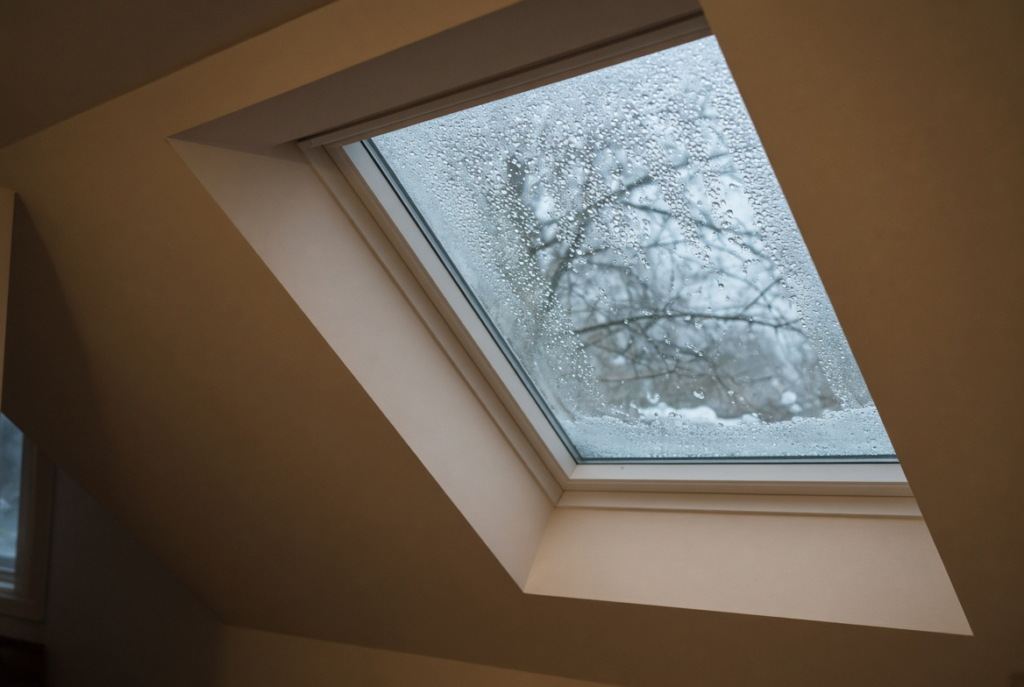
Is It a Leak, or Is It Condensation?
Check whether the water shows up when it’s cold, or when it’s raining. Condensation appears on cold mornings, in humid rooms, with no rain in the forecast. A leak follows weather.
Wipe the inside of the glass dry. If beads form again within an hour on a cold day with dry skies, that’s condensation. Warm indoor air is hitting the coldest surface in the room and giving up its moisture. Bathrooms, kitchens and laundry rooms do this constantly.
Most articles will tell you to run a fan. That’s a bandage. The real cause is usually the skylight shaft, that boxed-in tunnel between your ceiling and the roof deck. If the shaft was insulated with batts that were never sealed on the attic side, warm air moves through it all winter. You get condensation in the shaft, stains on the drywall, and dark blotches on the sheathing that a homeowner never sees. That’s why our attic check looks at sheathing for stains and soft spots before anyone touches the skylight from outside.
One tell that separates the two: condensation runs down the glass and pools at the bottom of the frame. A flashing leak usually shows up at a corner, or as a stain on the ceiling a foot or two away from the skylight opening.
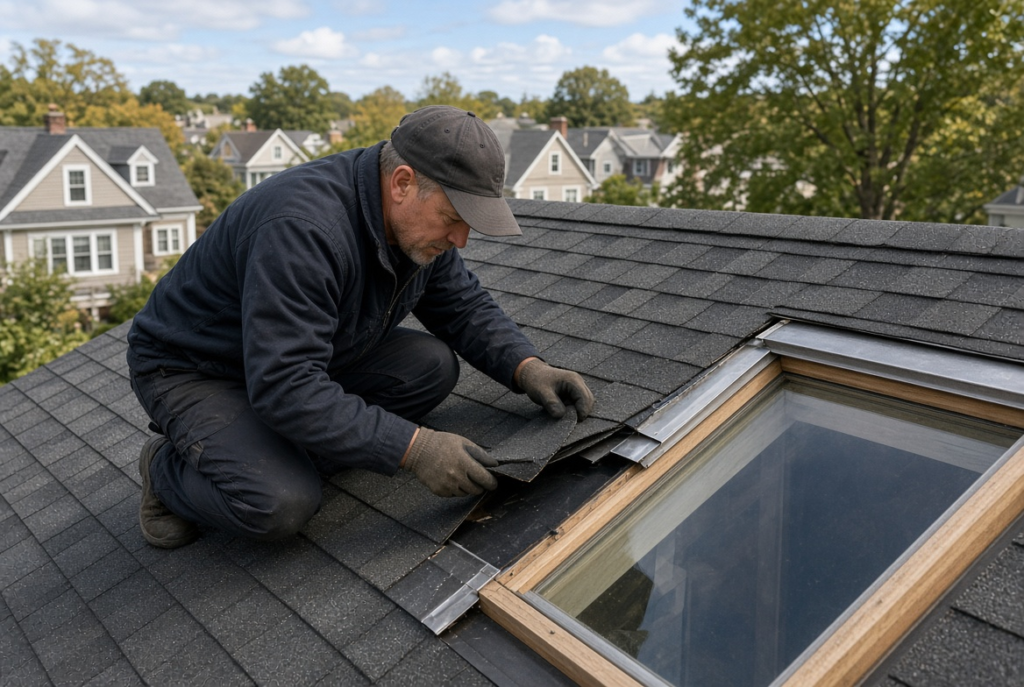
Where the Water Is Actually Getting In
Work top down. Water enters high and exits low, so the wet spot you see is almost never under the hole. That is the same reason finding a roof leak starts in the attic rather than on the roof.
Start above the skylight, not at it. Look at the shingles on the uphill side. Lifted shingles, a torn or missing head flashing, or a valley dumping runoff into the top of the skylight curb will all put water into the assembly. From there it runs down the inside of the frame and drips out somewhere that looks like a skylight failure.
Then check the step flashing along both sides, where the skylight meets the roof plane. This is where most of the real failures live, and it matches what causes roof leaks in Massachusetts generally: flashing and pipe boots, not worn shingles. Step flashing is a stack of overlapping metal pieces woven into the shingle courses. If a previous roofer reused the old flashing, bent it flat, or replaced it with a bead of tar, it will leak. Every time.
Only after those two do you look at the skylight itself: the gasket, the glass seal, and the drainage channels in the frame. Debris in the channels is real and it’s cheap to fix. It’s just rarely the whole story.
The order matters because it’s the difference between re-flashing a skylight and finding out in March that the decking under it is soft. When we’ve traced a roof leak on a call like this, the entry point and the drip point have been in different rooms more than once.
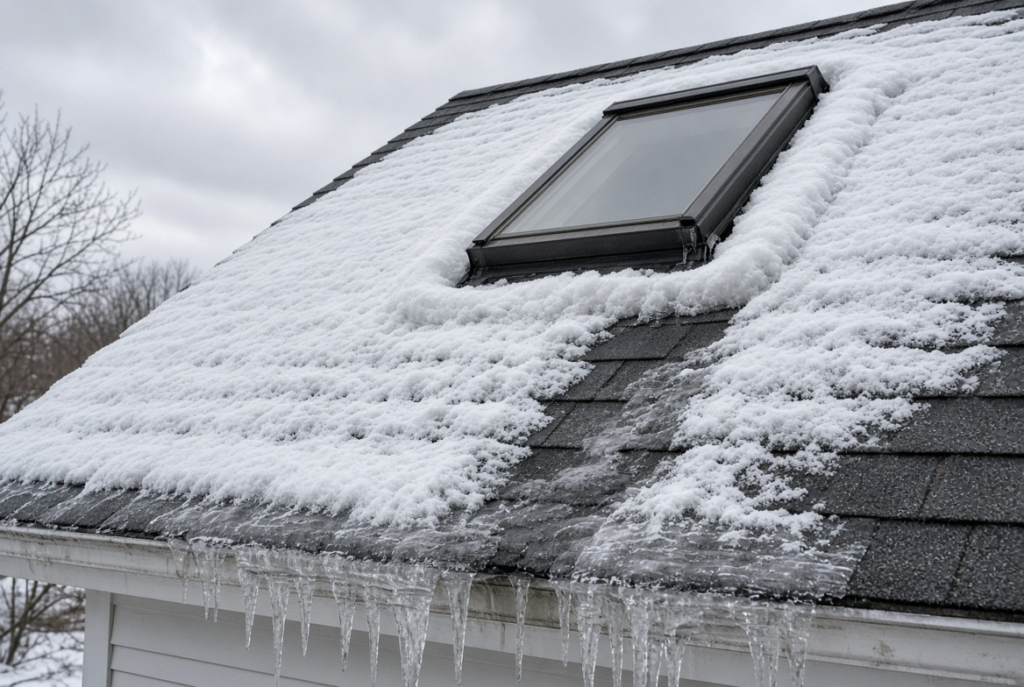
Why a Skylight Leaking in February Is Rarely the Skylight’s Fault
Because in winter the skylight is the thing making the water. It’s the warmest, least insulated patch on your roof, so it melts the snow sitting on it, and that meltwater refreezes on the cold roof below.
This isn’t my theory. Paul Fisette, who ran the Building and Construction Technology program at UMass Amherst, wrote it out in his piece on preventing ice dams: “Ice dams also form below skylights because they are typically low-R assemblies that melt water that subsequently runs down to a cold section of roof below the skylight.”
The numbers behind it are worth knowing. Fisette puts the insulating value of snow itself at roughly R-0.5 to R-1 per inch, and says ice dams can form with as little as 1 or 2 inches of snow on the roof, with two conditions attached: the roof has to be poorly insulated and air sealed, and the snow has to be followed by several days of sub-freezing temperatures. That is a normal February in eastern Massachusetts. He also recommends, and this is a recommendation and not a code requirement, at least R-38 of ceiling insulation for northern climates, about 12 inches. A skylight shaft is nowhere near R-38. That temperature difference is the whole mechanism.
So a skylight that was dry for eight years can start dripping in its ninth February without anything on the skylight having failed. The ice dam backed water up under the shingles above it, and the flashing was never designed to hold standing water. That is also why ice dam damage shows up on claims as roof damage rather than skylight damage.
Massachusetts code has a partial answer for this. The state’s published guidance on ice barrier requirements says the barrier has to “extend from the lowest edges of all roof surfaces to a point not less than 24 inches (610 mm) inside the exterior wall line of the building,” and that on roofs “equal to or greater than 8 units vertical in 12 units horizontal” it also has to run at least 36 inches from the eave edge. It is not a blanket rule. It applies where there is a history of ice forming along the eaves and backing water up. One note on vintage: that guidance was issued under the 9th edition of 780 CMR, which amended the 2015 IRC. Massachusetts moved to the 10th edition on October 11, 2024, and it has been the only code in force since June 30, 2025, so confirm the current section text with your building department before you rely on it for a permit.
Read that requirement closely and you’ll spot the gap. It covers the eaves. It says nothing about wrapping a skylight. That part is up to whoever installs it, which is exactly why installation quality decides whether a skylight leaks in year nine.
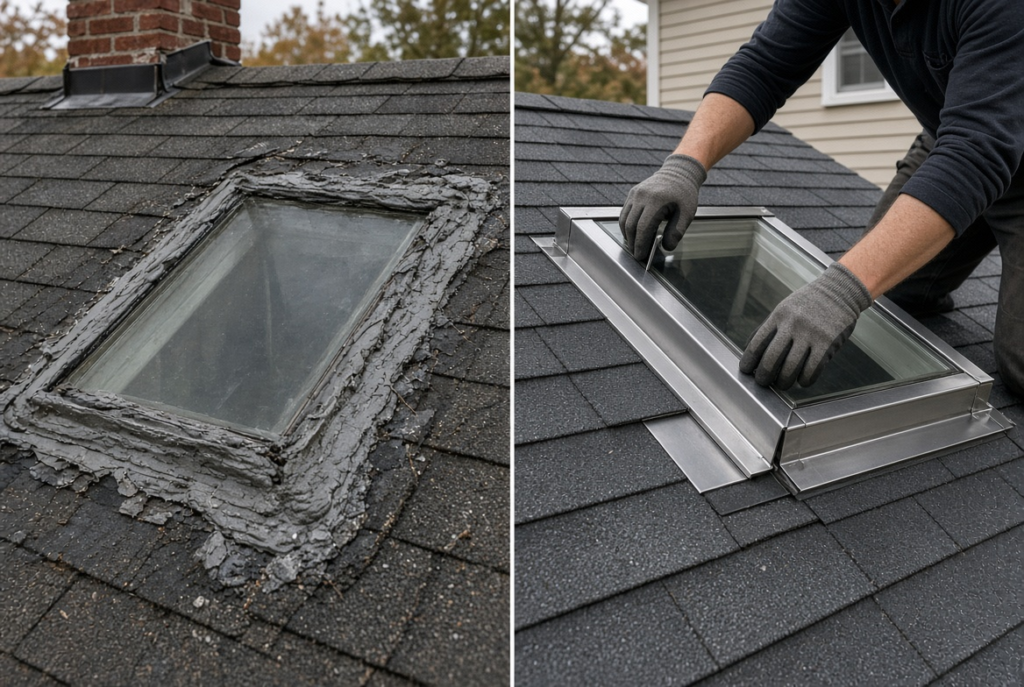
Caulk Is Not a Repair, and VELUX’s Own Warranty Says So
If you take one thing from this page: a bead of sealant over a flashing failure is not a repair. It’s a delay, and it can void the coverage you already paid for.
The most-linked skylight advice online tells homeowners to load a caulk gun with roofing cement and push it under the shingle, then run clear silicone around the glass. VELUX, which made a large share of the skylights on Massachusetts roofs, documents the opposite approach. On its page explaining what skylight flashing does, VELUX says its flashing kits “are designed to shed water without relying on sealants that can break down over time and cause damage to your roof.”
The warranty is narrower than most homeowners realize. VELUX’s own limited warranty puts the 10-year “No Leak” installation coverage on a short list of conditions. For its A21 series deck-mounted units, the skylight has to be “the original installation on residential buildings with one layer of properly installed roofing material” and installed “strictly in accordance with VELUX deck-mounted skylights and related flashing instructions.” Not a sealant. The flashing kit. Curb-mounted models carry a parallel clause with their own flashing list.
Worth saying plainly: that document never states that caulk voids your warranty. What it does is tie coverage to the flashing instructions and to good workmanship, and there is no sealant-based repair anywhere in the covered path. So the risk isn’t a clause with your name on it. The risk is that a tube of roofing cement is not the repair the coverage was written around.
Two exclusions in that document matter here, and almost nobody writes about them:
The warranty does not cover leaks from “re-roofing without re-wrapping using VELUX adhesive skylight underlayment and VELUX approved and related flashing.” Translation: if a roofer shingled around your existing skylight and reused the old flashing, your leak coverage is already gone. That happens on a lot of Massachusetts re-roofs.
The second one is the layer count. If your house has two layers of shingles, and plenty of older MA housing stock does, the No Leak warranty terms don’t apply. That’s one more reason a new roof goes on bare deck here instead of over the old layers.
The glass is covered longer, and more narrowly than people assume. On its listed models, VELUX warrants the insulating glass for 20 years against “material obstruction of vision” caused by a failure of the hermetic seal, with breakage carved out. So a foggy pane and a leaking curb are two separate conversations with two separate remedies.
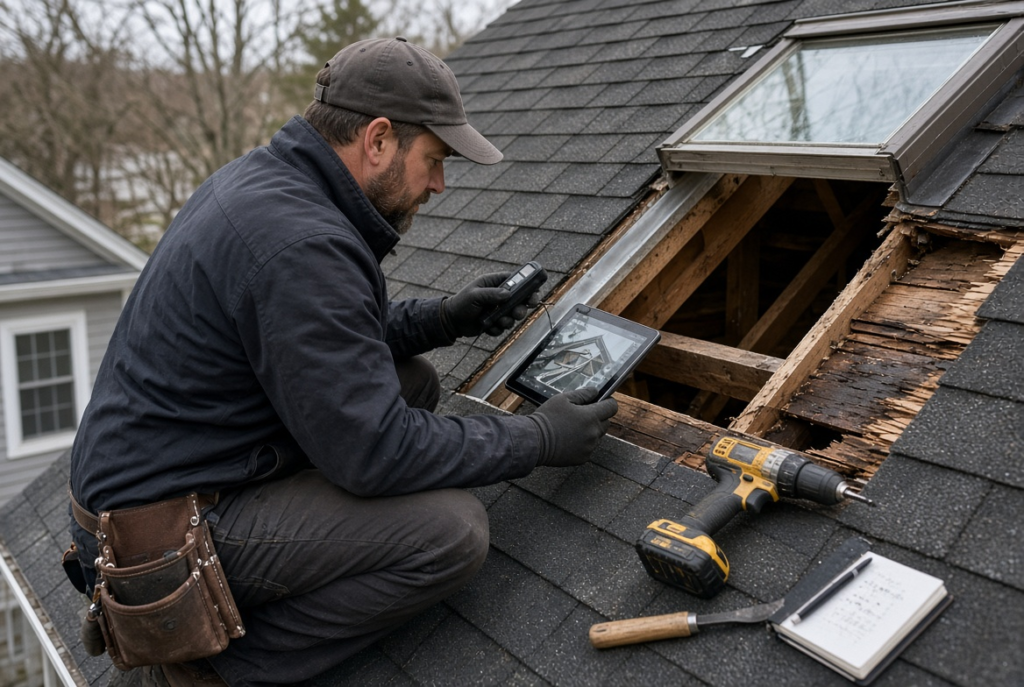
What Does Skylight Leak Repair Cost in 2026?
The price hangs on which of the four failure points is wet, and nobody knows which one that is until somebody has been on your roof.
I don’t like throwing fake prices online, because every roof is different. What I can give you is the honest version: the six things below are what a real scope looks like, in ascending order of what they cost us to do. Where your leak lands in that list is the whole answer.
| What actually failed | What the fix involves | Skylight job or roof job? | Comes back if you only seal it? |
|---|---|---|---|
| Debris in the drainage channels | Clear the channels, check the gasket, confirm the unit closes | Skylight | No. This one is a real fix. |
| Failed gasket or weatherstripping | Strip and replace to the manufacturer’s spec | Skylight | No, if the flashing underneath is sound. |
| Failed glass seal (foggy pane) | Glass or unit replacement | Skylight | Sealant does nothing here. The seal is between the panes. |
| Step or head flashing failure | Pull shingle courses back, install a manufacturer flashing kit, re-weave the courses | Roof | Yes. Every season, and worse each time. |
| Soft or rotted decking under the flashing | Cut out and replace sheathing, then re-flash | Roof | Yes, and the damage keeps spreading while you wait. |
| The roof above the skylight is failing | Roof repair or replacement. This stops being a skylight job. | Roof | Yes. Nothing you do at the skylight touches the cause. |
That bottom row is the one that wrecks budgets, because it isn’t on anybody’s skylight price list. If that’s your row, the number you need is a roof number, and it is a different conversation with a different scope. What moves it: roof size, pitch, how many layers come off, rotted decking, flashing and skylight work, ventilation, access around the home, and whether gutters or fascia are in the job. Ask for that in writing, itemized, so you can set it beside another roofer’s line by line. A number over the phone is a guess dressed up as a quote.
On timing, our own numbers are simple. A like-for-like skylight replacement is typically a one-day job. Cutting a new opening and finishing the shaft runs two to three days. A sun tunnel is usually under a day.
How Long a Skylight Lasts Before It Starts Leaking
Plan on the skylight and the roof aging together. VELUX states the lifespan of a skylight is “generally about the same lifespan as your roof.”
That single sentence should change how you think about this. The industry habit is to quote a skylight age threshold, 20 years or 25 years, and most of those numbers come with no source attached. The manufacturer’s own framing is more useful: the two assemblies wear out on the same clock, because they take the same weather.
Which leads to the decision most homeowners get wrong.
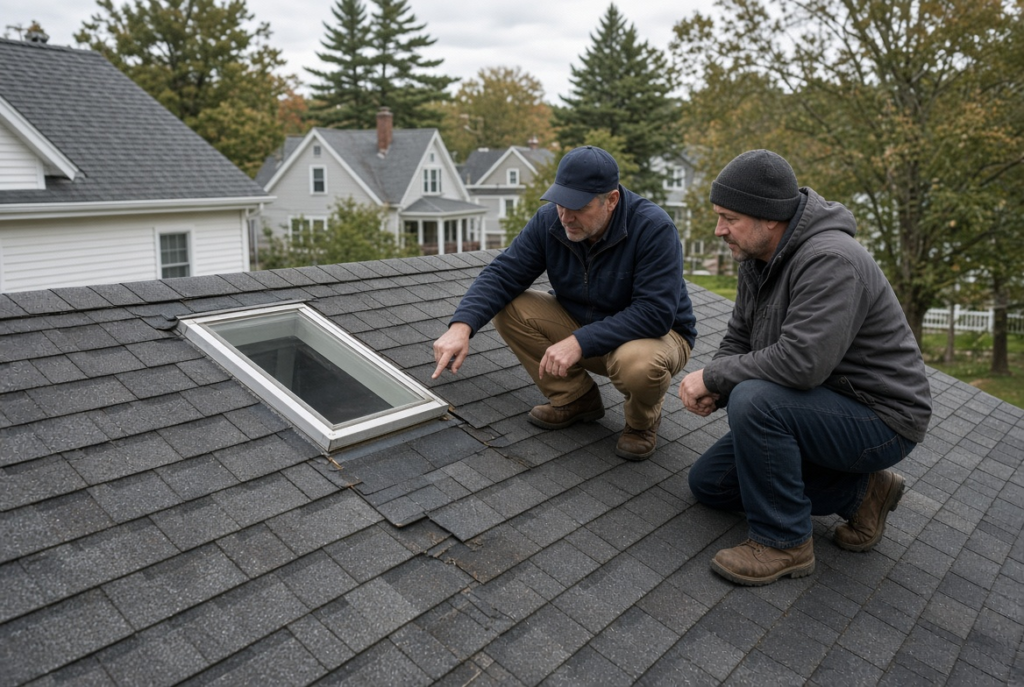
Repair or Replace? Ask About the Roof, Not the Skylight
Don’t start with the skylight’s age. Start with how many years the roof has left. That number decides whether a repair is money well spent or money spent twice.
| Roof’s remaining life | Skylight condition | What I’d tell you to do |
|---|---|---|
| 10 years or more | Flashing failed, unit sound | Re-flash it properly now. Worth doing right. |
| 10 years or more | Glass seal or unit failed | Replace the unit and re-flash. You’ll get the full life out of it. |
| 3 to 7 years | Anything | Repair to get you there, then replace the skylight with the roof. |
| Under 3 years | Anything | Tarp or patch to stop damage. Put the money into the roof and do both at once. |
| Already leaking at multiple points | Anything | Get an inspection before you spend anything. |
The reason the bottom two rows exist is that a skylight replaced on an old roof gets its flashing cut into shingles that are about to come off. You pay for that flashing work twice. VELUX makes the same point from the other direction: a skylight without a problem before roof work “will develop one if it’s not replaced with the roof.”
This is where I’ll push back on my own industry. A roofer who quotes you a skylight replacement without asking the age of your roof isn’t giving you a scope. If your roof is showing its age, the skylight is a symptom, and repair or replace the roof is the conversation worth having. And if it’s a five-year-old roof with bad flashing, the answer is to fix the flashing, not to sell you a new roof. We say that out loud on inspections, and it costs us jobs sometimes.
Our inspection ends with a now, soon, or fine verdict on every finding, plus the photos behind it and itemized pricing. That’s so you can see which row of the table above you’re actually in instead of taking my word for it.
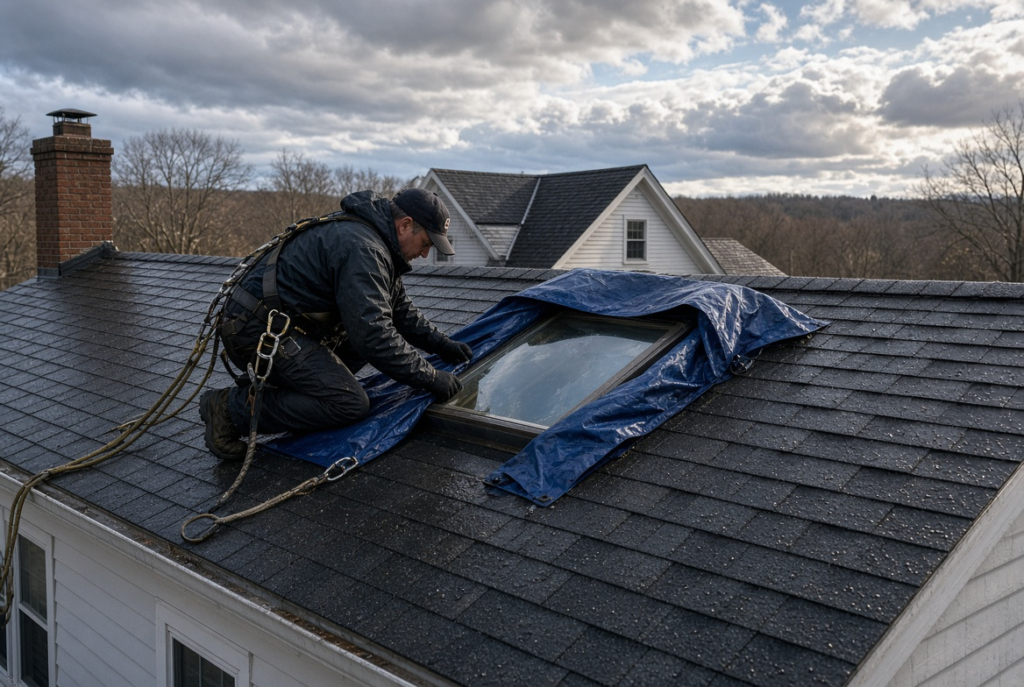
What to Do in the Next Ten Minutes
Stop the damage, document it, then diagnose. In that order.
Put a bucket down and move anything that can be ruined. There is more on how to temporarily stop a leak if you need it tonight. If water is running along the ceiling, poke a small drain hole at the low point of the bulge so it drips into your bucket instead of collapsing the drywall. Photograph everything, including the date on your phone, before you clean it up. If the ceiling is actively wet, insurance will want that.
Don’t get on the roof in the rain, in the snow, or on anything steep. That’s not caution for its own sake. Wet asphalt at pitch is how people get hurt, and the diagnosis needs a dry roof anyway.
Then get eyes on it from both sides. We’re a Quincy roofing company working the South Shore, and a photo-documented roof inspection from above and from inside the attic is the only way to tell a flashing problem from rotted decking. If it’s actively dripping right now, our line is answered around the clock and we do same-day tarping whenever conditions allow.
One last thing. A skylight leaking today has been getting in somewhere for a while, because water needs time to find a path through drywall. Whatever the diagnosis turns out to be, the decking above that ceiling has already been wet longer than the stain suggests. Get it looked at before the next freeze.
Frequently Asked Questions
Is My Skylight Leaking, or Is It Condensation?
Condensation shows up on cold days with no rain, forms on the inside face of the glass, and runs down to pool in the bottom of the frame. A leak follows the weather and usually stains the ceiling a foot or two out from the opening. Wipe the glass dry on a cold, dry day. If beads return within an hour, you’re looking at condensation, and the fix is usually air sealing and insulating the skylight shaft rather than anything on the roof.
Can I Stop a Skylight Leaking With Caulk?
You can slow it down, and you may hide the real problem while you do. VELUX’s limited warranty conditions its 10-year No Leak coverage on the unit being installed “strictly in accordance with VELUX deck-mounted skylights and related flashing instructions,” and VELUX describes its flashing kits as designed to shed water without relying on sealants that break down. The warranty does not say caulk voids it. It says the coverage was written around the flashing kit, and a bead of roofing cement over failed step flashing is a delay rather than a repair.
How Much Does It Cost to Fix a Leaking Skylight?
Nobody can tell you honestly without seeing it, and the range is wide enough that a phone number would be a guess. Clearing blocked drainage channels and replacing a gasket sit at the bottom. Pulling shingle courses back to install a manufacturer flashing kit sits well above that. Replacing rotted sheathing under the flashing sits above that again. And if the roof above the skylight is the actual failure, you need a roof number instead, which is a different scope altogether. Get either one itemized in writing so you can compare it line by line.
Should I Replace the Skylight When I Replace the Roof?
Usually yes, and the manufacturer agrees. VELUX states that a skylight lifespan is “generally about the same lifespan as your roof,” and that a skylight without a problem before roof work “will develop one if it’s not replaced with the roof.” Its warranty also excludes leaks caused by “re-roofing without re-wrapping using VELUX adhesive skylight underlayment and VELUX approved and related flashing,” so reusing old flashing on a new roof can cost you the coverage.
Will Homeowners Insurance Cover a Leaking Skylight?
It depends on the policy and on the cause, and nobody should promise you an outcome. Carriers generally treat sudden damage from a storm differently from gradual wear or a bad past installation. We photograph and document what we find and we’ll meet an adjuster when it makes sense, but we won’t tell you to open a claim if the damage isn’t there.
Can a Leaking Skylight Cause Rotted Decking or Mold?
Yes, and it’s the most common reason a small repair turns into a large one. Water entering at the head flashing runs down the sheathing before it ever reaches your ceiling, so the wood is wet well before the stain appears, which is why waiting on a roof leak costs more than fixing it. By then it is a roof repair, not a skylight job. That’s why our attic check looks at sheathing for stains and soft spots as part of the inspection instead of judging the roof from the outside alone.
How Long Do Skylights Last Before They Start Leaking?
Plan on the same clock as your roof. VELUX puts the lifespan of a skylight at “generally about the same lifespan as your roof” and warrants the insulating glass on its listed models for 20 years against “material obstruction of vision” from hermetic seal failure. Age alone is a weak signal though. A well-flashed 18-year-old unit often outlasts a 6-year-old one that was sealed in with tar instead of a flashing kit. If you have a skylight leaking on a roof that is only a few years old, the age is not your problem. The install is.