To tarp a roof, you run a heavy tarp from below the damage, up the slope, and over the ridge, then wrap the edges around wood boards and fasten those boards down. The tarp should extend at least 4 feet past the damage on every side. Work on a dry roof. Never during a storm. Never alone.
That’s the answer every guide on the internet gives you, and it’s fine as far as it goes.
Here’s what they leave out. I roof houses in Massachusetts. A good share of the leaks I get called to look at between December and March cannot be stopped by a tarp at all, because the water isn’t coming through a hole. It’s coming in under shingles that are still nailed down tight. You could spend a Saturday on a frozen roof doing everything in this article correctly and still have a wet ceiling Sunday morning.
So read the second section before you buy a tarp.
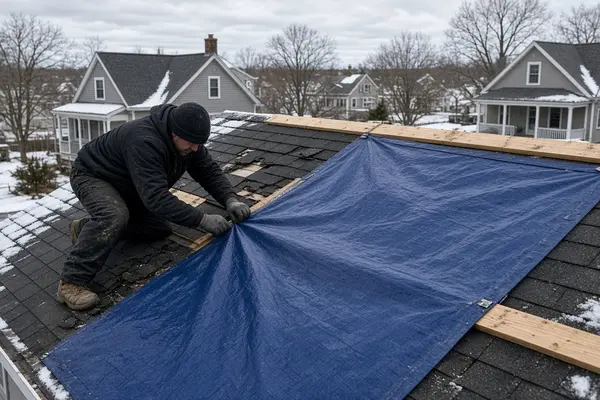
What Is Roof Tarping?
Roof tarping is a temporary cover installed over damaged roofing to keep water out until a permanent repair or replacement can be done. A tarp bridges holes, missing shingles, and open decking. It is not a repair. The federal government’s own emergency roofing program builds its temporary coverings to last 30 days, not a season.
That last number matters more than people think, and I’ll come back to it.
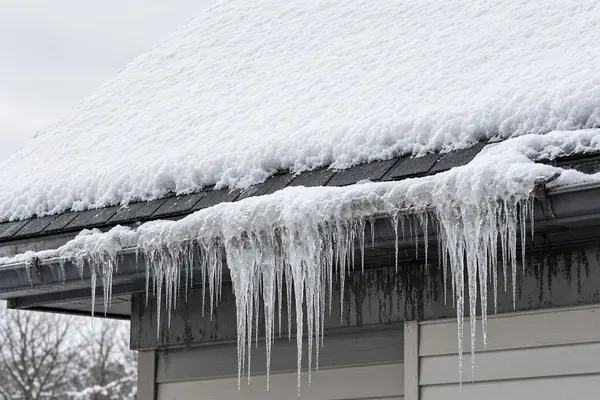
Half of Massachusetts Winter Leaks Don’t Need a Tarp
A tarp covers a hole. That’s the whole job. If water is getting in some other way, a tarp does nothing but put you on a roof in bad weather.
Across the roofs we look at, the problem usually isn’t the shingle you can see. It’s flashing at a chimney or wall. It’s a pipe boot that dried out and split. It’s a valley. It’s a previous install where somebody nailed high or skipped the leak barrier. And in winter, it’s an ice dam.
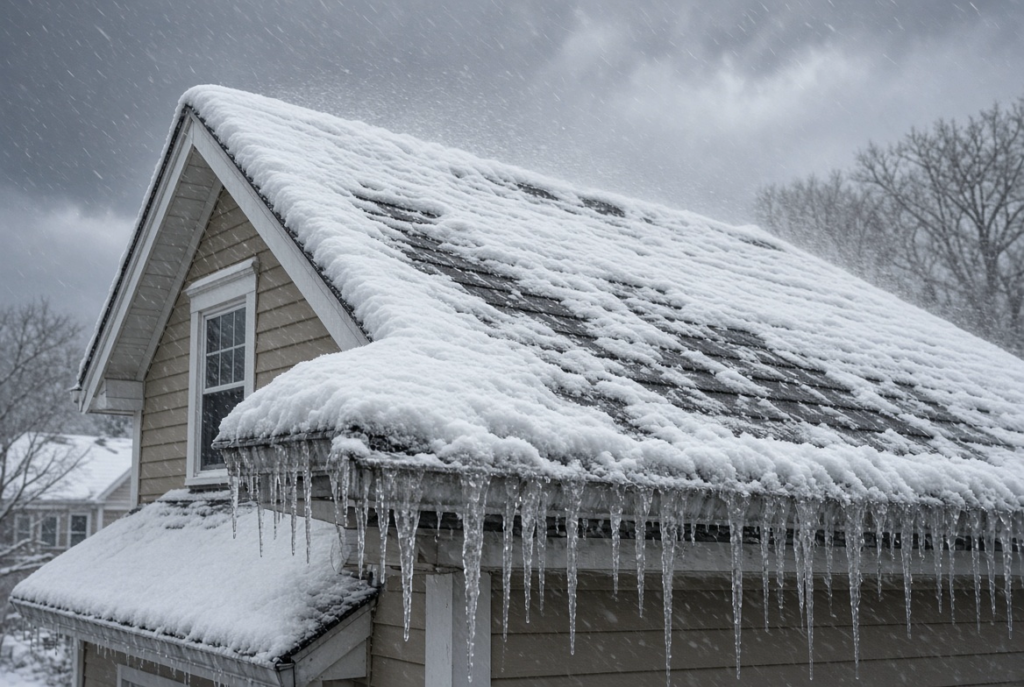
Ice dams work like this. Heat escapes into the attic, snow on the roof melts, the meltwater runs down and refreezes at the cold eave. The Commonwealth’s own guidance describes it plainly: ice dams form when snow melts and runs down the roof to the eaves, where it turns to ice. That ice backs water up the slope, and the water goes under the shingles, because shingles shed water down. They don’t seal against water pushing up.
Now put a tarp over that. The tarp sits on top of shingles that are already doing their job. The water is underneath it. You’ve changed nothing.
Here’s my rule, and it’s the one I give homeowners on the phone before they climb anything:
| What you’re looking at | Tarp it? | Why |
|---|---|---|
| Hole in the roof, tree limb through it, visible decking or sky | Yes, right away | Open water path. A tarp is the correct fix. |
| Section of shingles blown off in a wind event | Yes | Underlayment is exposed and won’t hold long. |
| A few lifted or cracked shingles, no water yet | Usually no | Get it repaired. A tarp adds fasteners for no reason. |
| Leak at a chimney, skylight, or wall | No | It’s flashing. A tarp over it misses the entry point. |
| Water stain at the eave or ceiling edge after a snow | Almost never | This is an ice dam pattern. A tarp does nothing. |
| Water at the eave with icicles and a snow load | No, and stay off the roof | The state warns against climbing or chipping. Get help. |
If you’re not sure which one you have, trace where water is getting in from inside the attic first. It’s safer and it’s usually faster. And if water’s already coming through the ceiling, there are ways to slow a leak from inside that don’t involve a ladder.
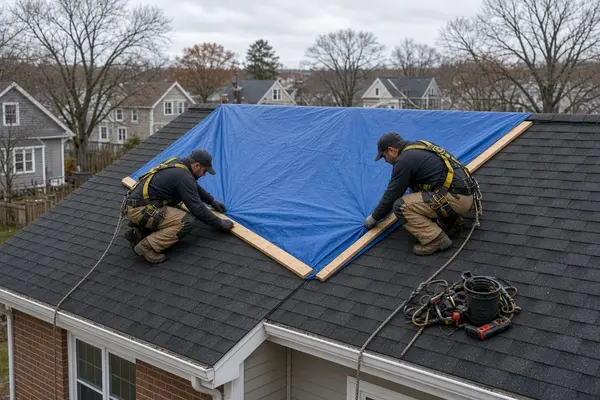
How Do You Tarp a Roof, Step by Step?
If you’ve got a real hole and a dry, walkable roof, here’s the sequence. Two people minimum.
- Wait for the weather to clear. Not “mostly clear.” Clear. Wet asphalt shingles are slick, and a tarp on a wet roof is a sail.
- Look at it from the ground and from the attic. You want to know how big the damaged area is before you’re standing on it. Daylight through the attic sheathing tells you exactly where the hole is.
- Clear the debris. Branches, loose nails, broken shingle pieces. Anything under the tarp becomes a wear point that grinds a hole through it in a week.
- Measure the damage, then add 4 feet in every direction. The tarp has to run past the damage on all sides. Going over the ridge is the part people skip, and it’s the part that matters most. If the top edge of your tarp stops partway up the slope, rain runs down the roof and straight under it. You’ve built a funnel.
- Cover any large opening with plywood first. If a limb went through, half-inch sheathing over the hole gives the tarp something to sit on instead of sagging into the cavity and holding water.
- Roll the tarp out from the ridge down. Upper edge over the peak, then unroll toward the eave. Pull it flat. Air gaps let wind get under it.
- Anchor it with boards, not bare nails. Covered in the next section. This is where most DIY tarps fail.
- Check it after the next storm. And after the one after that.
If water is already inside the house, deal with that first. There’s more on what to do in the first hour of a roof emergency, including the ceiling-poke trick that saves you a drywall replacement.
Tarp Size, Thickness, and What the Federal Program Actually Uses
Buy a tarp bigger than you think you need. A 20 by 30 foot tarp on a small hole is not a waste. A tarp that’s 2 feet short is a total loss.
The overlap number that shows up across the field is 3 to 5 feet past the damage. I use 4 feet as the floor, and more on the uphill side.
On thickness, here’s something none of the big guides mention. The U.S. Army Corps of Engineers runs the federal Operation Blue Roof program, and it doesn’t use hardware-store poly tarps. It installs fiber-reinforced plastic sheeting, secured with strips of wood fastened with nails or screws. That’s a different product from the folded blue tarp in the seasonal aisle.
I’m not saying you need a federal contract to cover a hole. I’m saying the thin economy tarp is not what a professional emergency cover is made of, and it will tell you so in the first real wind event. Buy the heaviest one the store carries.
One more thing from that program worth knowing: it won’t cover flat roofs, or clay, slate, or asbestos tile. Those roofs are too easy to destroy with fasteners. The same logic applies to your house. If you have slate, do not put nails in it.
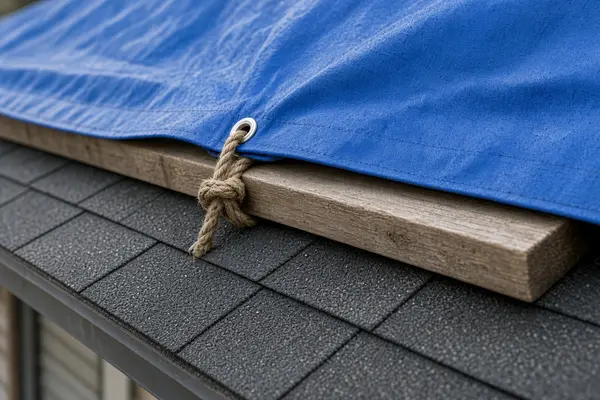
Anchoring a Tarp Without Wrecking the Roof Underneath
Every fastener you drive to hold a tarp is a hole in your roof. That’s the trade, and it’s usually worth making. But where you put those holes matters a lot in Massachusetts, and nobody writes about this.
Massachusetts residential code requires an ice barrier on shingle roofs, running from the lowest edge of the roof to a point at least 24 inches inside the exterior wall line. On steeper roofs, at least 36 inches measured up the slope from the eave. The state’s building code FAQ is direct about why: weather patterns have shown that Massachusetts homes are subject to ice forming at the eaves and backing water up.
That membrane is the only thing standing between an ice dam and your ceiling. And it sits in exactly the strip of roof where people like to nail their tarp battens, because it’s the easiest part to reach from a ladder.
So: anchor high, not low. Put your boards up the slope, above the damage and near the ridge where you can. If you have to fasten near the eave, know that you’re punching the ice barrier, and tell your roofer where you did it so it gets addressed at repair time.
The method itself is simple. Wrap the tarp edge around a 2×4, roll the board a full turn so the tarp is sandwiched, then fasten the board through the roof. Cut boards about 2 feet longer than the tarp is wide. Set them perpendicular to the ridge, not parallel, so water and snow shed off instead of pooling against them.
Sandbags and the No-Nail Methods
You can hold a tarp down without driving a single fastener, using sandbags or weighted battens laid over the tarp instead of through it. That’s the right call on slate, tile, or a roof you’re replacing next month anyway. It’s the wrong call in a nor’easter. Sandbags hold a tarp against gravity, not against wind getting under a loose edge and peeling it off like a sticker.
Can You Tarp a Roof in Winter?
Mostly, you shouldn’t. Not because it’s impossible, because it’s dangerous and it usually doesn’t solve the problem.
A snow-covered asphalt roof is one of the worst work surfaces there is. The Commonwealth’s ice dam guidance tells homeowners flat out not to get on the roof or chip at ice from the ground, and warns that the weight of ice can collapse roof overhangs. That’s the state telling you the thing you’re about to do is how people get hurt.
There’s a second problem. Snow lands on the tarp. Snow gets heavy. A tarp bridging a hole with 18 inches of wet snow on it is now a bathtub with a plastic bottom, and the boards you fastened at the edges are the only thing holding it. In a New England winter, a tarp needs to be checked after every storm, not once a month.
If you have real winter damage and open sheathing, that’s what emergency roof repair exists for. That’s not a sales line. It’s the one time of year I’d rather talk a homeowner out of a Saturday project.
Roof type changes the winter math too. We compared how asphalt and metal shed snow if you’re already thinking about replacing.
How Long Can a Tarp Stay on a Roof?
Shorter than you’ve been told. Most roofing sites say 90 days or three months. I’ve never seen one of them cite a source for it, and I’ve looked.
Here’s a source. FEMA’s temporary roofing fact sheet says the Blue Roof covering it installs after federally declared disasters is designed to last 30 days. That’s professional-grade reinforced sheeting, installed by contractors under a federal spec. If that’s a 30-day product, your hardware-store tarp is not a 90-day product.
Massachusetts makes it worse than the national average. UV degrades poly year-round, and then you add freeze-thaw cycles, ice loading, and wind. NOAA’s archived disaster record counts 45 billion-dollar weather events affecting Massachusetts between 1980 and 2024. Fifteen of them were winter storms. Fifteen were severe storms. Only nine were tropical cyclones. A tarp here isn’t waiting out one hurricane season. It’s waiting out a rotation.
Treat 30 days as the plan and anything past that as borrowed time. Check it after every storm. If it’s flapping, torn, or holding water, it’s done. Waiting has a price, and we’ve written about how long you can leave a leak before the decking starts paying for it.
Thirty days is plenty, though. Most standard roof replacements we do go on in one to two days once material is delivered and the weather cooperates. Our average install is a single day. A tarp doesn’t need to survive a season. It needs to survive the gap between the storm and a repair or a replacement, and that gap should be measured in weeks, not months.
What Roof Tarping Costs in Massachusetts
I don’t put roof prices on the internet, because every roof is different and a number without a scope behind it is just bait. What I can tell you is exactly what moves the number, so you can read a quote instead of guessing at one.
Roof size and how much of it needs covering. Pitch, because a steep roof takes fall protection and more time. Height, because a third-story dormer is a different job than a low ranch. Access, meaning where a ladder can safely go and whether there’s a fence, a deck, or landscaping in the way. Whether plywood is needed under the tarp. And whether it’s a scheduled visit or a call at 9 p.m. during a nor’easter, because storm-night work costs more everywhere.
Doing it yourself costs the tarp, the boards, and the fasteners. That’s the cheapest version, and it’s the right one for a small opening on a low, dry, walkable roof. It is not the right one for a steep roof, a big hole, or February.
What I’d tell you either way: don’t let the tarp price drive the decision. The tarp is the cheap part of this. The expensive part is the decking underneath it if the water sits for six weeks.
Does Homeowners Insurance Cover a Roof Tarp?
Usually yes, and in Massachusetts you’re generally expected to protect the house after a loss.
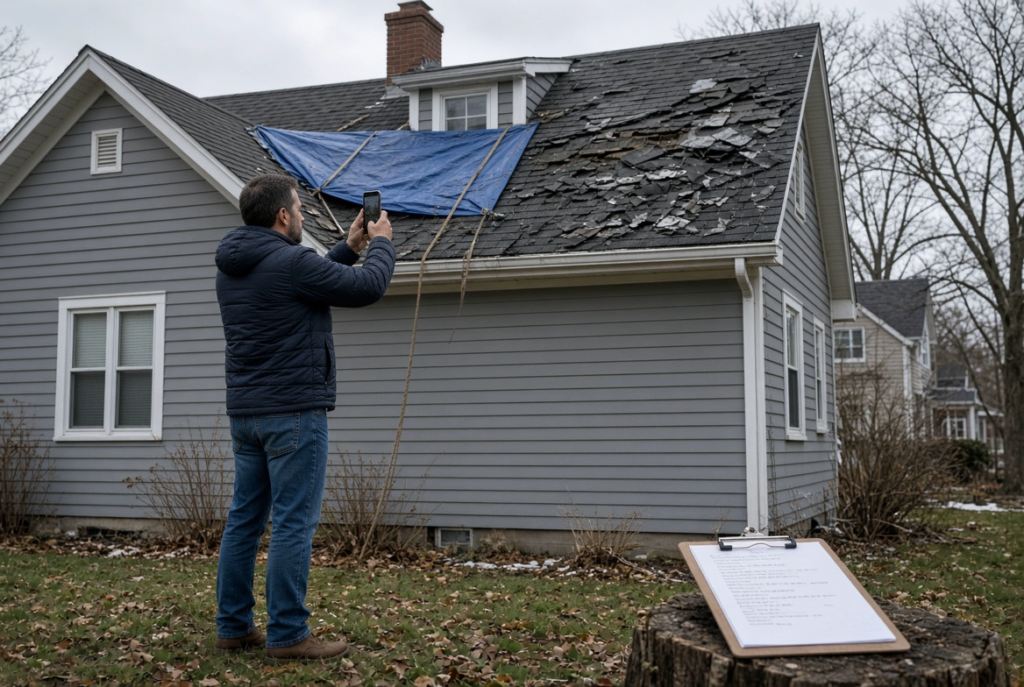
The Massachusetts Division of Insurance tells homeowners to protect your property from further loss or damage, and says that if you make temporary repairs, you should keep a record of what you do and save all receipts for the expenses you take on.
Read that in reverse and it’s a warning. If you had a hole in your roof, did nothing for three weeks, and the water ruined the decking and the insulation, an adjuster can reasonably ask why you didn’t cover it. Mitigation isn’t a favor you’re doing the insurance company. It’s a condition of most policies.
Three practical things:
- Photograph the damage before you cover it. Then photograph the tarp. Then keep photographing after storms.
- Keep every receipt, including the tarp and the lumber.
- Don’t let anybody tell you a tarp is a repair on a claim. It’s mitigation. The repair is a separate line.
Hiring the Tarp Crew in Massachusetts
After a big storm, trucks show up. Some of them are good. Some of them followed the weather here from three states away.
Massachusetts gives you a filter that has nothing to do with reviews. Contractors doing home improvement work here are required to be registered with the state, and the Office of Consumer Affairs publishes what that registration protects and what you give up by skipping it. Ask for the registration number before anybody gets on your roof. Any real contractor here has one and will hand it over without a pause.
There are more questions worth asking before you sign, but that one is the fastest filter after a storm.
After the Tarp: The Repair or Replace Call
The tarp buys you time to make a decision without water in the house. That’s it. Once it’s up, the actual question starts.
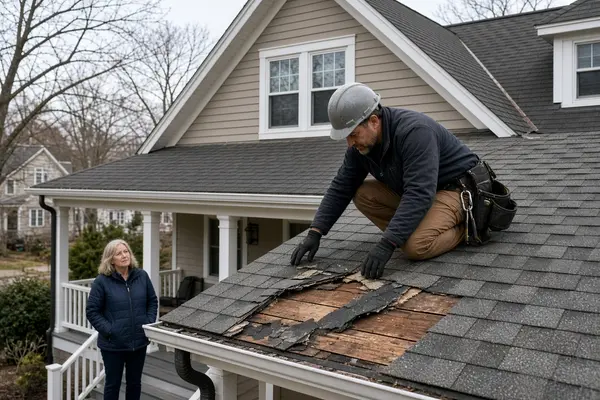
Get on the roof, or get someone on the roof, and find out what’s under it. From the ground a roof can look fine. Once you inspect it, you may see lifted shingles, granule loss, bad flashing, soft wood, nail pops, dried-out pipe boots, or a ventilation setup that caused the ice dam in the first place. That’s the difference between a patch and a real fix.
Photos settle it. When I look at a roof, the homeowner sees what I see, and then we talk about whether it’s a repair or a replacement in normal words. Sometimes the answer is repair. If a roof can be repaired, I say so. What I won’t do is sell somebody a roof they don’t need because a storm made them nervous. That’s the whole approach at Powersol Roofing: show the photos, explain it plainly, let the homeowner decide.
If you want to know what a real inspection covers before you book one, we wrote out the checklist we use on Massachusetts roofs.
If you’ve got a tarp on your roof right now in Quincy, Brockton, Taunton, Randolph, Stoughton, Dorchester, or anywhere on the South Shore, get it looked at before the 30 days are up. We’ll inspect it, show you photos of what’s actually going on, and tell you straight whether you need storm damage repair or a full replacement. No pressure, no free-roof promises.
Most people who learn how to tarp a roof learn it at the worst possible moment. If that’s you this week, cover the hole, then get somebody to look under it.
Frequently Asked Questions
How Do You Tarp a Roof Yourself?
Wait for dry weather, clear debris, measure the damaged area and add 4 feet on every side, run the tarp over the ridge, and anchor the edges by wrapping them around 2x4s and fastening the boards through the roof. Cut the boards about 2 feet longer than the tarp is wide and set them perpendicular to the ridge. Never do it alone and never in active weather.
How Long Can a Tarp Stay on a Roof?
Plan on 30 days. FEMA’s temporary roofing fact sheet says the reinforced sheeting installed under the federal Blue Roof program is designed to last 30 days, and that’s a professional-grade product. The 90-day figure repeated across roofing sites has no published source behind it. In Massachusetts, check the tarp after every storm.
What Does It Cost to Tarp a Roof?
It depends on roof size, pitch, height, access, whether plywood is needed underneath, and whether it’s a scheduled visit or a storm-night call. Every roof is different, so ask for a written scope rather than a number over the phone. Doing it yourself costs the tarp, boards, and fasteners, and only makes sense on a low, dry, walkable roof with a small opening.
Does Homeowners Insurance Pay to Tarp a Roof?
Generally yes. The Massachusetts Division of Insurance tells homeowners to protect their property from further loss or damage after a loss, and to keep a record of any temporary repairs and save all receipts for the expenses. Carriers may reimburse those costs depending on the policy. Photograph the damage before you cover it.
Should You Tarp a Roof in Winter?
Usually not yourself. A snow-covered roof is a fall hazard, and Massachusetts guidance specifically tells homeowners not to climb on the roof or chip at ice. Snow load on a tarp bridging an opening adds serious weight. If you have open sheathing in January, call a roofer instead of climbing.
Will a Tarp Stop a Leak From an Ice Dam?
No. Ice dam water backs up under shingles that are still fastened down, so a tarp laid on top of them sheds nothing. Ice dams form when roof snow melts, runs to the cold eave, and refreezes. The fix is inside: air sealing, insulation, and attic ventilation, not a cover on the outside.
Can You Tarp a Roof Without Nails?
Yes, using sandbags or weighted battens laid over the tarp rather than fastened through it. That’s the right approach on slate, tile, or a roof scheduled for replacement. It holds much worse in high wind, so it isn’t a good choice before a nor’easter.