InterNACHI’s life expectancy chart puts an architectural asphalt roof at about 30 years and a 3-tab roof at about 20. Treat that as the ceiling. Our freeze-thaw winters and weak attic ventilation often pull the real number closer to 20 to 25 years, and smaller parts give out well before that. Rubber pipe boots usually split around year 10, and cracked or lifted flashing is the number 1 leak point I see. When a homeowner asks me “how long does a roof last in Massachusetts,” my answer is: as long as its weakest part.
A roof in Massachusetts lasts until its weakest part fails. InterNACHI’s chart puts architectural asphalt shingles at about 30 years, 3-tab at 20, metal at 40 to 80 and slate at 60 to 150. Flashing, rubber pipe boots, valleys and eave decking usually fail first here, and those parts set the real replacement date.
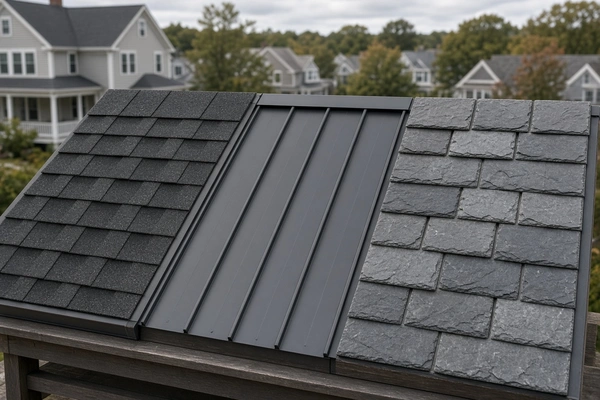
How Long Does a Roof Last in Massachusetts, by Material?
Asphalt shingles run 20 to 30 years on InterNACHI’s chart, metal 40 to 80 and slate 60 to 150. InterNACHI says its figures “should be used as guidelines only, and not relied upon as guarantees or warranties,” and that’s how I use them.
| Roof type | InterNACHI estimate | What we see on Massachusetts houses |
| Architectural asphalt (we install GAF Timberline HDZ) | 30 years | Often closer to 20 to 25 with weak attic ventilation |
| 3-tab asphalt | 20 years | Found on older roofs; we install architectural shingles |
| Metal | 40 to 80 years | Our metal roofing page puts coated steel at 40 to 60, with aluminum often lasting longer near salt water |
| Slate | 60 to 150 years | The widest range on the chart |
The chart also says “the life of a roof depends on local weather conditions, building and design, material quality, and adequate maintenance.” Massachusetts weather goes after the details first. Flat roofs on triple-deckers and storefronts use EPDM, TPO or modified bitumen membranes, so treat them as a separate roof.
The Part That Fails First Sets Your Roof’s Real Age
Your roof is done when its weakest part lets water reach the deck. On the roofs we inspect, the leak usually isn’t coming from the shingles.
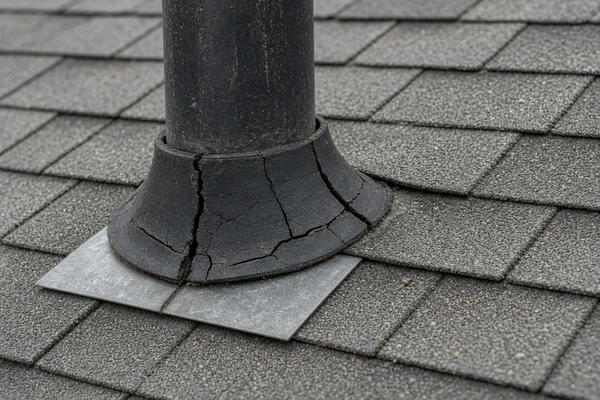
Pipe boots crack early. The rubber collar around each plumbing vent dries out and splits, usually around year 10, long before the shingles are done. Boots tend to fail as a group, so when we find 1 cracked, we check every vent on the roof.
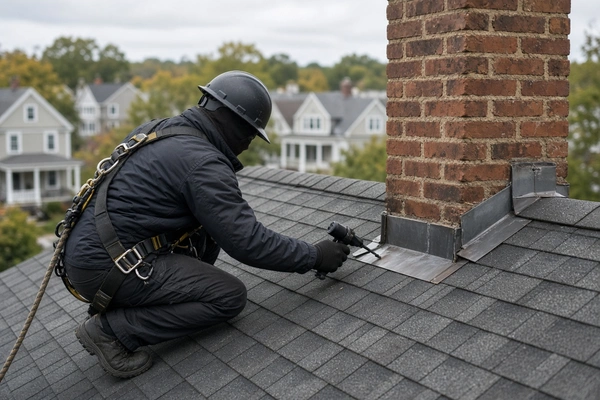
Flashing causes the most leaks. Metal flashing separates from chimneys and other masonry as the mortar ages and freeze-thaw cycles work the joint open. Most shingle leaks we get called about turn out to be failed flashing.
Valleys and the ridge wear out ahead of the rest of the roof. Valleys carry the most water, and the ridge takes the most wind.
The eaves take the ice dam water, and that’s where we find rotted decking where water has been sneaking in for years. On a Taunton job, we replaced the roof, swapped the gutters and changed the fascia and soffit over to PVC so the edges would stop rotting.
Bad nailing shows up in the first big wind. Shingles nailed too high when the roof went on can lift in a nor’easter.
That’s why I treat the shingle rating as a ceiling and the first part to let water in as the real date. On a younger roof, most of these failures are a single-visit repair.
What Massachusetts Winters Do to a Roof
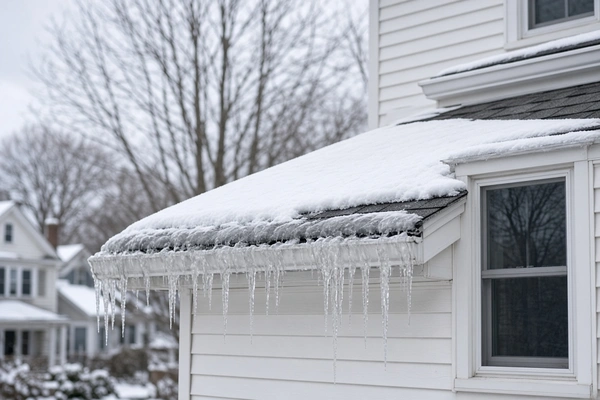
A Massachusetts winter wears a roof down with repeated freeze-thaw swings and heavy snow at the eaves.
At Boston Logan, NOAA’s 1991-2020 climate normals show about 92 days a year with a low at or below 32°F, but only about 23 days when the high stays at or below freezing. That leaves roughly 68 days a year when the temperature drops below freezing and climbs back above it, with about 14 to 16 a month from December through March. Each swing gives trapped water a chance to freeze and expand in flashing joints and cracked sealant.
The same normals put Boston’s snowfall at 49.2 inches a year. The U.S. Department of Energy’s Building America Solution Center notes that ice dams can form once 2 inches of snow builds up on a roof. Heat from the house melts the snow, the water runs down and refreezes at the cold eaves, and then it backs up under the shingles. That’s how you get a leak that only shows up on a sunny day in February.
Summer does its own damage. A hot attic cooks shingles from underneath and shortens their life, which is part of why asphalt here wears out early.
Do Ice Dams Mean You Need More Attic Ventilation?
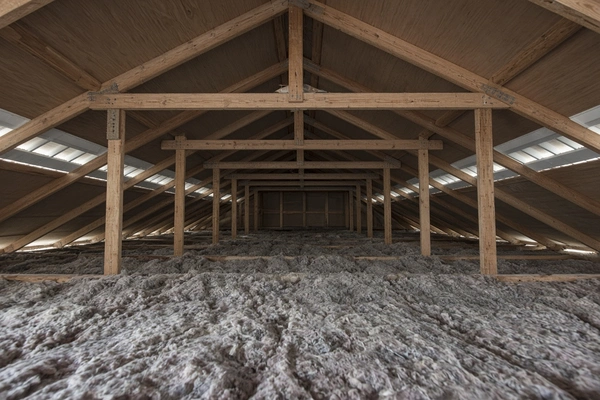
Not on their own. The Building America Solution Center says an ice dam needs snow on the roof, a poorly air sealed or poorly insulated attic, and freezing temperatures. It calls sealing the air leaks from the house into the attic “the most important step,” ahead of insulation and ventilation.
Ventilation still matters, and every GAF roof we install gets a Cobra ridge vent with balanced intake and exhaust. But a new vent can’t keep up if warm air keeps leaking up from the rooms below. If a roofer sells you a ridge vent as the whole ice dam fix, ask what’s being done about the attic floor. The same DOE page also calls for an air gap of at least 2 inches between the top of the attic insulation and the underside of the roof deck.
Massachusetts code adds a backstop. The residential code (780 CMR 51.00) requires an ice barrier at the eaves of shingle roofs statewide, running to at least 24 inches inside the exterior wall line. That membrane keeps ice dam water out of the house. It doesn’t stop the dam from forming, and it’s a big reason an overlay rarely works here.
Does a “Lifetime” Shingle Last a Lifetime?
No. On GAF shingles, “Lifetime” describes how long the warranty runs for the original owner. It says nothing about how long the roof holds up in a Massachusetts winter.
GAF defines Lifetime on its warranty comparison page as “as long as you, the original owner(s)” own the property, and only on a single-family detached house owned by individuals. For any other owner or building, the term is 40 years. The non-prorated window, which GAF calls Smart Choice Protection, is 10 years on its base shingle warranty and 50 years on its System Plus, Silver Pledge and Golden Pledge warranties. After that window, coverage is prorated, so any payout shrinks to reflect the years of use you’ve already had.
Workmanship is a separate promise. GAF lists it as “Not covered” on the base warranty and on System Plus, and failures like loose flashing or high nailing are installation problems. We back every new roof with a 25-year workmanship guarantee and register the GAF material warranty in your name.
Metal Buys Decades You May Not Use
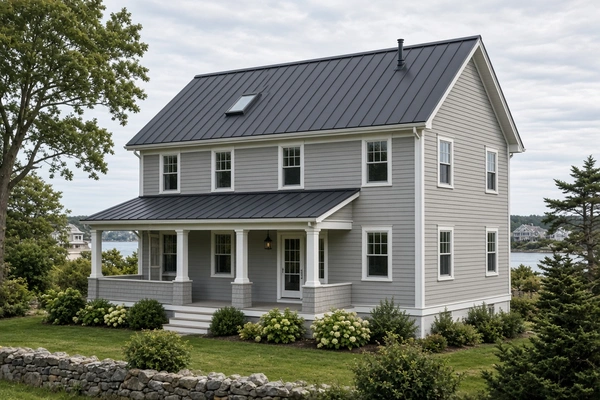
Metal lasts 40 to 80 years on InterNACHI’s chart, 2 to 3 asphalt roofs’ worth, but the extra decades pay off only if you stay long enough to use them.
We install standing seam and metal shingles on the South Shore, with aluminum or Galvalume and a PVDF finish near the water and G90 steel inland. Within about a mile of salt water, we spec a marine-grade coating system. NAR’s 2025 Profile of Home Buyers and Sellers put the median time in a home before selling at 11 years, an all-time high. If you sell on that timeline, a new asphalt roof outlasts your stay. If this is the house you keep, the math tilts toward metal every year you stay.
How to Find Out How Old Your Roof Is
Start with the permit record. A reroof in Massachusetts needs a building permit, so your town’s building department should have a date on file. In Quincy, that’s the Inspectional Services Department at (617) 376-1450.
If you’re buying or selling, we schedule the inspection around showings and closings. Our photo-documented inspection covers the roof from above and the attic from below: flashing at chimneys, walls and skylights, attic sheathing for stains and soft spots, ventilation intake and exhaust balance, vent boots and every roof penetration, and signs of past ice dams at the eaves. Every finding gets photographed and explained in plain English.
From year 15 on, I’d have a roofer check it every year, because that catches small failures while they’re still repairs.
When Roof Age Changes the Repair-or-Replace Call
Under 15 years, a repair is usually right unless the damage is structural. Over 20, replacement is usually the smarter move, especially before you sell.
Between 15 and 20, the photos decide whether you repair or replace the roof. Damage in 1 spot on a sound deck is a repair. Brittle, granule-shedding shingles across the field and soft decking in more than 1 area are replacement signs.
That’s how we decide at Powersol Roofing, without the fear pitch. If the roof is sound, the report says so, and that answer is worth as much as any repair.
What Goes Into a 2026 Powersol Roof
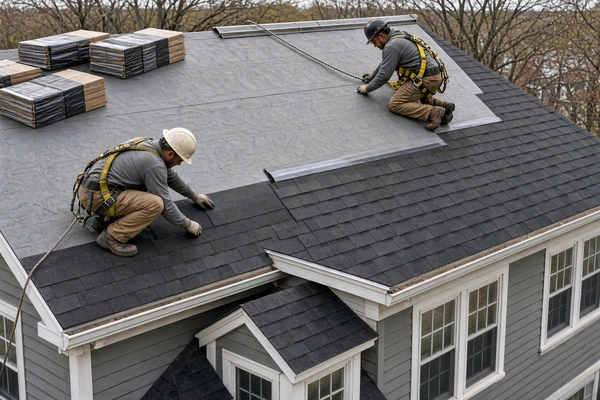
Every replacement we do starts with a tear-off down to the deck and a full GAF system going back on.
That system is new metal drip edge, GAF WeatherWatch ice and water leak barrier at the eaves, GAF FeltBuster synthetic underlayment, GAF Pro-Start starter strips, new flashing at every chimney, sidewall and skylight, GAF Timberline HDZ shingles, and a GAF Cobra ridge vent with Seal-A-Ridge caps.
Every layer is priced in writing before anyone climbs a ladder with tools, and if we find rotted decking, we replace it at the per-sheet price already written in your estimate. Most standard replacements take 1 to 2 days once material is on site and the weather holds, and our average install runs about a day. Massachusetts code also won’t allow a new layer over 2 existing ones. The same project lead stays with you from the estimate to the final walkthrough, and cleanup includes a magnetic nail sweep and final photos.
Find Your Roof’s Real Number
If you’ve been asking “how long does a roof last in Massachusetts,” the textbook answer is 20 to 30 years for asphalt shingles. Your roof’s real number depends on its pipe boots, flashing, valleys and attic, and the only way to know is to look. Book a free inspection or call (617) 631-5435, and we’ll photograph what we find and tell you what it needs, if anything.
Frequently Asked Questions
How long does a roof last in Massachusetts?
InterNACHI’s life expectancy chart puts architectural asphalt shingles at about 30 years, 3-tab at 20, metal at 40 to 80 and slate at 60 to 150. On Massachusetts asphalt roofs with weak attic ventilation, Powersol often sees the real number closer to 20 to 25 years. Rubber pipe boots can split around year 10, so the first leak often comes well before the shingles wear out.
How long does a roof last in Massachusetts with poor attic ventilation?
Plan on the low end. A hot attic cooks shingles from underneath, which is why Powersol often sees asphalt roofs here last 20 to 25 years instead of the 30 InterNACHI lists for architectural shingles. For ice dams, the Department of Energy’s Building America Solution Center puts attic air sealing first, then insulation, then ventilation.
Is a 20-year-old roof still good?
It can be, but it’s due for a close look. Past 20 years, replacement is usually the smarter move, especially before you sell, while a roof under 15 with damage in 1 spot is usually a repair. From year 15 on, a yearly inspection catches small failures while they’re still repairs.
How long do rubber pipe boots last on a roof?
The rubber collar around a plumbing vent usually dries out and splits around year 10, long before the shingles are done. Pipe boots tend to fail as a group, so if 1 is cracked, check the rest. Replacing them is usually a single-visit repair.
Do black streaks mean my roof is failing?
Not by themselves. The Asphalt Roofing Manufacturers Association describes algae discoloration as brown to black, sometimes in streaks, and its damage warnings are about cleaning: it says high-pressure washing is likely to damage asphalt roofing. ARMA separates algae from moss, so have a roofer look at moss or lifted shingles.
How long does a roof replacement take in Massachusetts?
Most standard replacements take 1 to 2 days once material is on site and the weather holds, and Powersol’s average install runs about a day. From the day you sign to the final walkthrough, plan on 2 to 6 weeks. Triple-deckers and roofs with flat sections take longer.
Should I replace my roof before installing solar panels?
If the roof is past year 15, have it inspected first. The Department of Energy notes that solar panels last about 25 to 30 years, similar to a roof, and that replacing the roof first avoids re-installing the panels after a reroof.