If you’re putting on asphalt shingles and you get to choose, the best time to replace a roof in Massachusetts is late spring through early fall. Boston’s normal highs climb from 66.5°F in May to 82.1°F in July, and new shingles get the warm, sunny days they need to seal. Fall is popular, but shingles installed then may not seal until spring. Winter works too. At Powersol Roofing, we install year-round, and on cold installs we hand-seal the tabs as we go. If your roof is leaking right now, don’t wait for a better month.
The best time to replace a roof in Massachusetts is the stretch when new shingles can seal fast, roughly May through September for asphalt. GAF, which makes the shingles we install, says self-sealing shingles “must be exposed to warm, sunny conditions for several days before they completely seal.”
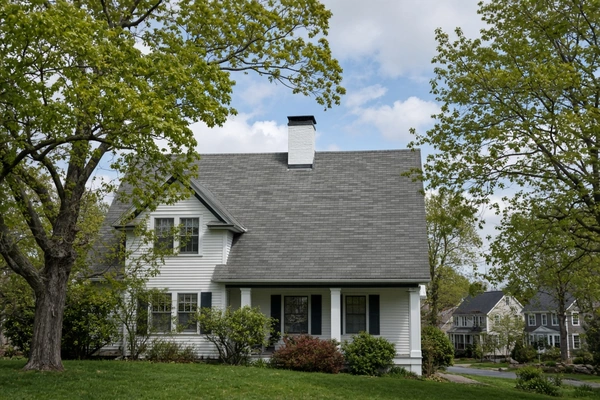
Massachusetts Roof Weather, Month by Month
May through September is the easiest stretch for asphalt shingles. January and February are the hardest. The table uses NOAA’s 30-year climate normals for Boston Logan Airport and the temperature guidance in GAF’s technical bulletins.
| Month | Normal high / low (°F) | Days with 0.01 in. or more of rain or snow | Normal snow (in.) | Roof notes |
| January | 36.8 / 23.1 | 11.8 | 14.3 | Normal high under GAF’s 40°F easy-handling mark. Cold-weather steps apply. |
| February | 39.0 / 24.6 | 10.6 | 14.4 | Snowiest month. Normal high still under 40°F. |
| March | 45.5 / 31.1 | 11.6 | 9.0 | Low at or below freezing on 16.2 days. |
| April | 56.4 / 40.8 | 11.6 | 1.6 | Spring is a busy booking season. |
| May | 66.5 / 50.3 | 11.8 | 0.0 | First month with no snow on average. |
| June | 76.2 / 59.7 | 10.9 | 0.0 | Summer “tends to be the most ideal time,” per GAF. |
| July | 82.1 / 66.0 | 9.4 | 0.0 | Warmest month, still under GAF’s 90°F easy-handling mark. |
| August | 80.4 / 65.1 | 9.0 | 0.0 | Ties September for the fewest wet days. |
| September | 73.1 / 58.2 | 9.0 | 0.0 | Fewest wet days. Dry stretches book out. |
| October | 62.1 / 47.5 | 10.5 | 0.2 | Fall booking backlog. Nor’easter season is underway. |
| November | 51.6 / 37.9 | 10.3 | 0.7 | GAF calls for hand-sealing fall installs. |
| December | 42.2 / 29.2 | 11.9 | 9.0 | Most wet days of the year. Cold-weather steps apply. |
The figures come from NOAA’s 1991-2020 monthly normals for Boston Logan. The roof notes draw on GAF’s bulletins, the National Weather Service and our own scheduling.
January and February are the only months with normal highs under 40°F. Even then, all-day freezes are the exception: January averages 9.7 days that stay at or below 32°F, and February averages 6.7. These are Boston Logan numbers, so your town’s may differ.
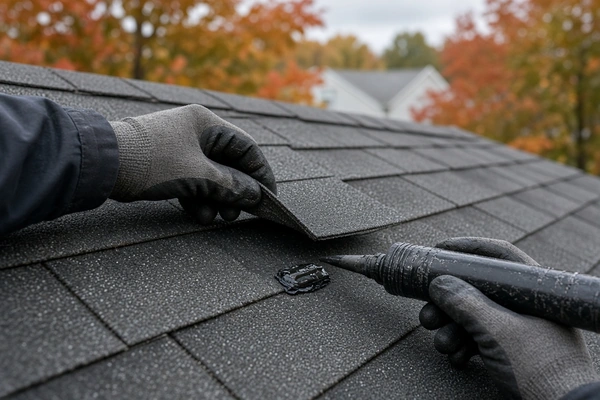
Fall Books Up Fast, but It Isn’t the Safest Season for Shingles
Fall fills the calendar, but a fall roof can head into nor’easter season with shingles that haven’t sealed yet.
In spring and fall, every good roofer in eastern Massachusetts has a booking backlog, and a dry stretch in September books out.
But read what GAF says about shingles that go on late in the year. A GAF guide written for roofing contractors says summer “tends to be the most ideal time for installing a new roof.” It says autumn “can be an equally good time” too. A separate section of the same guide warns that shingles installed in fall or winter may not seal until the following spring. GAF’s hand-sealing bulletin, TAB-R-114, tells contractors to hand-seal shingles when installing “in cold weather, fall or winter.” Its temperature bulletin, TAB-R-133, says the shingle warranty stays in effect at any air temperature. But it excludes damage like blow-offs that happen before the sealant activates.
Now add the weather. The National Weather Service says nor’easters are most frequent and most violent between September and April. An unsealed fall roof can sit through months of that before its sealant strips bond.
What hand-sealing looks like
Hand-sealing means putting dabs of roofing cement under the shingle tabs so they hold before the factory sealant kicks in. GAF’s bulletin uses a quarter-sized dab as the guide for how much cement goes down, and the shingle’s install instructions set how many dabs go where. Too much cement can run down the face of the shingle or cause blistering. On cold installs, our crews hand-seal every tab. If you book a fall install with anyone, ask whether they will.
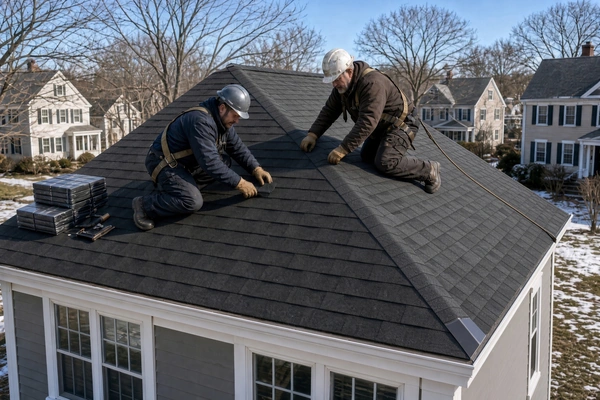
Winter Roof Replacement: What Changes in the Cold
Yes, you can replace a roof in a Massachusetts winter, and we install year-round. GAF’s contractor guide cautions that “sustained stretches of very cold weather” aren’t suitable for asphalt shingles, so winter work means picking the right days and adding cold-weather steps.
Start with the shingles. GAF’s temperature bulletin says, “There is no practical lower or upper temperature limit governing when asphalt fiberglass shingles may be applied, as long as appropriate precautions are taken.” It names 40°F as the mark for easiest handling. GAF also warns that “during very cold weather,” shingles may “become brittle and possibly crack, break or delaminate when bending.” So it suggests storing them in a heated space above 70°F for at least 24 hours before they go up, if possible. For laminate shingles in the cold, it recommends nailing in the common bond, which can help limit blow-offs until the sealant activates.
Then there’s the leak barrier. Massachusetts code requires an ice barrier at the eaves statewide, and our guide to ice and water shield covers how far up it has to run. We use GAF WeatherWatch. GAF’s instructions for it call for air temperatures between 45°F and 120°F. Its cool-weather bulletin adds steps for days below 40°F: rolls stored at least overnight at 55°F or warmer, a membrane at least 45°F when it goes down, and back-nailing every 18 inches along the top edge right away.
Winter schedules run lighter than the spring rush. The trade-off is weather. Snow, ice and high winds stop work for safety, so a winter job can still take longer to schedule and finish, and we don’t install in rain, snow or high wind. Our average asphalt install takes about 1 day on the roof, and cold can stretch it to 2.
Thinking about metal instead? We compared metal and asphalt roofs for Massachusetts snow.
4 questions to ask before a winter install
- Will you hand-seal the shingle tabs?
- Where are the shingles and leak barrier rolls stored before they go up?
- How do you protect an open roof if the forecast turns?
- Are you nailing laminate shingles in the common bond?
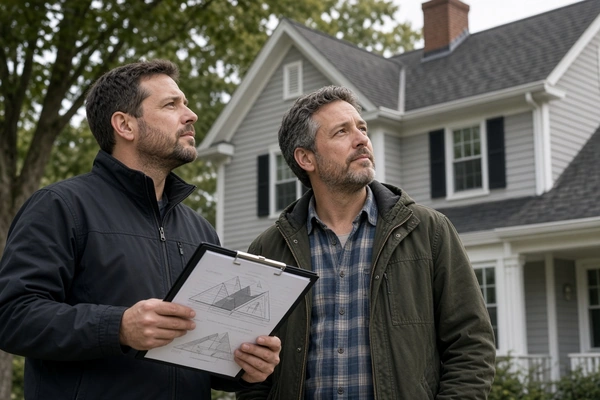
What Goes Into a Roof Replacement Quote
A roof quote should price every layer of the job in writing. For a roof replacement in Quincy or a South Shore town we serve, we walk the roof, photograph what we find and put every layer on paper.
Look for a full tear-off to the deck, a per-sheet price for rotted decking, ice and water leak barrier at the eaves and in the valleys, and synthetic underlayment across the rest of the deck. It should also list new drip edge, new flashing at every chimney, sidewall and skylight, new pipe boots, balanced attic ventilation with a ridge vent and ridge cap, and a full cleanup with a magnetic nail sweep. Get the workmanship warranty and proof of insurance in writing, too.
With the roof stripped, we walk every sheet of plywood. Soft or rotted decking gets photographed, shown to you and replaced at the per-sheet price already written in your estimate.
Permits and Booking Lead Time in 2026
Plan on 2 to 6 weeks from signing to final walk-through. Most of that is scheduling, material ordering and the weather window. The contract, material order and scheduling take 1 to 3 weeks, and the install takes 1 to 2 days on the roof for most single-family homes. Spring and fall have the longest waits.
Book earlier than you think you need to, and expect a real date only once the material is on site. Material delivery and weather drive the schedule. Our stage-by-stage install timeline walks through each step.
Who should pull the permit
Your roofer should. We pull the building permit on our jobs, and that detail protects you. The state’s Office of Consumer Affairs and Business Regulation says that to be eligible for the Guaranty Fund, you must not pull your own building permit. According to Mass.gov, the fund pays eligible homeowners up to $25,000 for unpaid judgments against contractors.
The state’s building permit form also asks for the contractor’s Construction Supervisor License and Home Improvement Contractor registration numbers. Here’s how to check a roofer’s license and insurance before you sign.
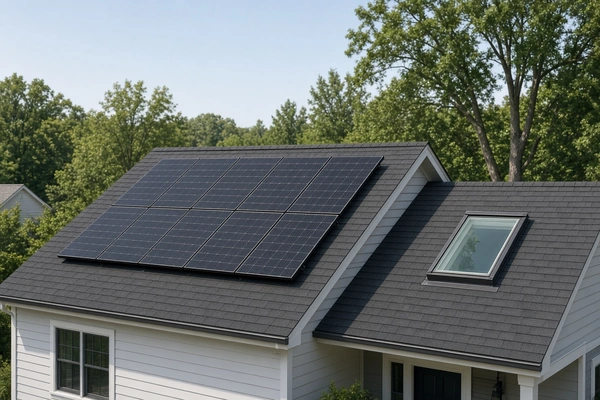
Plan Around Solar Panels and Skylights
Solar panels and skylights add steps to the plan, and solar can set the whole calendar.
If you have solar, start with your solar contract, not your roofer. The panels have to come off and go back on, and that timeline usually runs longer than the roof itself. The detach and reset schedule belongs to your solar provider, and it sets your real calendar. Our roof replacement prep checklist covers the steps.
Skylights belong in the same plan. The flashing comes off and goes back new on every tear-off, because it’s woven into the shingle courses being removed. Replace the unit with the roof if it’s over 10 years old, fogged between the panes or plastic. Keep it if it’s glass, under 10 years old and dry. Doing it during the tear-off costs less, since most of the gap is labor you’d otherwise pay for twice. Here’s our full answer on whether to replace skylights with the roof.
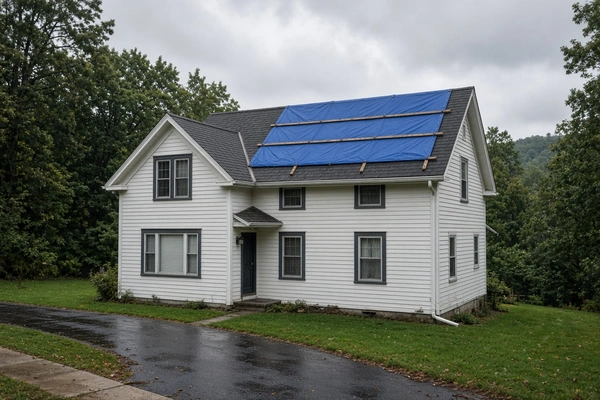
When the Best Time Is Right Now
If water is coming in, the best time is today. Get a tarp on first, then schedule the permanent repair or replacement once the weather allows.
Our emergency line at (617) 631-5435 is answered around the clock, and tarp visits happen the same day, usually within hours. Read what to do in a roof emergency while you wait.
Not sure the roof needs replacing at all? Ask for an inspection. We document the roof with photos and tell you which one you’re looking at, a repair or a replacement. If a repair solves it, we say so, even when a replacement would pay us more.
The best time to replace a roof in Massachusetts is the one you plan with real photos of your own roof. Our estimate visit is free and takes about an hour. You keep the photos and the report whether you hire us or not. Book a free roof inspection, and we’ll tell you whether it needs a repair or a replacement.
FAQs
Is fall the best time to replace a roof in Massachusetts?
It’s a popular choice and it can work, but it isn’t the safest season for sealing. A GAF guide for roofing contractors says summer “tends to be the most ideal time” and warns that shingles installed in fall or winter may not seal until spring. If you book fall, ask your roofer to hand-seal the tabs, as GAF’s bulletin TAB-R-114 directs.
Can you replace a roof in winter in Massachusetts?
Yes. We install year-round and hand-seal the tabs on cold installs. Snow, ice and high winds still stop work, and cold can stretch a 1-day install to 2 days. Even in January, Boston Logan averages only 9.7 days that stay at or below freezing all day, according to NOAA’s 1991-2020 normals.
What temperature is too cold to install asphalt shingles?
GAF’s bulletin TAB-R-133 says there’s no practical lower temperature limit for applying its asphalt shingles, as long as appropriate precautions are taken. It says shingles are easiest to handle above 40°F, and it warns that “during very cold weather” they can turn brittle and crack when bent. In cold weather, GAF’s hand-sealing bulletin says to hand-seal the shingles.
Is October too late to replace a roof?
October isn’t too late. Its normal high at Boston Logan is 62.1°F, with 10.5 days of rain or snow on average, according to NOAA. Book early, because fall fills fast, and know that GAF says sealing time depends on the roof’s slope, its orientation and how much sun and heat the shingles get.
Does a cold-weather install affect my roof warranty?
GAF’s bulletin TAB-R-133 says its shingle warranty stays in effect regardless of air temperature. It excludes damage like cracking or blow-offs before the sealant activates, which is why we hand-seal every tab on cold installs. Powersol roofs also carry our 25-year workmanship guarantee plus GAF’s material coverage.
How far ahead should I book a roof replacement?
Plan on 2 to 6 weeks from signing to final walk-through, most of it scheduling, material ordering and the weather window. The install itself takes 1 to 2 days on the roof for most single-family homes. Spring and fall have the longest waits, and winter schedules run lighter than the spring rush.
What’s the best time to replace a roof in Massachusetts if it’s already leaking?
Now. Call for a tarp first: our emergency line is answered around the clock, and tarp visits happen the same day, usually within hours. The permanent repair or replacement goes on once the weather allows.