Yes. Stay home.
Almost every roofing blog on this topic tells you to clear out for a week. That advice was written by crews whose jobs take a week. Most Quincy homes we tear off and rebuild are finished in 1 to 2 days, and day 1 is the only one that’s loud.
That changes the question completely. You’re not relocating a household. You’re planning about 10 hours.
There’s also a better reason to stay that nobody in this field says out loud. The only time anyone sees the wood under your shingles is the window right after tear-off. Stand in your driveway when that happens and you see it yourself. Sit in a coffee shop and you get a phone call and a description.

What Staying Home During a Roof Replacement Means
Staying home during a roof replacement means living in your house while a crew strips and rebuilds the roof over your head. Nothing requires you to leave. It’s safe as long as you stay indoors and off the perimeter of the building. What you give up for the day is quiet, your driveway, and attic access.
Should You Stay Home During a Roof Replacement, or Leave?
Stay, unless 1 of 3 things is on your calendar. The decision comes down to what you have to do between 7 a.m. and 4 p.m., not to how much noise you think you can handle in the abstract.
| Your situation | What we’d tell you |
|---|---|
| You work from home with calls booked | Leave, or push the calls past 1 p.m. |
| Infant or toddler who naps midday | Leave for the tear-off window, come back after lunch |
| Night shift worker sleeping during the day | Leave. No room in the house will be quiet enough |
| Dog that hides during thunderstorms | Board the dog. You can still stay |
| You want eyes on the decking before it’s covered | Stay. Best reason on the list |
| Nobody home during the day anyway | Either. Leave a number you’ll actually answer |
What Time a Roofing Crew Can Legally Start in Quincy
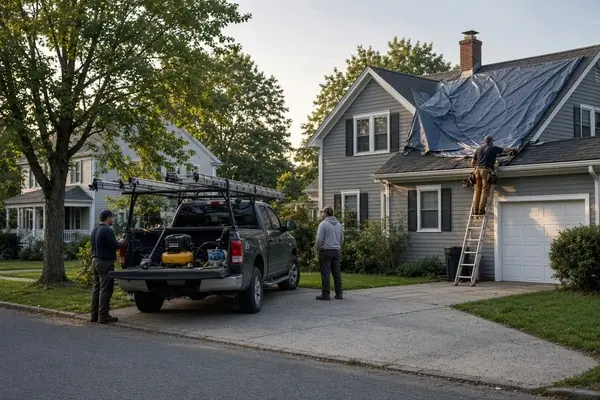
Earliest start is 7 a.m. on a weekday, and it’s set by the city, not by the roofer.
Quincy’s noise ordinance sets the daytime construction window at 7:00 a.m. to 5:00 p.m. on weekdays. Inside that window, construction noise is capped at 75 dBA without an approved noise-suppression plan, measured no more than 50 feet from the source. Outside it, the ordinary residential limits apply, which are lower.
Weekends are different. The city’s own guidance puts the 75 dBA weekday allowance at 7 a.m. to 5 p.m. and the weekend and holiday allowance at 9 a.m. to 5 p.m., drops the limit to 65 dBA after 5 p.m., and attaches a $100 per day penalty to violations.
Two things worth knowing about that. The city’s constituent services page says construction should finish before 6 p.m. while the ordinance text sets the daytime window to 5 p.m. When those disagree, go with the ordinance, because that’s the enforceable text. And if a crew is on your roof at 6:30 a.m. on a Tuesday, they’re outside a written rule, not just being rude.
Practical version: set your alarm for 6:45 a.m. Move the cars the night before.

Hour by Hour: Day 1 of a Quincy Roof Replacement
Here’s what day 1 looks like on a typical Quincy, Wollaston or North Quincy home. Times shift with roof size, pitch and weather.
| Time | What’s happening | What you’ll notice inside |
|---|---|---|
| 6:45 to 7:15 a.m. | Crew arrives, tarps go over shrubs and siding, ladders and the dump trailer get set | Voices, truck doors, ladders on the gutters |
| 7:15 to 10:00 a.m. | Full tear-off to the deck. Old shingles and felt come off in sections | Loudest part of the day. Scraping overhead, steady thumping, vibration through the ceiling |
| 10:00 a.m. to noon | Decking inspection, soft sheathing swapped, drip edge and GAF WeatherWatch ice and water barrier at the eaves per MA code | Quieter. Circular saw in bursts. This is your window to look |
| Noon to 1:00 p.m. | GAF FeltBuster synthetic underlayment goes down, roof is covered | Noticeably quieter |
| 1:00 to 4:00 p.m. | Pro-Start starter strips, then Timberline HDZ shingles from the eaves up, flashing at chimneys, vents and valleys | Steady rhythmic nailing. Easy to talk over compared to tear-off |
| 4:00 to 5:00 p.m. | Cobra ridge vent and Seal-A-Ridge caps, debris out, magnetic nail sweep, gutters cleared | Footsteps and a magnet roller |
| Before the crew leaves | Walk the property with the foreman | Your driveway back |
Circle the 10 a.m. to noon block. That’s when your roof is open.
The Real Reason to Stay: What’s Under Your Shingles
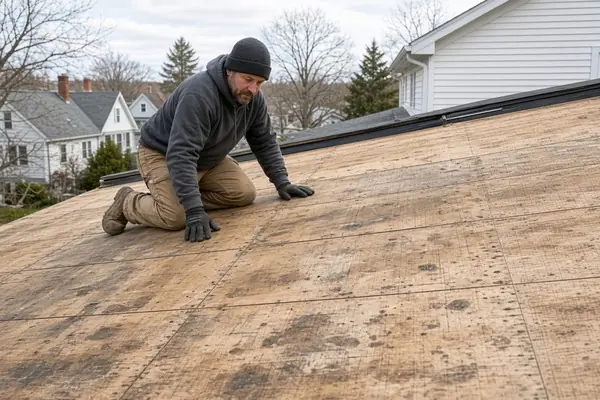
Between tear-off and underlayment there’s a window where the sheathing under your shingles is fully exposed. That’s the only time before your next tear-off that anyone sees it.
South Shore housing stock gives us plenty to find. Ice dam history along the eaves, bath fans vented into the attic instead of through the roof, nail pops and delamination on older plywood. You don’t spot that from the ground, and you only half spot it from inside the attic. It shows up when the shingles come off.
If you’re home, we show you the board and you make the call standing there. If you’re out, that same conversation happens over the phone while a stranger describes wood you can’t see.
This is the same reason a proper roof inspection comes with a photo record of every finding rather than a verbal summary. Seeing it yourself beats being told about it, and staying home is the free version of that.
Can You Work From Home While Your Roof Is Being Replaced?
Partly. Plan on losing the morning and keeping the afternoon.
Tear-off is the problem. Quincy allows construction noise up to 75 dBA measured at 50 feet, and roofing work sits near the top of what the ordinance permits. Your walls and insulation knock a lot of that down, but what carries indoors is the low-frequency thumping, and that’s exactly what a laptop microphone picks up.
What actually works:
- Move calls to after 1 p.m. Once shingles are going on, the noise turns rhythmic instead of percussive, and noise-cancelling software handles it far better.
- Work in a basement or a first-floor interior room. Every floor between you and the roof helps. A second-floor bedroom under the ridge is the worst seat in the house.
- Don’t plan to record anything. Vibration travels through the structure, not just the air.
- Keep a hotspot handy if your router sits in the attic.
If your whole day is calls, leave. That isn’t a roofing problem, it’s a math problem.
The Night-Before List
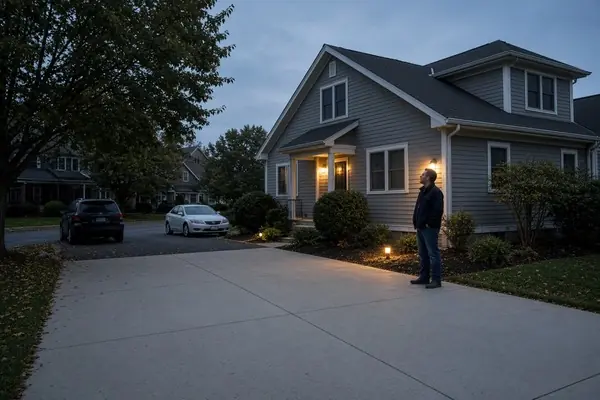
5 things, and 4 of them take under 10 minutes.
Move both cars to the street. Not the end of the driveway. The dump trailer and the supply truck need the full apron, and a car parked under the eaves collects tear-off debris whether or not anyone means it to.
Take anything off the walls you’d be upset to lose. Vibration from nailing travels through the framing. Mirrors, framed photos, plates on a rail, anything on a floating shelf.
Go up to the attic and cover what’s stored there. Old sheathing drops dust and grit through the gaps when it comes off. A drop cloth over boxes takes 5 minutes and saves you an afternoon.
Walk the outside of the house and photograph what’s already damaged. Bent gutter, cracked walkway paver, torn screen, dented light fixture. Dated photos settle any question later without an argument.
Leave the side gate open. If the crew can’t get a wheelbarrow into the back yard, cleanup takes an extra hour.
Do Roofers Need to Come Inside Your House?
Usually no. Sometimes yes, and it’s better to know which before 7 a.m.
A standard shingle replacement happens outside. Nobody needs your bathroom, your kitchen or your living room. Your water, power and plumbing all run normally.
Three situations change that:
- Attic access. If there’s a question about ventilation, an old leak stain, or where a bath fan terminates, the foreman may ask to look at the underside of the deck. That’s a 5-minute look with a flashlight, and it matters, because ridge ventilation only works if the intake side is clear.
- Skylights. Replacing or reflashing a unit means someone works directly over an open room, so we tarp the interior first. If a skylight is anywhere in your plans, doing the skylight work during the reroof spares you a second round of tear-out and tarping later.
- An active leak. If water is already coming through, we want to see where it lands inside, not just where it enters. Finding the source means working backwards from the stain, the water path across the attic, and the roof detail uphill of it.
Ask at the estimate whether any of those apply. If none do, you can stay in your house all day without opening the door.
Kids, Pets and the Parts Nobody Warns You About
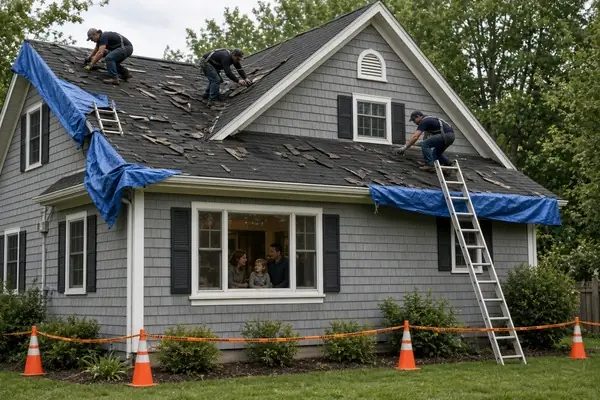
Kids indoors are fine. Kids outdoors are not, and the reason is specific. During tear-off, crews slide debris off the roof edge without being able to see what’s below the gutter line. Keep the perimeter of the house clear all day, roughly 15 feet out. That includes the deck, the swing set if it’s close, and the walk to the mailbox.
Pets are more about stress than safety. A dog that hides during thunderstorms will have a hard 3 hours between 7 and 10 a.m. Board it, or put it in a basement room with something loud and familiar playing. Cats mostly go under a bed and stay there, which is fine.
Two things people rarely think about:
Your doorbell camera will fire constantly. Turn off motion alerts for the day or your phone buzzes 200 times.
If you have a sump on a float switch or an alarmed system in the basement, know where the breaker is. Nothing about roofing touches them, but vibration plus an old float switch occasionally equals a nuisance alarm, and it’s easier to check than to wonder about.
What If It Rains Halfway Through?
The deck gets covered before the crew leaves, and here’s the part most roofing blogs skip: covered is not the same as waterproof.
A crew doesn’t tear off more than it can cover. On a 1-to-2-day job the exposed deck is under synthetic underlayment by roughly midday. But GAF’s own spec sheet states that FeltBuster is water resistant and specifically not waterproof. It’s built to shield the deck from wind-driven rain getting under shingles, not to stand in as a roof through a nor’easter.
So the honest answer is that a crew watches the radar and stops tearing off when the window closes. That’s the scenario where a 1-day job becomes a 2-day job, and it’s the right call every time. If a storm does open something up, same-day tarping across Quincy and the South Shore is a phone call away, and the emergency line runs 24/7 through nor’easter season.

How to Check the Cleanup Before the Crew Leaves
Walk it with the foreman and check 5 specific places rather than glancing at the lawn.
The gutters. Tear-off debris ends up in them. They should be clear, not mostly clear.
The flower beds and mulch. Magnets don’t pull nails out of mulch. This is where a hand check matters.
Under the cars, where they were parked before you moved them, and the length of the driveway apron.
The back side of the house. The side nobody photographs is the side that gets missed.
The attic, a few days later, on a sunny afternoon with the lights off. You should see no daylight through the deck.
If something’s off, say it while the trailer is still in your driveway. Everything is easier to fix before the crew leaves than after.
Book Your Quincy Roof Replacement
Powersol Roofing has put on more than 1,000 roofs across the South Shore in over a decade, and roofing is the only thing we do. Every new roof installation is licensed and insured in Massachusetts and carries a 25-year workmanship guarantee registered in your name, on top of manufacturer coverage.
The crew that shows up is ours. That first crew has grown past 50 trained installers, working out of a fixed address at 100 Hancock St in Quincy.
Before your job is scheduled, we walk you through the hour-by-hour plan for your specific roof, so deciding whether to stay home during your roof replacement comes down to real information instead of a guess.
Call 617-631-5435, or book a free estimate online.
Frequently Asked Questions
Should I Stay Home During a Roof Replacement?
Yes, for most people. For a standard Quincy home the job runs 1 to 2 days and only day 1 is loud, so staying costs you a noisy morning between 7 and 10 a.m. and gives you a look at your roof deck while it’s exposed. Leave for the day if you have calls booked, a napping infant, or you sleep days.
How Long Does a Roof Replacement Take on a Typical Massachusetts Home?
Most Quincy homes are finished in 1 to 2 days. The 2-to-7-day figure repeated across roofing sites reflects slower crews, not a standard. Size, pitch, weather and how much decking needs replacing are what move the number.
What Time Can Roofers Start Work in Quincy, MA?
7 a.m. on weekdays. Quincy’s Chapter 215 sets the daytime construction window at 7:00 a.m. to 5:00 p.m. on weekdays and caps construction noise at 75 dBA measured within 50 feet of the source. The city puts the weekend and holiday window at 9 a.m. to 5 p.m., drops the limit to 65 dBA after 5 p.m., and attaches a $100 per day penalty to violations.
Can I Work From Home During a Roof Replacement?
Yes, in the afternoon. Tear-off between roughly 7 and 10 a.m. produces low-frequency thumping that laptop microphones pick up clearly. Once shingles start going on after lunch the noise turns rhythmic and noise-cancelling software handles it. Work from a basement or first-floor interior room, not a second-floor bedroom.
Do I Have to Move My Car for a Roof Replacement?
Move both cars to the street the night before, not to the end of the driveway. The crew needs the full apron for a dump trailer and a supply truck, and a car parked under the eaves collects tear-off debris. Moving them the night before also means nobody gets blocked in at 7 a.m.
Is It Safe for Kids and Pets to Stay Home During a Roof Replacement?
Indoors, yes. Keep everyone out of the perimeter around the house, roughly 15 feet, for the whole day, because crews slide debris off the roof edge without being able to see the ground below the gutter line. A dog that hides during thunderstorms should be boarded or kept in a basement room.