Flat roof maintenance in Massachusetts comes down to 3 jobs: keep water moving off the roof, keep the edges and penetrations sealed, and get eyes on the membrane twice a year. Do those and a rubber roof can run past 30 years. Skip them and the same roof fails at 12, usually at a seam or a drain, usually in February. The rest of this is what those 3 jobs look like on a Quincy three-decker or a Worcester porch roof, month by month, with the numbers behind each call.
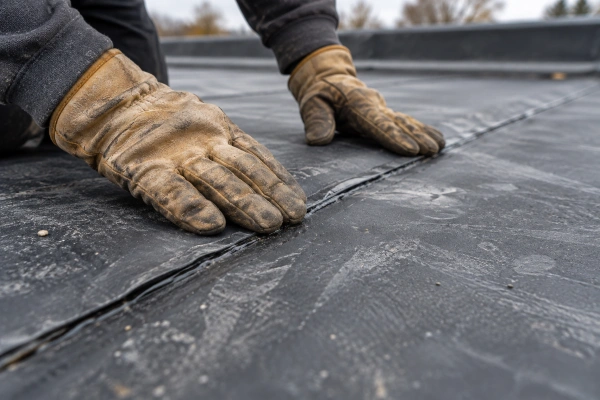
What Is Flat Roof Maintenance, And What Does It Cover?
Flat roof maintenance is scheduled upkeep on a low-slope roof: clearing drains and scuppers, removing debris, checking seams, flashing, and edge metal, watching for standing water, and patching small openings before water gets under the membrane. It’s preventive work on a watertight surface, not repair after a leak shows up inside.
That distinction matters more on a flat roof than a pitched one. A shingle roof leaks where the water comes in. A membrane roof spreads water sideways between the membrane and the deck, so the stain on your ceiling can sit 20 feet from the actual hole. By the time you see it, the insulation under that path is usually wet. If you already have a stain, start with why flat roofs leak instead, because that’s a diagnosis problem, not a maintenance one.
The EPDM Roofing Association puts the expected service life of a properly designed, installed, and maintained EPDM membrane at 38 years, and its 2025 survey of 569 roofing professionals reported service lives from 25 years to more than 40 depending on membrane thickness and how it was attached. Read the qualifier. Maintained is doing real work in that sentence.
Your Massachusetts Flat Roof Maintenance Year
Spring and fall is the advice every flat roof article gives. In Massachusetts that misses the 2 moments that matter most, which are the weeks on either side of the freeze.
| When | What to do | Why this month |
|---|---|---|
| Early October | Clear every drain, scupper, and gutter. Cut back branches. Check seams and edge metal. Fix anything open now | Once the deck freezes, adhesives and sealants stop bonding. A patch in December is a patch that fails in March |
| After the first hard freeze | Look for standing water that froze in place. Note where it sits | Ice tells you where your low spots are better than any hose test |
| Mid-winter, after a heavy storm | Check the load, not the membrane. Walk the inside: doors sticking, ceilings sagging, new cracks in drywall | Warning signs show up inside before the roof gives |
| Late March | Second full inspection. Seams, flashing, drains, and the parapet or edge | Freeze-thaw works all winter on any seam that was already weak |
| After any wind event | Look at the edges and corners, not the field | Wind lifts a membrane at the perimeter first |
The 2 anchor visits are early October and late March. Everything else is watching.
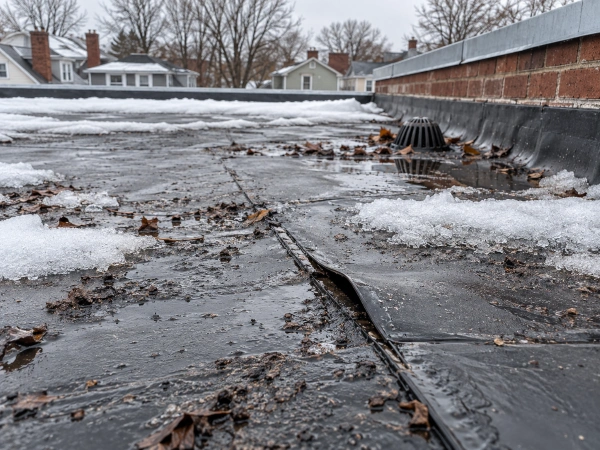
How Often Should A Flat Roof Be Inspected In New England?
Twice a year, plus after any storm that drops heavy snow or high wind. That’s the baseline the trade uses nationally, and in Massachusetts the post-storm check is the one that earns its keep, because a single nor’easter can lift edge metal or split a seam that looked fine in October.
On a low-slope roof the order changes from the pitched-roof version. We start at the drains, then the perimeter, then the penetrations, then the field of the membrane last. The field is where homeowners look first and where problems start least often.
Should You Shovel Snow Off A Flat Roof?
Usually no, and the wrong answer here costs more than the snow does. Most of the time you’re trading a load problem you probably don’t have for a puncture you will.
Here is the weight math, from the Department of Energy’s Building America Solution Center:
- 1 foot of light dry snow: about 3 pounds per square foot
- 1 foot of heavy wet snow: about 21 pounds per square foot
- 1 inch of ice: about 5 pounds per square foot
- 2 feet of old snow plus 2 feet of new snow: up to 60 pounds per square foot
That last figure is the one to watch, because it sits above what many roofs are built to carry. The same guidance notes that most residential roofs anywhere in the country should hold about 20 pounds per square foot of snow before they are stressed.
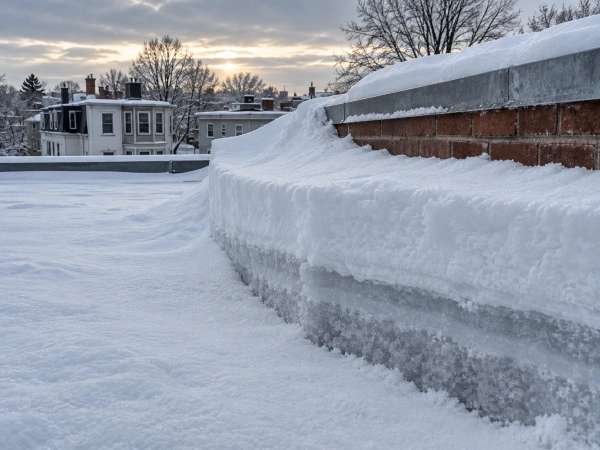
Massachusetts roofs are built for more than that. The state building code sets ground snow loads town by town in Table R301.2(2), ranging from 25 pounds per square foot on the islands to 60 in the western and north-central hills, and it names a design flat roof snow load specifically. Quincy and Boston sit in the middle of that range. A roof framed to current Massachusetts code isn’t in danger from an ordinary storm.
So watch for the signs instead of the snow depth: doors or windows that suddenly stick, new cracks in ceilings or interior walls, a sagging line in the ceiling, creaking. Those mean call someone. A white roof after a storm doesn’t.
If snow does have to come off, it comes off with a roof rake from the ground or by a crew, and it never comes off to bare membrane. The Building America guidance is to leave an inch or 2 behind rather than scrape down to the roof surface. On a rubber or TPO membrane a metal shovel edge will open a seam in one pass, and that repair is worse than anything the snow was going to do.
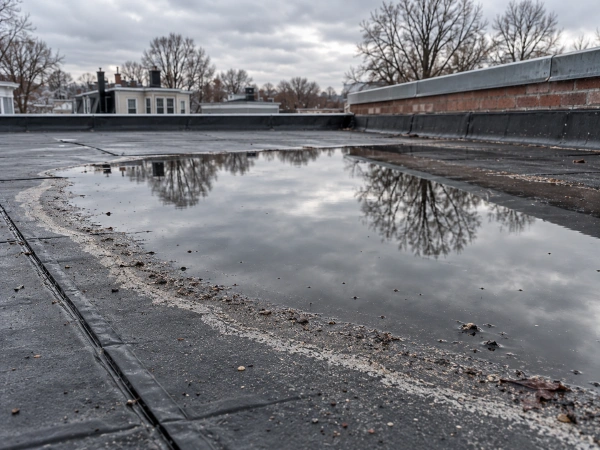
Ponding Water: The 48-Hour Rule, And The Warranty Myth
Water that is still sitting on your roof 48 hours after it stopped raining is ponding, and that number isn’t a rule of thumb. The Asphalt Roofing Manufacturers Association, citing the NRCA Roofing Manual, defines ponding water as water that remains on a roof 48 hours or longer, and recommends a minimum slope of 1/4 inch per foot so it drains. Model codes require that same 1/4 inch per foot on new construction.
Now the part most roofers get wrong. You have probably been told that ponding voids your warranty. The EPDM Roofing Association, the trade body for the membrane itself, says the opposite: “Ponded water on an EPDM roofing system will not void a manufacturer’s warranty or be the sole reason to deny issuance of a warranty.”
I’m not telling you to live with ponding. Standing water carries dirt and debris to one spot, holds it against the membrane, freezes and thaws there all winter, and adds weight where you least want it. Fix the drainage. But if a contractor is using a voided warranty to push you into a full replacement, ask him to show you that clause in writing. That’s a sales line, not a warranty term. Check your own warranty document, because terms differ by manufacturer and by whether you hold a material-only or a system warranty.

Keep The Drains, Scuppers, And Edges Clear
Clogged drainage causes more flat roof failures in Massachusetts than membrane wear does. On a three-decker or a rear ell the water has 1 or 2 ways off the roof, and when those close, the roof becomes a shallow pool.
Three things to clear every October:
Internal drains and their strainers. Pull the dome, clear the leaves, put the dome back. A missing strainer dome lets debris into the leader and you find out during the first heavy rain.
Scuppers through the parapet. These freeze first. A scupper that ices over turns the parapet into a dam, and the water finds the wall flashing instead.
Gutters and downspouts at the edge. The same rule as a pitched roof, and the reason we replaced gutters along with the roof on the Taunton job: the edge details decide whether the water leaves the building or runs behind the fascia.
Cleaning EPDM, TPO, PVC, And Modified Bitumen
Clean the membrane with water, a soft brush, and a low-sudsing soap. That’s the whole method for every membrane on a Massachusetts house, and the differences between them matter far less than what you must not do.
Never use a pressure washer, never use a solvent or oil-based cleaner, and never use a stiff or metal-bristled brush. Pressure lifts seams. Solvents attack the membrane chemistry. A wire brush scores the surface that is keeping water out of your house.
Most residential flat roofs here don’t need cleaning on a schedule. They need debris removed so water can move and so organic matter stops holding moisture in one place. If you’re not sure which membrane is on your building, a roofer can tell you from the seam pattern and the edge detail in about 5 minutes.
Coatings Buy Time. They Don’t Buy A New Roof
A reflective coating over a sound membrane can extend its life and cut summer heat gain. Over a membrane that’s already wet underneath, it seals the water in and hides the problem for 2 more years.
The EPA’s cool roof research found that reflective roofs lower maximum indoor temperatures by 2.2 to 5.9 degrees Fahrenheit in buildings without air conditioning, and cut peak cooling demand by 11 to 27 percent in air-conditioned homes. For a third-floor unit under a flat roof in July, that is real.
The part nobody mentions in Massachusetts: the EPA also states that cool roofs may increase energy use during winter in cold climates, though it notes that penalty is typically offset by the summer savings, helped by the lower winter sun angle, shorter days, insulation, and snow cover. In Quincy that trade is closer than it is in Phoenix. Coat the roof because the membrane needs protection, not because you were promised a lower bill.
Before any coating goes on, someone has to confirm the insulation under the membrane is dry. That’s a core cut or a moisture scan, not a look.
Maintain, Recoat, Or Replace In 2026?
| Situation | What it needs | What it costs, and what moves the number |
|---|---|---|
| Under 15 years, no ponding, seams tight | Maintain. 2 visits a year, clear drains, spot-seal | This Old House puts flat roof maintenance at $4 to $13 per square foot |
| 15 to 25 years, surface chalking or checking, insulation confirmed dry | Recoat after repairs | Priced per square foot once the repairs under the coating are scoped |
| Any age, wet insulation found under the membrane | Replace the wet sections at minimum | This Old House puts flat roof repair and replacement at $7 to $30 per square foot |
| Repeat leaks at multiple locations, or a third patch in the same area | Replace | Roof size, access around the building, how many layers come off, and deck repairs move the number most |
I don’t publish fake prices, because every roof is different. You get a written scope with the number on it, so you can compare 2 bids line by line instead of chasing the cheapest total.
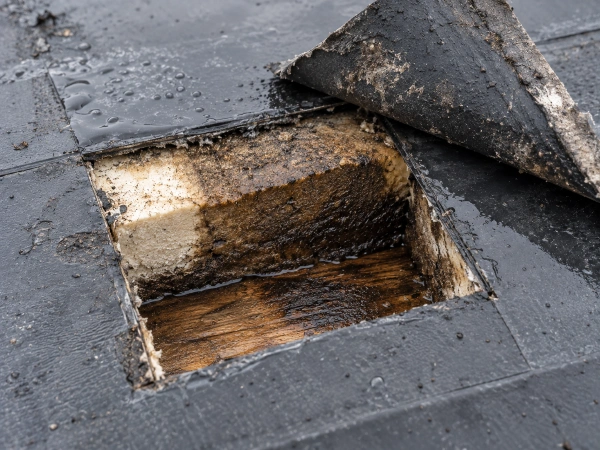
The trigger in that table isn’t age. It’s whether the insulation under the membrane is dry. A 22-year-old roof with a dry deck is worth coating. A 9-year-old roof with 400 square feet of soaked insulation isn’t, no matter how good the top looks.
The Line Between Homeowner Work And Roofer Work
Clearing debris, pulling leaves out of a drain strainer, raking snow from the ground, and looking at your own ceilings after a storm. All of that is homeowner work.
Walking the roof is where it changes. A low-slope roof has no visual cue for where the structure is sound, membranes get slick with frost and algae, and the fall is off an edge with nothing to catch you. Seam work, flashing, coatings, and anything involving a torch or adhesive belong to a roofer. Our flat roofing service covers the work above that line across the South Shore, and we run the same scope for flat roofs in Worcester. For the pitched sections of the same house, our Massachusetts roof maintenance guide has the full seasonal breakdown.
What We Find On Massachusetts Flat Roofs
Across the roofs we look at, the problem is almost never the field of the membrane. It’s the flashing, the drains, the edges, and whatever the last installer did at a transition.
The pattern repeats: a porch roof tied into a pitched roof with sealant instead of proper flashing. A parapet with no counter-flashing, so wind-driven rain runs behind the membrane. A pipe boot reused from the last roof because replacing it cost 40 dollars and nobody wanted the line item. Rotted decking at the edges that nobody mentions until the old roof comes off.
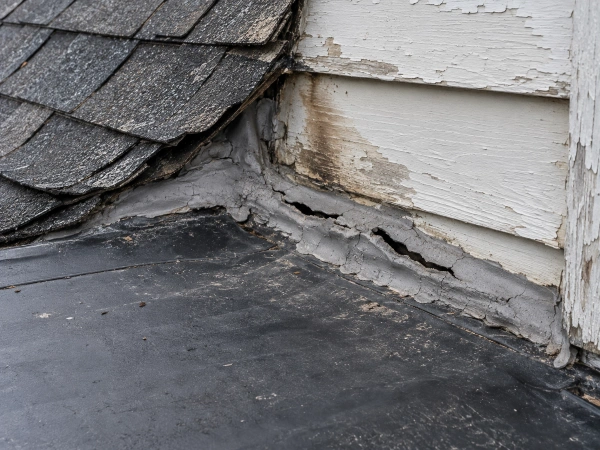
We photograph all of it and show the homeowner before we quote anything. If a roof can be maintained, we say that. If it needs 200 square feet of decking replaced, you see the picture of the soft wood. That’s the same standard we hold on a full replacement, where most standard installs run 1 to 2 days once material is on site, and it’s why we’d rather book a roof inspection than sell you a roof you don’t need yet.
Flat roof maintenance in Massachusetts isn’t complicated work. It’s 2 visits, clear drainage, and an honest look under the membrane before anyone sells you a coating. That’s how we work at Powersol Roofing, and if water is coming in right now, our line runs 24/7.
Flat Roof Maintenance Questions, Answered
How often should a flat roof be inspected in Massachusetts?
Twice a year, in early October and late March, plus a check after any heavy snow or high-wind storm. October matters because sealants and adhesives stop bonding once the deck freezes, so any repair you defer past the first hard freeze waits until spring. The March visit catches what freeze-thaw opened up over the winter.
Does ponding water void a flat roof warranty?
Not on EPDM. The EPDM Roofing Association states that ponded water will not void a manufacturer’s warranty or be the sole reason to deny one. Ponding is still worth fixing, because standing water collects debris, freezes and thaws in place all winter, and adds weight. But check your own warranty document, since terms vary by manufacturer and by whether you hold a material-only or a system warranty.
Should I shovel snow off my flat roof?
Usually not. A foot of light dry snow weighs about 3 pounds per square foot and a foot of heavy wet snow about 21, while most residential roofs are built to carry at least 20 pounds per square foot of snow and Massachusetts ground snow loads run from 25 to 60 depending on the town. Watch for sticking doors, new ceiling cracks, or sagging instead. If snow must come off, leave an inch or 2 rather than scraping to bare membrane.
How long does a flat roof last in Massachusetts?
The EPDM Roofing Association puts the expected service life of a properly designed, installed, and maintained EPDM membrane at 38 years, and its 2025 survey of 569 roofing professionals reported 25 to more than 40 years depending on thickness and attachment method. Neglected roofs in New England fail much earlier, usually at a seam, a drain, or a flashing detail rather than in the field of the membrane.
What is the fastest way to ruin a flat roof membrane?
A pressure washer, a solvent-based cleaner, or a metal shovel. Pressure lifts seams, solvents attack the membrane chemistry, and a shovel edge opens a cut that is worse than anything the snow was going to do. Clean with water, a soft brush, and a low-sudsing soap.
Is flat roof maintenance worth it compared to replacement?
Usually yes, and the deciding factor isn’t the roof’s age. It’s whether the insulation under the membrane is dry. This Old House puts flat roof maintenance at $4 to $13 per square foot against $7 to $30 per square foot for repair and replacement. A 22-year-old roof over dry insulation is worth maintaining. A 9-year-old roof over soaked insulation isn’t.
Can I do flat roof maintenance myself?
You can clear debris, pull leaves from a drain strainer, rake snow from the ground, and check your own ceilings after a storm. Walking a low-slope roof is a different matter, because there’s no visual cue for where the structure is sound and the edge has nothing to stop a fall. Seam work, flashing, and coatings belong to a roofer.