The short answer to “how often should a commercial roof be inspected?” is at least twice a year, spring and fall, plus after severe weather. That’s NRCA’s recommendation. GAF’s maintenance checklist sets once a year as the minimum and calls twice a year “optimal.” Johns Manville’s published sample warranty requires inspections at least semi-annually.
Our commercial maintenance program runs on that same schedule: spring and fall visits, plus post-storm checks. The calendar is the easy part. On a roof with a manufacturer warranty, foot traffic, missing records or a late leak report can each cost you coverage.
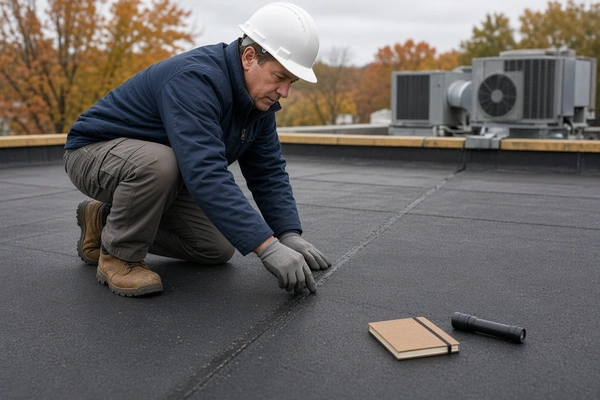
Is Once a Year Enough for a Commercial Roof?
Once a year meets GAF’s minimum. It falls short of NRCA’s recommendation and of Johns Manville’s warranty terms, so read your warranty before you pick a schedule.
NRCA’s Professional Roofing magazine has advised owners to schedule maintenance inspections “at least biannually, preferably in spring and fall,” with more after severe weather such as a hurricane, tornado or hailstorm. Manufacturers put their own terms in writing. The table compares 3 of those documents.
| Document | How often | Records | Rooftop traffic | Leak notice |
| GAF Scheduled Maintenance Checklist (2024) | At least once a year; twice is “optimal” | Keep the guarantee, inspection reports, repair and maintenance bills, and original drawings | Limit access and keep a roof access log | See the guarantee |
| GAF EverGuard System Pledge guarantee | Follow the Scheduled Maintenance Checklists | “Keep records of this work” | Doesn’t cover leaks caused by traffic off GAF walkways | In writing to GAF within 30 days; telling your roofer doesn’t count |
| Johns Manville sample warranty | At least semi-annually, plus after severe weather | Logs of all inspections and repairs | Avoid unnecessary traffic, log service trips, no penetrations by service crews | Certified mail within 30 days of finding the leak |
Our answer for commercial roofs is twice a year, spring and fall, plus after any major storm. A roof under warranty may not leave you a choice. Some roofs need more: grease exhaust degrades membrane fast, so restaurant roofs get sacrificial protection at the fans and more frequent checks.
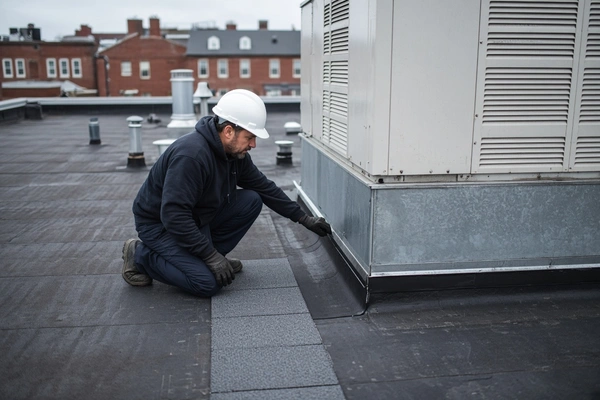
Why Inspections Alone Won’t Protect a Roof Warranty
Warranty terms also cover who walks on the roof, what records you keep and how fast you report a leak. A perfect inspection schedule won’t rescue a claim that fails on any of those.
Start with traffic. GAF’s EverGuard System Pledge guarantee does not cover leaks caused by “traffic of any nature on the roof unless using GAF walkways.” Johns Manville’s sample warranty excludes “damages resulting from any form of rooftop traffic.” It also tells owners not to let service personnel make penetrations in the roof. Those should be made only by a JM approved roofing contractor.
Every HVAC tech or solar installer who walks the roof can leave damage your warranty won’t pay for. Our first visit to any building starts with questions about how the building is used. Keep a roof access log, as GAF’s checklist recommends, and walk the roof after every trade visit.
Next, records. GAF’s guarantee says, “You must perform regular inspections and maintenance and keep records of this work.” GAF’s checklist tells owners to keep the guarantee, inspection reports, repair and maintenance bills, and original construction drawings in a single file. Johns Manville asks for logs of all inspections and repairs.
Every visit on our maintenance program ends with dated photos, what we found, what we did and what to watch. Boards use those reports for reserves, managers use them for budgeting, and they stand as evidence when storm claims come up. Put them in that file.
Last, the leak report. GAF requires written notice to GAF within 30 days, “or GAF will have no responsibility for making repairs.” The guarantee adds that “notice to the roofing contractor is NOT notice to GAF.” Johns Manville requires certified mail within 30 days of finding the leak. Our 24/7 emergency line gives same-day response for active leaks. Getting written notice to the manufacturer is still your job under both documents.
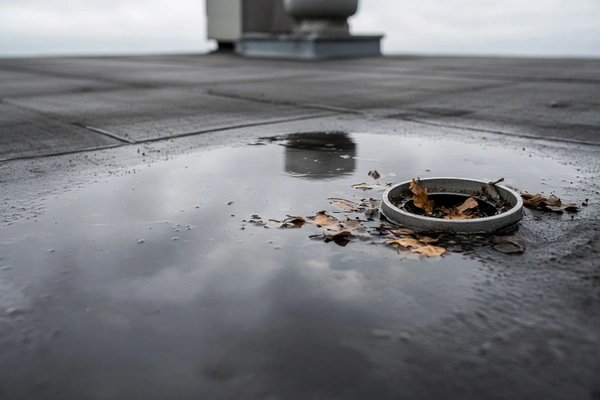
What Should Trigger an Extra Inspection?
Book an extra inspection after severe weather, heavy snow, any trade working on the roof, a new leak or stain, or water that sits on the roof for more than 48 hours. Each one earns its own visit on top of spring and fall.
Severe weather
The National Weather Service calls a thunderstorm severe when it brings hail 1 inch or larger or winds of 58 mph or higher. If a storm like that hits your building, get the roof checked.
GAF’s checklist and Johns Manville’s warranty both call for checks after hailstorms, heavy rains and high winds. Wind and hail damage is often invisible from the ground. On a storm damage call, we photograph every affected area. Dated pre-storm condition photos are the difference between a paid claim and an argument.
Another trade on the roof
HVAC service, a solar install, new signage or a cell antenna all put people and tools on the membrane. Most leaks start where the roof meets parapets, chimneys, vents and HVAC curbs, so walk the roof after each visit and check the curbs and penetrations the crew touched.
GAF’s guarantee doesn’t cover leaks caused by overburden, modifications or additions made after the roof is done unless GAF approved them in writing first. Get that approval before solar panels go up.
Leaks, stains and standing water
A new ceiling stain means water already got past the membrane, and the drip isn’t always under the hole. Water can travel along the deck before it shows up inside. Book an inspection. If the roof has a GAF or Johns Manville warranty, the 30-day notice window has started.
Standing water counts too. NRCA defines ponding as water that stays in low spots more than 48 hours after precipitation, in conditions where it should have dried. On flat roofing jobs, we correct slope with tapered insulation and make sure drains and scuppers move water where it should go.
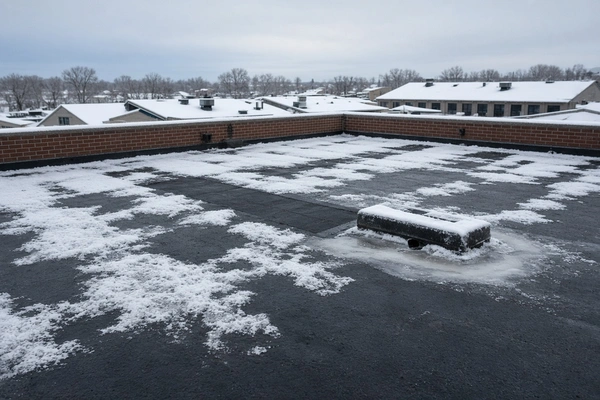
What a Massachusetts Winter Does to a Flat Roof
Snow adds weight, and frozen or clogged drains trap meltwater on the membrane. New England freeze-thaw cycles also work on seams, flashings and drains faster than most owners expect.
MEMA, the state’s emergency management agency, says flat and low-pitched roofs “are at the greatest risk of buckling under heavy snow and ice accumulations.” The winter of 2015 showed why. NOAA’s Weather Prediction Center reported that Boston set a record for the most snow in a 30-day period, 71.8 inches, and noted reports of roofs collapsing in the Boston area under the weight.
Quincy and the near South Shore run on flat and low-slope roofs. Flat-roof three-deckers are some of the most common buildings in Quincy and Dorchester, and most of them carry black EPDM rubber. Those roofs are engineered for snow load, but sustained heavy accumulation and clogged drains are the real risks. For heavy winters, we advise on safe snow removal thresholds.
MEMA’s snow removal guidance tells owners to keep drains clear of ice, snow and debris. It also says not to stand on the roof or put heavy equipment on it unless a registered professional engineer approves, and to consider hiring professionals. MEMA lists these warning signs inside a building:
- A sagging roof
- Sprinkler heads that have dropped below ceiling tiles
- Doors that pop open, or doors and windows that are hard to open
- Cracked or split wood members, or bends and ripples in supports
- Creaking, cracking or popping sounds
If you see signs of structural damage, MEMA says to leave the building without touching light switches and call 911 from outside.
What a Commercial Roof Inspection Covers
It’s a full walk of the membrane, seams, flashing, drains, edges and rooftop units, with dated photos at the end. Moisture readings come in when a repair is on the table.
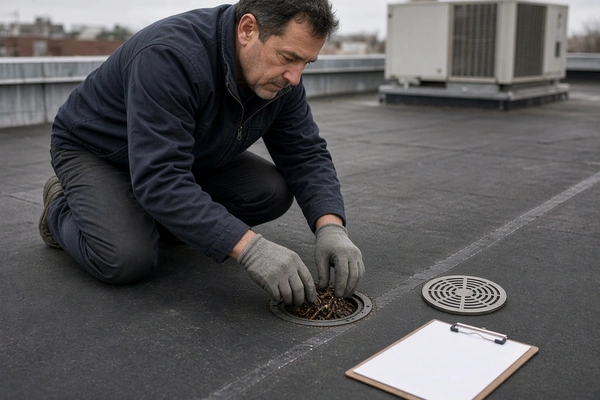
Drainage gets checked first, always. During a maintenance visit, we clear drains and scuppers, check seams and flashings, and make minor repairs on the spot. A 20-minute drain clearing in November routinely prevents a January ceiling collapse over inventory.
Flat roofs fail at the details, never in the middle: seams, flashing at walls and penetrations, drains, and areas of standing water. Seam work is invisible from the ground, so somebody has to walk the roof. Those are workmanship items, not material flaws.
Membrane roofs repair well if the insulation and deck underneath are dry. Once water has saturated the layers below, patching the surface hides the problem. We check with moisture readings and tell you which situation you have, in writing. Most membrane repairs happen on the roof with no interior access needed, and we schedule staging and noise around your operations. Every finding on a roof inspection is photographed and explained in plain English.
How Often Should a Commercial Roof Be Inspected as It Ages?
Keep the twice-yearly schedule for the life of the roof. After year 10, regular seam and flashing checks extend its life.
A properly installed and maintained EPDM or TPO roof typically lasts 20 to 30 years in New England. Drainage is the biggest variable: a membrane that sheds water reliably outlasts an identical one that ponds. Maintenance is the swing factor. Documented semiannual attention routinely adds years of service, and a neglected roof of the same spec can fail a decade early at the drains and seams.
Each condition report gives a replacement horizon: a realistic year, not a sales date, so reserves and capital plans can be set early. If the roof is sound, the report says so. If a repair solves it, we say that, even when a replacement would pay us more.
Your 2026 Commercial Roof Inspection Calendar
Plan 2 scheduled inspections a year, then add a visit whenever one of these triggers shows up. Put every report in the warranty file.
- Spring, after the snow melts: a full inspection. Clear drains and scuppers, check seams and flashings, and look for shovel damage and winter punctures.
- Fall, before leaves and snow: clear drains and scuppers again, fix small problems and check edge metal before winter storms.
- Any storm with hail 1 inch or larger or winds of 58 mph or higher: check for hail and wind damage.
- Heavy snow: keep drains clear and watch for MEMA’s warning signs inside.
- HVAC, solar or other trade visits: walk the roof, check the curbs and penetrations, and log the visit.
- A new leak: book the repair, then send written notice to the manufacturer within the time your warranty sets (30 days for GAF and Johns Manville).
If the answer to “how often should a commercial roof be inspected?” on your building has been “when it leaks,” start with spring and fall. Call us at (617) 631-5435 or request a roof assessment. Powersol Roofing is based at 100 Hancock St in Quincy and serves commercial buildings across the South Shore, including Braintree, Weymouth, Milton, Randolph, Hingham and Dorchester.
Frequently Asked Questions
How often should a commercial roof be inspected in Massachusetts?
At least twice a year, in spring and fall, plus after severe storms, heavy snow and any rooftop work by other trades. NRCA recommends inspections at least twice a year. Snow raises the stakes here: in 2015, Boston set a record of 71.8 inches of snow in 30 days, and NOAA noted reports of roofs collapsing in the Boston area.
How often should a commercial roof be inspected under a manufacturer warranty?
As often as the warranty requires. Johns Manville’s sample warranty says to inspect at least semi-annually. GAF’s EverGuard System Pledge guarantee requires owners to follow GAF’s Scheduled Maintenance Checklists, which call for at least 1 inspection a year and describe twice a year as “optimal.”
Who do I notify about a roof leak to keep my warranty?
The manufacturer, in writing. GAF requires written notice to GAF within 30 days and says notice to the roofing contractor is not notice to GAF. Johns Manville requires certified mail within 30 days of finding the leak.
Can HVAC or solar work affect a commercial roof warranty?
Yes. GAF’s guarantee doesn’t cover leaks caused by traffic off GAF walkways, or by additions to the roof made without GAF’s prior written approval. Johns Manville’s sample warranty tells owners not to let service personnel make penetrations in the roof. Walk the roof after every trade visit and keep an access log.
What counts as severe weather for a roof inspection?
The National Weather Service calls a thunderstorm severe when it brings hail 1 inch or larger or winds of 58 mph or higher. GAF and Johns Manville both list hailstorms, heavy rains and high winds as reasons to inspect. In Massachusetts, treat heavy snow on a flat roof the same way.
What is ponding water on a flat roof?
NRCA defines ponding as water that stays in low spots more than 48 hours after precipitation, in conditions where it should have dried. Standing water is one of the 4 points where flat roofs fail, along with seams, flashing and drains. Tapered insulation and drains that move water are the fix.
What should a commercial roof inspection report include?
The date, photos, the condition of the roof, the work done and what to watch. Powersol’s reports also give a replacement horizon, written in plain English for boards and managers. Keep every report with the warranty, repair bills and original drawings, as GAF’s maintenance checklist recommends.