Home / Services / Flat Roofing
Flat Roofing In Quincy, MA
Flat roofs fail at the details, never in the middle.
EPDM rubber, TPO, and modified bitumen for the flat and low-slope roofs this area runs on: three-deckers, additions, porch roofs, dormers, and commercial buildings. We install them with the drainage and flashing detail that decides whether a flat roof lasts 25 years or leaks in three. Serving Quincy and the South Shore.
The short version
What Flat Roofing Is, and Why the Details Decide Everything.
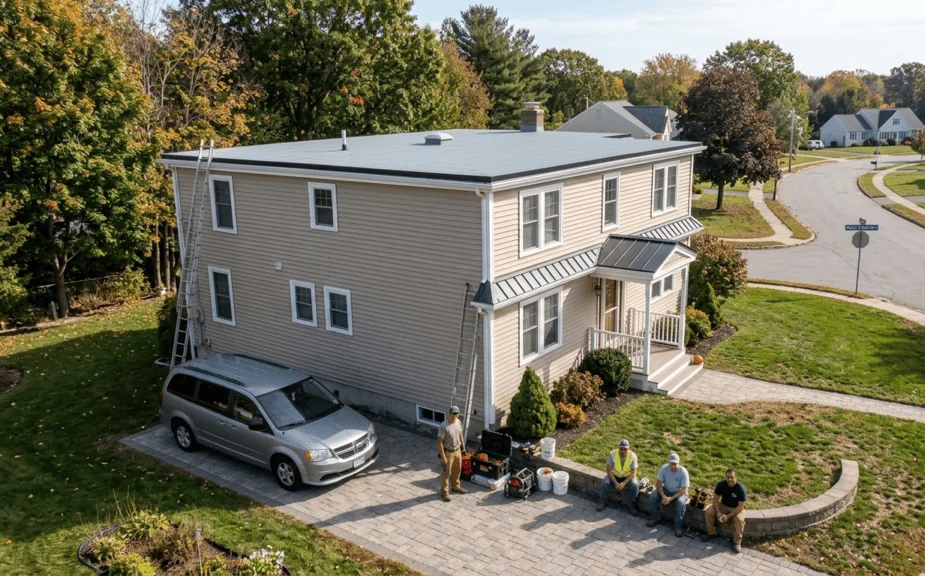
Flat roofing is a single-membrane system for surfaces too shallow for shingles, generally anything below a 2:12 pitch. One continuous waterproof layer of EPDM rubber, TPO, or modified bitumen carries water to drains, scuppers, or gutters instead of shedding it downhill. With no slope doing the work, the seams, flashings, and drainage paths carry the whole load. That is where flat roofs are won or lost.
Powersol Roofing installs and repairs flat roofs across Quincy and the South Shore from our shop at 100 Hancock St, on everything from a Wollaston three-decker to a porch roof in Braintree. Estimates are free and itemized line by line. Call (617) 631-5435 or send the estimate form.
What we install
Three Roofing Membranes One Right Match for Your Roof.
There is no single best flat roof material, only the right one for the size, drainage, and use of the roof. Here are the three we install and where each earns its place.
EPDM rubber
The black rubber membrane on most Quincy and Dorchester three-deckers, and for good reason: it tolerates freeze-thaw cycles, stays flexible in the cold, and repairs cleanly decades into its life. Fully adhered, with seams primed, taped, and rolled.
- Typical service life of 20 to 30 years
- Proven on New England multi-families
- Straightforward to patch and re-flash later
TPO
A white, heat-welded membrane whose seams fuse into one continuous sheet. The reflective surface cuts summer heat gain, which matters over living space, and welded seams remove the most common flat-roof failure point.
- Heat-welded seams, not glued
- Reflective white surface over bedrooms and offices
- Typical service life of 20 to 30 years
Modified bitumen
Asphalt-based rolled roofing reinforced with polyester or fiberglass. The practical choice for small porch roofs, bay windows, and tie-ins to existing mod-bit surfaces where matching the material matters.
- Granulated surface stands up to foot traffic
- Good for small and awkward roof sections
- Compatible with existing rolled roofing
Where flat roofs fail
Four Failure Points, and How We Prevent Them
Flat roofs almost never fail in the middle of the membrane. They fail at the details. Every install and repair we do is built around these four.
Ponding water
Water that still sits on the roof 48 hours after rain is what the industry calls ponding (the NRCA standard), and it ages any membrane fast while finding every weakness. We correct slope with tapered insulation and make sure drains and scuppers actually move water where it should go.
Seams
Every seam is a future leak if it is rushed. EPDM seams get primed, taped, and rolled; TPO seams get heat-welded and probe-tested. Seam work is the difference between installers, and it is invisible from the ground.
Flashing at walls and penetrations
Where the roof meets parapets, chimneys, vents, and HVAC curbs is where most leaks start. Each penetration gets its own flashing detail, terminated and sealed, not a smear of roof cement.
Edges and terminations
Wind gets under a flat roof at its perimeter. Drip edge, termination bars, and properly fastened edge metal keep a nor’easter from turning a corner of membrane into a sail.
Who this is for
Flat Roofing for Three-Deckers Storefronts, and Everything Between
Homes and multi-families
Quincy and the near South Shore run on flat and low-slope roofs: three-deckers, additions built out the back, porch roofs, shed dormers. We work on them with tenants and families in place, and we coordinate access and timing like people live there, because they do.
Commercial and mixed-use
Storefronts, offices, garages, and small industrial buildings, quoted the same way as our residential work: measured, itemized, and scheduled around your business hours where the job allows. One point of contact from estimate to final walkthrough.
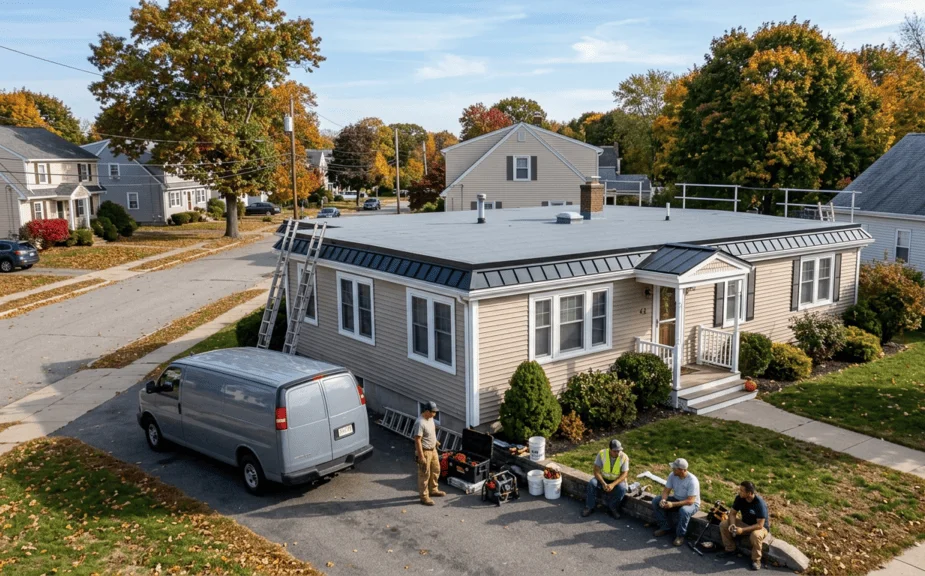
How the job unfolds
From the First Moisture Check to the Final Walkthrough
The most important flat roof work happens before any membrane is unrolled. If the layers underneath are wet, a new surface just hides the problem for a season. If they are dry, we tell you it is a repair, not a replacement. We don’t sell fear.
Inspect & moisture-check
We check the existing membrane, seams, flashings, and drainage, and test for trapped moisture below, so the quote reflects what is actually up there.
Line-item quote
Repair versus replace, stated plainly with the evidence for each. Membrane, insulation, flashing, and edge metal each priced separately.
Tear-off or prep
Wet material comes out, deck repairs happen while the roof is open, and tapered insulation corrects any slope problem that caused ponding in the first place.
Membrane, details & walkthrough
Membrane installed, every seam and penetration detailed, drains cleared, and a photo record of the finished work. Workmanship warranty in writing.
Local, licensed, accountable
Flat Roofs Last When Every Detail Is Done Right
Anyone can roll out rubber. The roof that stays dry for 25 years belongs to the crew that primed every seam and flashed every pipe like it was their own building.
Where we work
Flat roofing across Quincy and the South Shore.
Based at 100 Hancock St in Quincy, we work on flat roofs from North Quincy to Hingham. This is three-decker country, and the flat roofs on those buildings are a specialty of ours, not a sideline.
Straight answers
Frequently Asked Questions
What is the best material for a flat roof in Massachusetts?
For most South Shore homes, fully adhered EPDM rubber is the workhorse: it handles freeze-thaw cycles well, repairs cleanly, and has decades of local track record on three-deckers and additions. TPO makes sense where summer heat gain matters, and modified bitumen suits small porch roofs and patch-in work. The honest answer depends on the roof’s size, drainage, and what is under it, which is what the free estimate establishes.
How long does a flat roof last?
A properly installed EPDM or TPO membrane typically lasts 20 to 30 years in New England; modified bitumen somewhat less. Drainage is the biggest variable: a membrane that sheds water reliably outlasts an identical one that ponds. Regular checks of seams and flashings after year ten extend the life meaningfully.
Do flat roofs leak more than pitched roofs?
A well-built flat roof does not leak more; a badly detailed one does. Flat roofs fail at specifics: seams, flashing at walls and penetrations, drains, and areas of standing water. Those are workmanship items, not material flaws, which is why installer quality matters more on a flat roof than on almost any other roof type.
Can you repair a flat roof, or does it need full replacement?
Membrane roofs repair well. Seam failures, punctures, and flashing gaps can usually be fixed section by section if the insulation and deck underneath are dry. Once water has saturated the layers below, patching the surface just hides the problem. We check with moisture readings and tell you which situation you have, in writing. See roof repair for how we trace the source.
How do flat roofs handle New England snow?
Flat roofs here are engineered for snow load, but sustained heavy accumulation and clogged drains are the real risks. We set up drainage so meltwater always has a path off the roof, and for heavy winters we advise on safe snow removal thresholds. Interior drains and scuppers are checked on every job.
Do you work on three-deckers and multi-family buildings?
Yes. Flat-roof three-deckers are some of the most common buildings in Quincy and Dorchester, and we roof them regularly: full membrane replacement, rubber over existing where code and conditions allow, and repairs coordinated with tenants in place. Commercial flat roofs are quoted the same way, line by line.